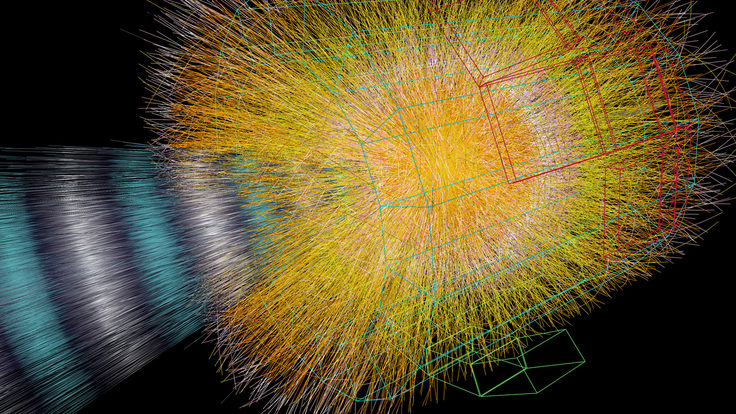
Among the 10,000 people from around the world who are working on the Large Hadron Collider, 1000 hail from universities and national labs in the United States.
They started out scanning the cosmos for signs of extraterrestrial intelligence with SETI@ home. They’ve plotted chess moves, battled malaria, and folded proteins, all from their home computers. Now, volunteers are tackling particle physics with LHC@home.
Meeting in CERN’s Restaurant 1, anthropologist Arpita Roy of the University of California, Berkeley is quick to declare that she will not be having any more coffee today. She has begun drinking multiple cups per day as she meets with CERN physicists to learn about their work.
Every time Fermilab scientist Tom Schwarz starts up SpartyJet, he inwardly grimaces. The computer program works well. It does a fine job of finding and recording jets—sprays of subatomic particles that emerge from collisions involving protons.
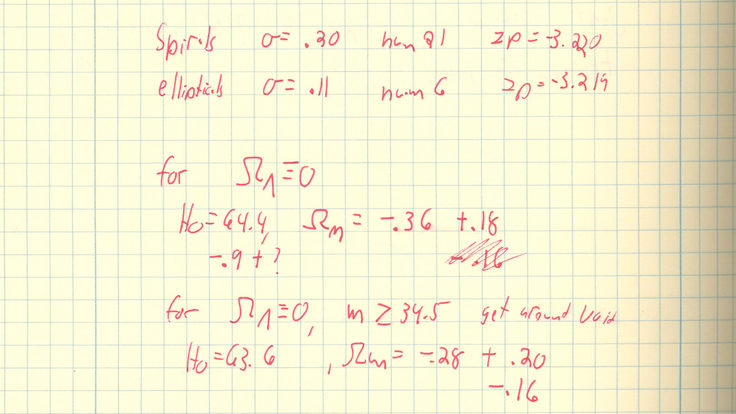
In the fall of 1997, I was leading the calibration and analysis of data gathered by the High-z Supernova Search Team, one of two teams of scientists the other was the Supernova Cosmology Projecttrying to determine the fate of our universe: Will it expand forever, or will it halt and contract, r
In March 2007, members of a US National Science Foundation panel went on a whirlwind bus tour of potential sites for the Deep Underground Science and Engineering Laboratory. Here's an account of that trip by Peter Fisher of the Massachusetts Institute of Technology.