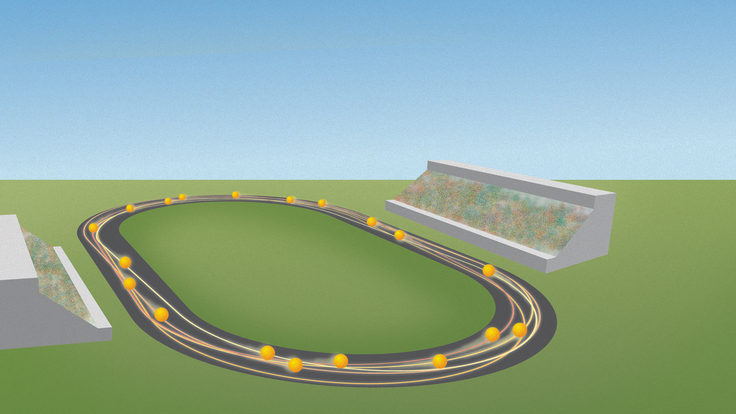
Hopes that the “proton radius puzzle” would upend particle physics and reveal new laws of nature have now been dashed by a new measurement reported in Science.
When it comes to getting rid of cancer, the sharpest scalpel may be a proton beam. Technology conceived and hatched in highenergy physics is now treating thousands of patients per year, with fewer side effects.
These photos represent an eye blink in the evolution of the Linac Coherent Light Source, a groundbreaking facility taking shape at SLAC National Accelerator Laboratory.
The life-saving medical technology known as Magnetic Resonance Imaging, or MRI, makes detailed images of soft tissue in the body, nearly eliminating the need for exploratory surgery.
In 1860, Parisian inventor Édouard-Léon Scott de Martinville set out to capture the beauty of a French folk song, "Au Clair de la Lune," using pig hair and soot.
Michael Miller watches grass grow for a living—super grass, of sorts, grass that could fuel a car and reduce carbon dioxide emissions at the same time.
As the Pierre Auger Observatory in Argentina collects cosmic rays for science, its thousands of solar panels are collecting data that could make solar power cheaper, more efficient, and more reliable.