In late October SuperCDMS scientists cooled their dilution refrigerator down to 5.3 millikelvin, only a few thousandths of a kelvin above absolute zero.
Astrophysicist Risa Wechsler explores why dark matter may be the key to understanding how the universe formed, and shares how physicists in labs around the world are coming up with creative ways to study it.
Some of Fermilab's mechanical technicians spend a lot of time underground. In the echoing tunnels of the Tevatron collider they fix things, crawling behind equipment to replace aging nuts and bolts and repair everything from vacuum pumps to multi-ton superconducting magnets.
Long after the hard shaking stops, an earthquake's seismic waves reverberate around the world, imperceptibly rocking the ground. As one seismologist puts it, a great earthquake causes every grain of sand on Earth to dance.
Since its launch in June 2008, the Fermi Gamma-ray Space Telescope has shed light on some of the brightest, most explosive events in the universe and opened tantalizing windows into dark matter and the nature of space-time.
A long time ago in a national laboratory far, far away some physicists looked around their workplace and thought of dark forces. Not dark matter; not dark energy; but the ultimate force from the dark side: Darth Vader.
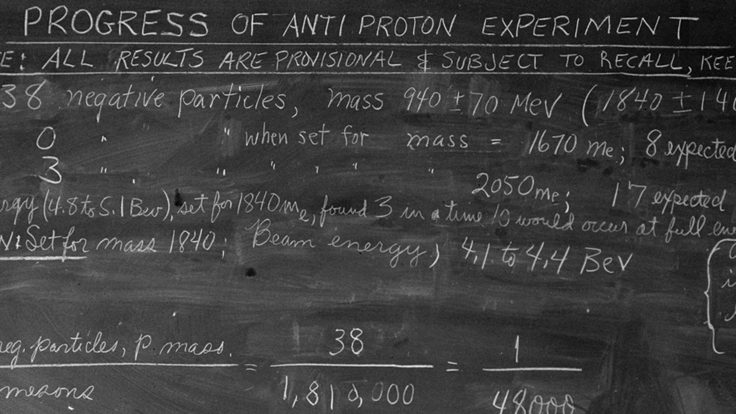
When the Bevatron switched on at Lawrence Berkeley National Laboratory in the fall of 1954, it was the largest particle accelerator ever built, capable of producing energies upwards of six billion electronvolts.
In August, robots, mummies, and giant jellyfish took over Chicago's Millennium Park. Fortunately, the invasion was peaceful—just part of the fun at the latest LabFest, a kind of pumped-up, hands-on outdoor science fair aimed to engage Chicagoans in the excitement of science.