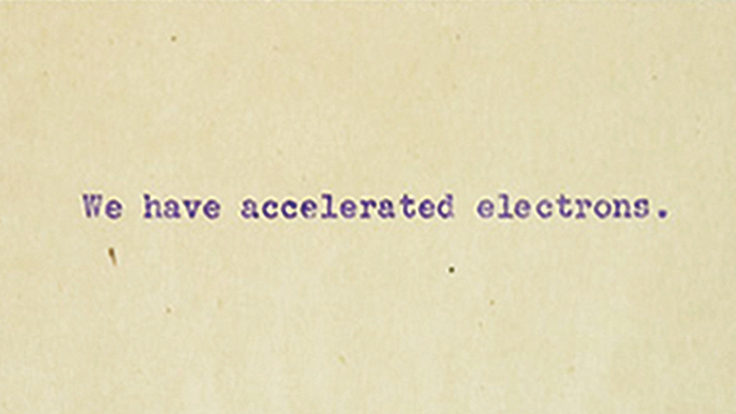
On April 28, 1947 Stanford Linear Electron Accelerator Project Report No. 7 announced the realization of a dream 15 years in the making: the linear acceleration of electrons.
Every so often, particle physics communicators from labs around the world gather to swap strategies for getting people interested in science. At the group's April meeting in Japan, the big hit was toilet paper.
Since its launch in June 2008, the Fermi Gamma-ray Space Telescope has shed light on some of the brightest, most explosive events in the universe and opened tantalizing windows into dark matter and the nature of space-time.
How do you make the invisible visible? Astrophysicists face this challenge daily. Unlike astronomers who view stars through telescopes, astrophysicists study cosmic particles that are too small or dark to see directly.
Canning, pickling, drying, freezing -- physicists wish there were an easy way to preserve their hard-won data so future generations of scientists, armed with more powerful tools, can take advantage of it. They've launched an international search for solutions.
Chugging along in the background, old physics machines are the workhorses behind many cutting-edge projects, from the world's most powerful X-ray laser to the Large Hadron Collider and a lab that tests microchips bound for Mars.