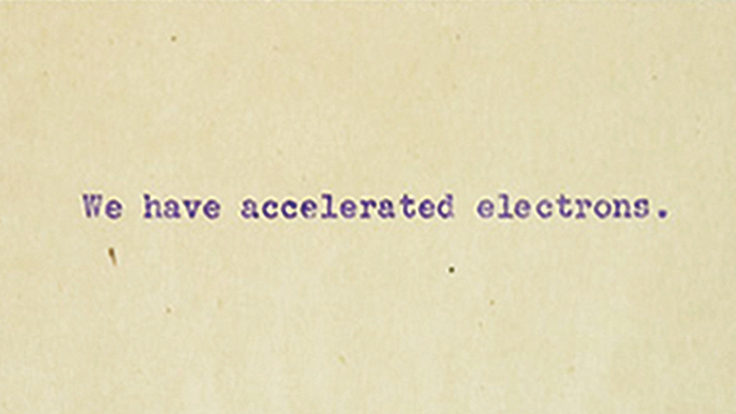
On April 28, 1947 Stanford Linear Electron Accelerator Project Report No. 7 announced the realization of a dream 15 years in the making: the linear acceleration of electrons.
How do you make the invisible visible? Astrophysicists face this challenge daily. Unlike astronomers who view stars through telescopes, astrophysicists study cosmic particles that are too small or dark to see directly.
Some of Fermilab's mechanical technicians spend a lot of time underground. In the echoing tunnels of the Tevatron collider they fix things, crawling behind equipment to replace aging nuts and bolts and repair everything from vacuum pumps to multi-ton superconducting magnets.
Since its launch in June 2008, the Fermi Gamma-ray Space Telescope has shed light on some of the brightest, most explosive events in the universe and opened tantalizing windows into dark matter and the nature of space-time.
Long after the hard shaking stops, an earthquake's seismic waves reverberate around the world, imperceptibly rocking the ground. As one seismologist puts it, a great earthquake causes every grain of sand on Earth to dance.
Canning, pickling, drying, freezing -- physicists wish there were an easy way to preserve their hard-won data so future generations of scientists, armed with more powerful tools, can take advantage of it. They've launched an international search for solutions.