The 2020 European Strategy recommends pursuing a Higgs factory, investigating a next-generation hadron collider at CERN, and ramping up accelerator technology R&D.
Ultrahigh-energy neutrinos could help scientists unravel some of the biggest mysteries in astrophysics—and the best place to find them may be the South Pole.
In 2023, the ALICE experiment was ready for their best year yet, until a mysterious signal threatened everything. As the LHC wraps up its 2025 lead-ion run, physicists recall how they worked together to solve the puzzle.
Thin layers of diamonds have become useful tools inside the detectors at the Large Hadron Collider. They're robust enough to monitor the harsh conditions, and they can even provide incredibly precise measurements of the timing of passing particles.
Almost a mile underground, in a new science facility in South Dakota, scientists of the LUX collaboration are building the world's largest dark-matter search experiment.
This year, results from the Large Hadron Collider in Europe and the Tevatron in the United States will either prove or refute the existence of the Standard Model Higgs particle, a keystone in theorists’ proposed explanation for the origin of mass.
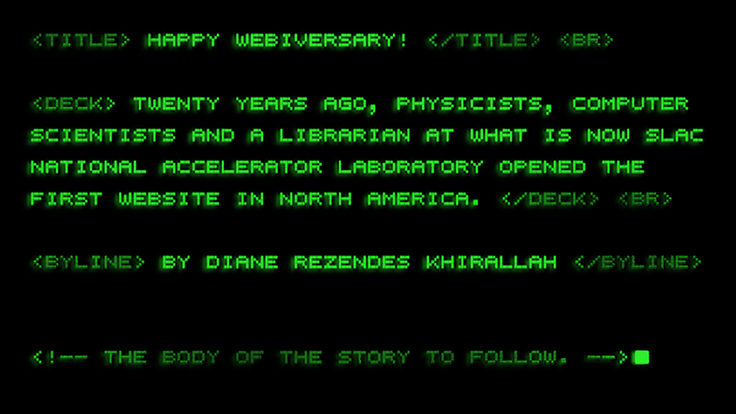
In 1991, physicists, computer scientists, and a librarian at what is now SLAC National Accelerator Laboratory opened the first website in North America.
Data from the world’s most powerful particle colliders should shed light on a 100-year-old astrophysics mystery, but even they cannot explain the perplexing properties of the universe’s most energetic particles. Are ultra-high-energy cosmic rays heavier than expected?
For those who live, breathe and laugh physics, one show entangles them all: The Big Bang Theory. To make the show's jokes timely and accurate, while sprinkling the sets with authentic scientific plots and posters, the show's writers depend on one physicist, David Saltzberg.