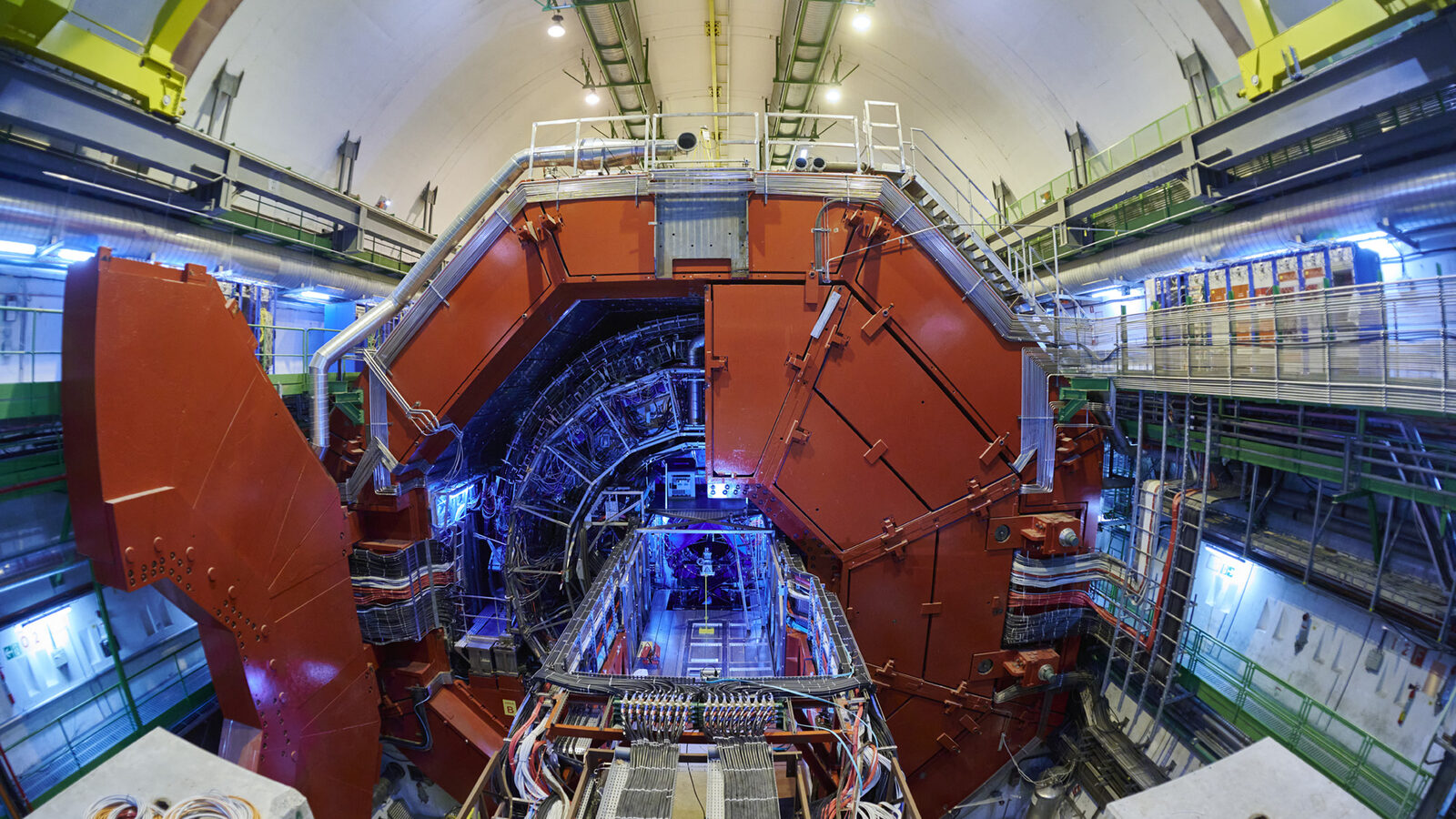
Workers at the world’s largest atom smasher are breaking ground on a performance-enhancing upgrade that will allow scientists to conduct even bigger and better physics experiments.
When two bunches of protons traveling close to the speed of light collide, artistic duo Semiconductor take that data and turn it into an immersive art installation.
In 2023, the ALICE experiment was ready for their best year yet, until a mysterious signal threatened everything. As the LHC wraps up its 2025 lead-ion run, physicists recall how they worked together to solve the puzzle.
Burl Skaggs lives in a two-story house in the foothills of the Sierra Nevada mountains. Each workday he has breakfast, kisses his wife Carol goodbye, and goes down to his extra-large garage.
Scientists working on the design of the proposed International Linear Collider have made some important decisions and agreed on the base-line configuration of the machine.
Upon arriving for work at the laboratory of Masatoshi Koshiba at the University of Tokyo, Yoji Totsuka handed me a fax telling of a supernova in the Large Magellanic Cloud, picked up by optical telescopes.
Innovative 21st century technology at Argonne National Laboratory is taking researchers back to the 19th century, the 16th century, and even the third millennium BCE.
Particle physics detectors in space will record gamma rays in search of dark matter, the evolution of stars, and natures most powerful particle accelerators.
Last October, the front of the SLAC computing center looked like an elaborate children's war game in progress. Ad hoc piles of polystyrene, plastic, wooden pallets, and cardboard created an image of bunkers and trenches in a plastic post-industrial landscape.