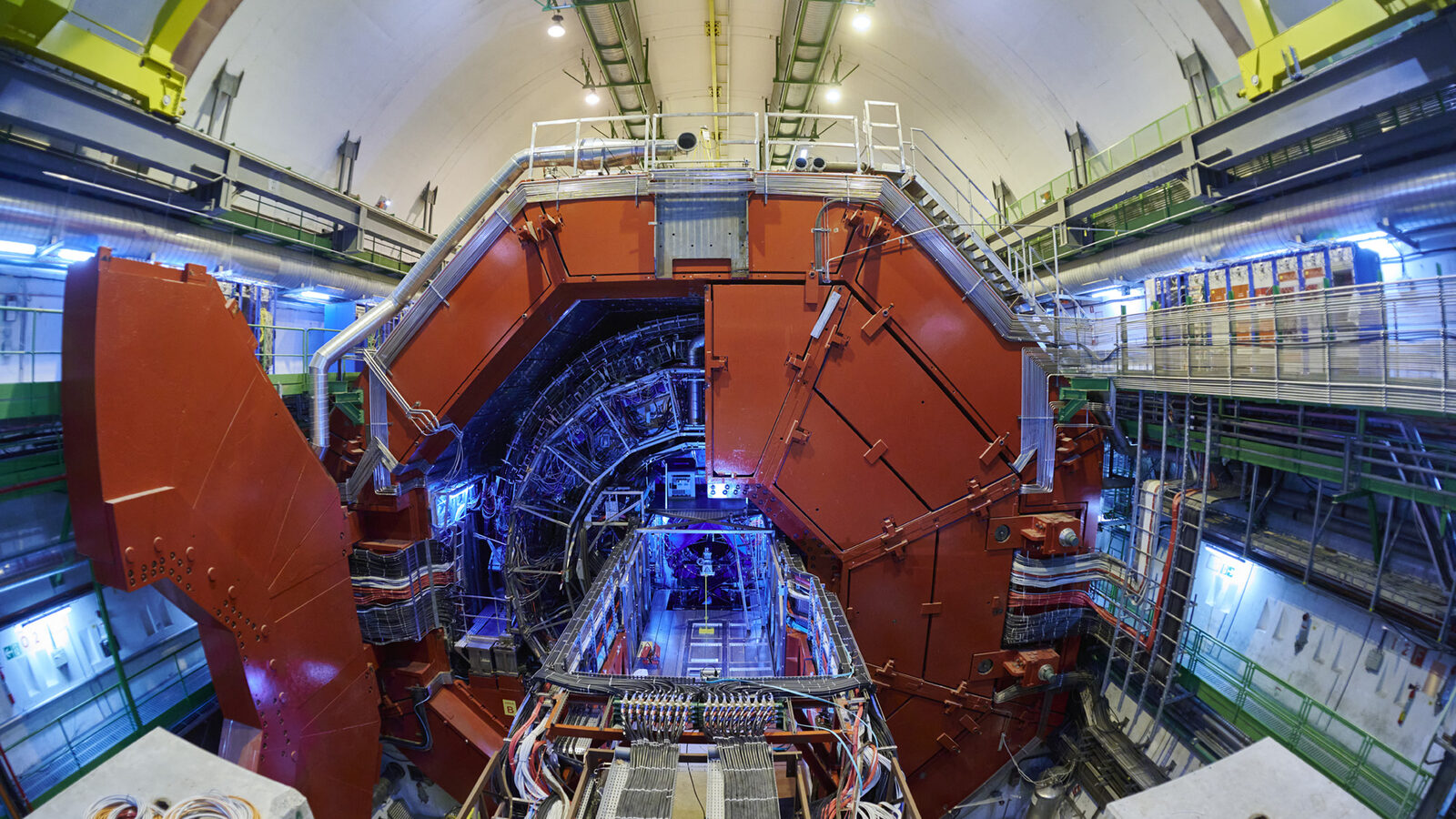
In 2023, the ALICE experiment was ready for their best year yet, until a mysterious signal threatened everything. As the LHC wraps up its 2025 lead-ion run, physicists recall how they worked together to solve the puzzle.
After undergoing a buffered chemical polishing (BCP) treatment at Cornell University, the first US-processed and tested International Linear Collider superconducting cavity achieved a milestone accelerating gradient of 26 MV/m (megavolts per meter)–surpassing the first gradient goal (25 MV/m).
Welcome to SLAC's End Station B, where work on the International Linear Collider (ILC) will help shape the future of particle physics–although some inhabitants don't seem to give a hoot.
Clouds of electrons could block the view of new discoveries at the proposed ILC, a multi-billion-dollar particle collider. Eliminating those clouds is critical to the prspects for the machine's success.
Physics has demonstrated that the everyday phenomena we experience are governed by universal principles applying at time and distance scales far beyond normal human experience.
Mesons. Bosons. Pions. Muons. Asparagus. Yes, asparagus. Physicists have spare time, too, and a few of them spend it in Fermilab's Garden Club, with roots almost as old as the lab itself.
Street banners honoring nine of Berkeley Lab's Nobel Prize winners, originally installed along Telegraph Avenue in 2003, have been mounted on poles on Cyclotron Road leading to Berkeley Lab in honor of its 75th anniversary.