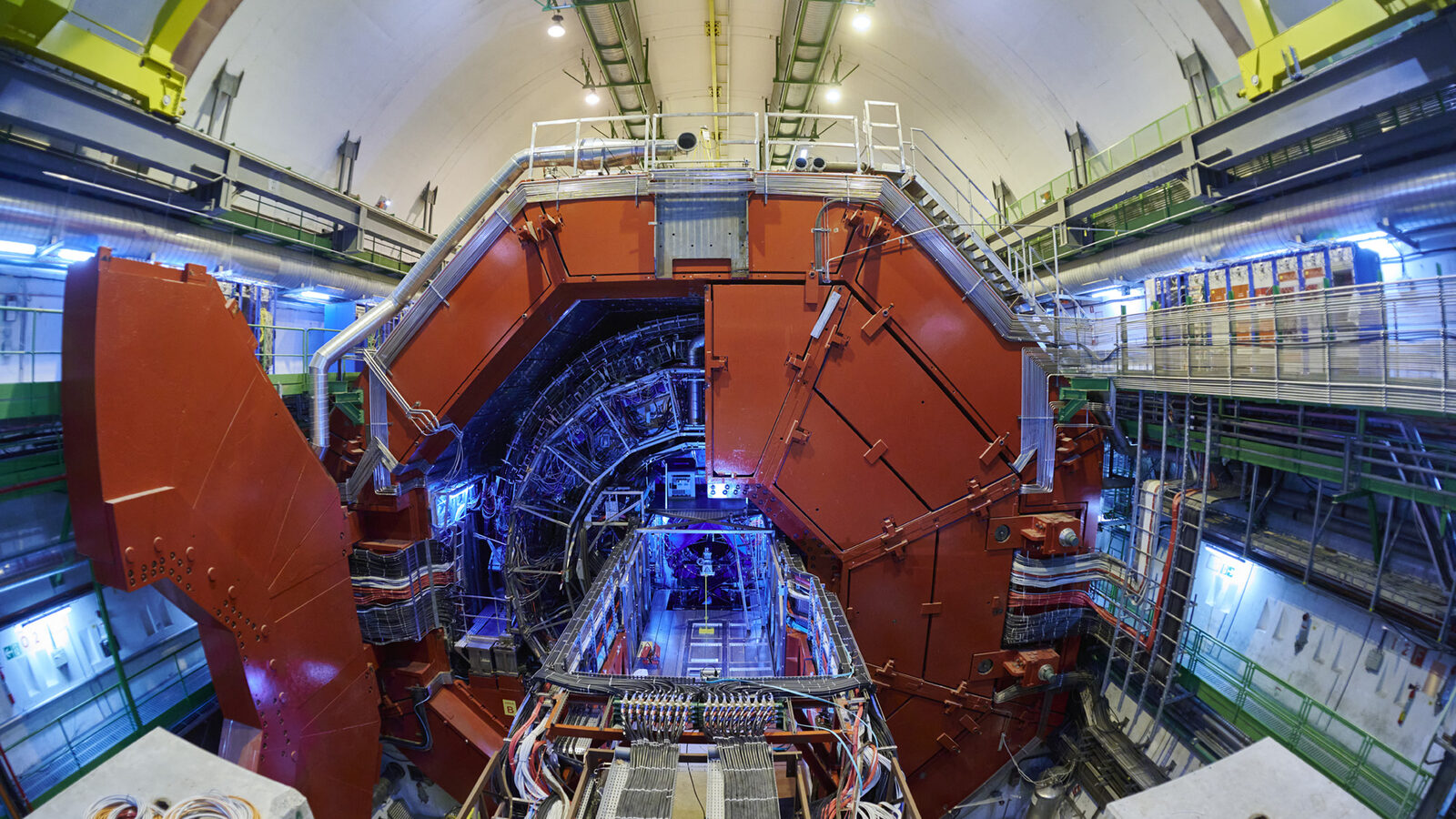
In 2023, the ALICE experiment was ready for their best year yet, until a mysterious signal threatened everything. As the LHC wraps up its 2025 lead-ion run, physicists recall how they worked together to solve the puzzle.
The problem: How to get short-lived radioactive drugs from the nuclear physics lab that makes them to a hospital 2.5 kilometers away, on the far side of a busy campus, in two minutes flat.
Affectionately known at the Stanford Linear Accelerator Center (SLAC) as simply “The Blue Book,” The Stanford Two-Mile Accelerator has been a classic on site since the day it was published in 1968.
Even in the company of a two-story nose-picking machine, human cupcakes, battling robots, and power-tool drag races, the giant Tesla coil stands out. Maybe it's the loud buzz and crackle of artificial lightning bolts, writhing like fiery serpents from the top of the thing.
In August 2006, after almost a year of preparation, we packed up all our belongings to move from Batavia, Illinois, to Geneva, Switzerland. We were following our particle physics careers from Fermilab to CERN, the European particle physics lab.
Lead bricks and radiation gloves normally indicate a need to protect lab workers from radioactivity. For a laboratory at the University of Alabama in Tuscaloosa, however, the opposite is true.
Just inside the site boundary, secluded from most of Fermilab, sits Leonard Baumann's rickety red barn. Baumann, like 55 other farmers, relocated 40 years ago to make way for the construction of Fermilab.
In the 1990s, astronomical observations revealed that the expansion of the universe is accelerating. Not knowing what causes this acceleration, scientists began to attribute the phenomenon to some unknown source of energy, coined "dark energy" by astrophysicist Michael Turner.