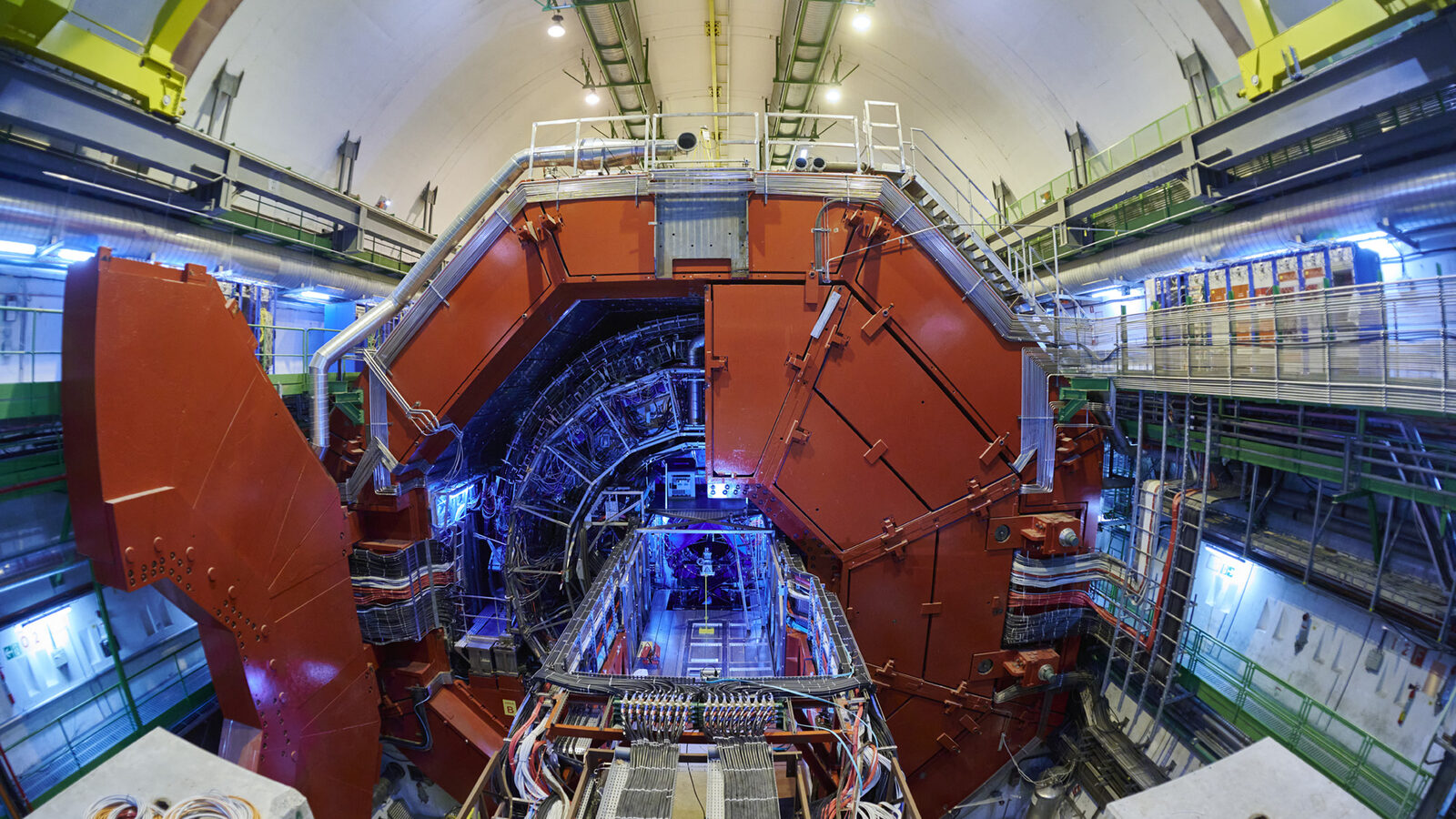
Workers at the world’s largest atom smasher are breaking ground on a performance-enhancing upgrade that will allow scientists to conduct even bigger and better physics experiments.
When two bunches of protons traveling close to the speed of light collide, artistic duo Semiconductor take that data and turn it into an immersive art installation.
In 2023, the ALICE experiment was ready for their best year yet, until a mysterious signal threatened everything. As the LHC wraps up its 2025 lead-ion run, physicists recall how they worked together to solve the puzzle.
Burl Skaggs lives in a two-story house in the foothills of the Sierra Nevada mountains. Each workday he has breakfast, kisses his wife Carol goodbye, and goes down to his extra-large garage.
High-energy physics labs worldwide are neighbors with numerous butterfly species–from the Common Blue (Polyommatus icarus, photo) found near CERN to the Pipevine Swallowtail (Battus philenor) that shares the Bay Area with SLAC. But where do butterflies go in the winter?
Supersymmetry. Dark matter. Extra dimensions. Scientists have proposed the International Linear Collider (ILC), a next-generation project designed to smash together electrons and their antiparticles at a higher-than-ever energy, to learn more about these and other mysteries of the universe.
Upon arriving for work at the laboratory of Masatoshi Koshiba at the University of Tokyo, Yoji Totsuka handed me a fax telling of a supernova in the Large Magellanic Cloud, picked up by optical telescopes.
Unveiling the three-dimensional structure of proteins thrills scientists. While the potential for understanding the folding and function of enzymes is truly exciting by itself, exploring macromolecule structures also satisfies a more fundamental urge: to see the invisible.