In late October SuperCDMS scientists cooled their dilution refrigerator down to 5.3 millikelvin, only a few thousandths of a kelvin above absolute zero.
Astrophysicist Risa Wechsler explores why dark matter may be the key to understanding how the universe formed, and shares how physicists in labs around the world are coming up with creative ways to study it.
In 2023, the ALICE experiment was ready for their best year yet, until a mysterious signal threatened everything. As the LHC wraps up its 2025 lead-ion run, physicists recall how they worked together to solve the puzzle.
Every so often, particle physics communicators from labs around the world gather to swap strategies for getting people interested in science. At the group's April meeting in Japan, the big hit was toilet paper.
How do you make the invisible visible? Astrophysicists face this challenge daily. Unlike astronomers who view stars through telescopes, astrophysicists study cosmic particles that are too small or dark to see directly.
Some of Fermilab's mechanical technicians spend a lot of time underground. In the echoing tunnels of the Tevatron collider they fix things, crawling behind equipment to replace aging nuts and bolts and repair everything from vacuum pumps to multi-ton superconducting magnets.
A long time ago in a national laboratory far, far away some physicists looked around their workplace and thought of dark forces. Not dark matter; not dark energy; but the ultimate force from the dark side: Darth Vader.
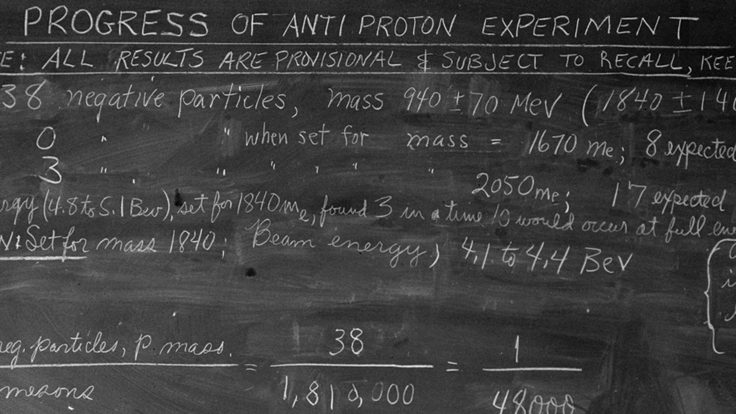
When the Bevatron switched on at Lawrence Berkeley National Laboratory in the fall of 1954, it was the largest particle accelerator ever built, capable of producing energies upwards of six billion electronvolts.
Physicists have been inventing new types of accelerators to propel charged particles to higher and higher energies for more than 80 years. Today, scientists estimate that more than 17,000 accelerators are in operation around the world—in industry, in hospitals, and at research institutions.
A visitor wandering around SLAC last July would be forgiven for thinking the hot California sun had triggered a mirage. A parking lot at the Stanford Synchrotron Radiation Lightsource had transformed into a glistening lake.