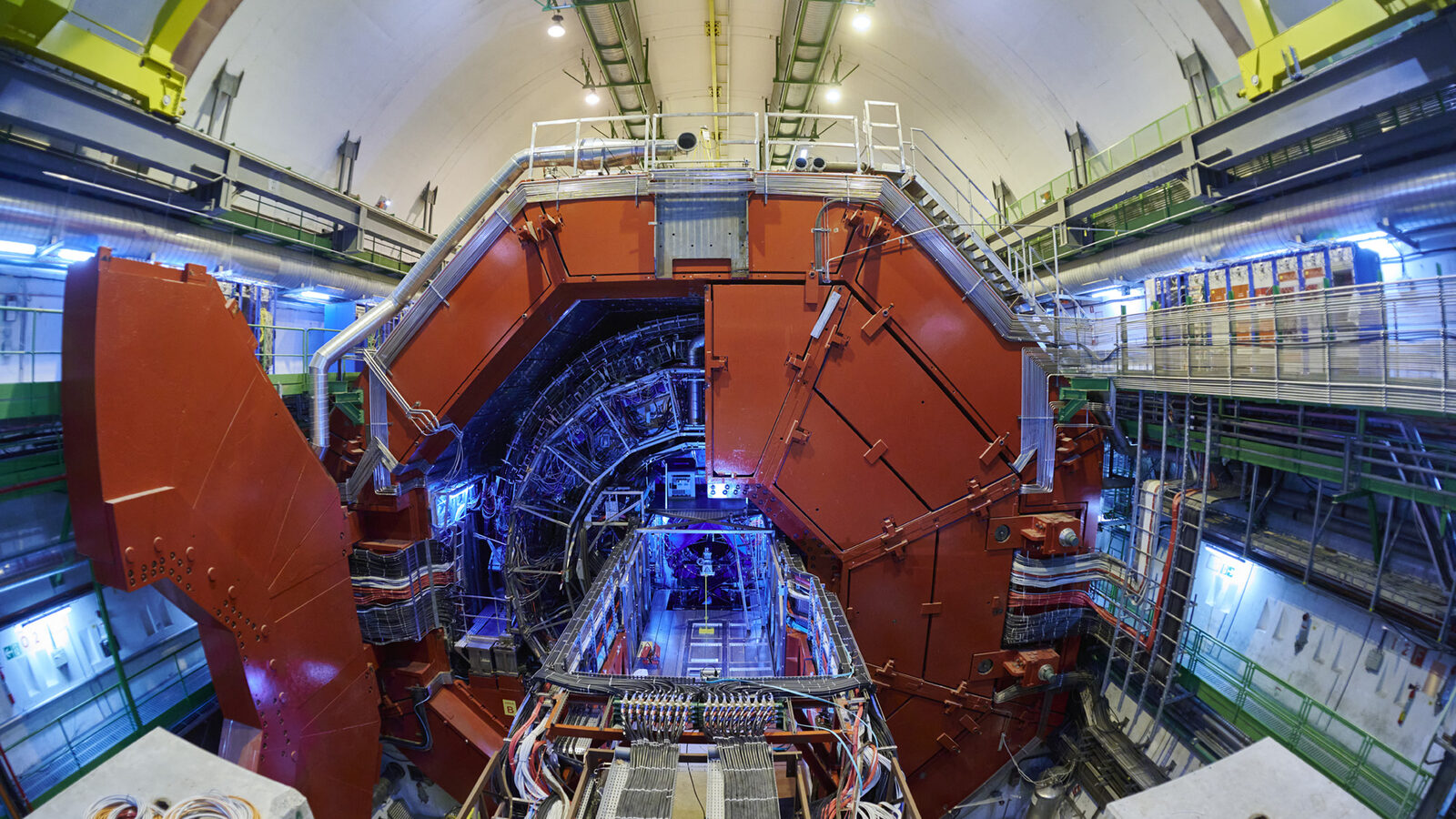
Workers at the world’s largest atom smasher are breaking ground on a performance-enhancing upgrade that will allow scientists to conduct even bigger and better physics experiments.
When two bunches of protons traveling close to the speed of light collide, artistic duo Semiconductor take that data and turn it into an immersive art installation.
In 2023, the ALICE experiment was ready for their best year yet, until a mysterious signal threatened everything. As the LHC wraps up its 2025 lead-ion run, physicists recall how they worked together to solve the puzzle.
Scientists since the time of Sir Isaac Newton (and before) have built their work on the work of those who preceded them. Newton famously described this by saying, “If I have been able to see farther, it was only because I stood on the shoulders of giants.”
Scientists working on the design of the proposed International Linear Collider have made some important decisions and agreed on the base-line configuration of the machine.
Upon arriving for work at the laboratory of Masatoshi Koshiba at the University of Tokyo, Yoji Totsuka handed me a fax telling of a supernova in the Large Magellanic Cloud, picked up by optical telescopes.
Hosting the "Late Show with Leon," Nobel laureate Leon Lederman shared with high school students his top fourteen ways to know you have won the Nobel Prize:
Particle physics detectors in space will record gamma rays in search of dark matter, the evolution of stars, and natures most powerful particle accelerators.
If the proposed International Linear Collider (ILC) completes the evolution from physicists' dream to discovery machine, Jonathan Dorfan will know when and where the transforming moment occurred: August 20, 2004, in Beijing, China.