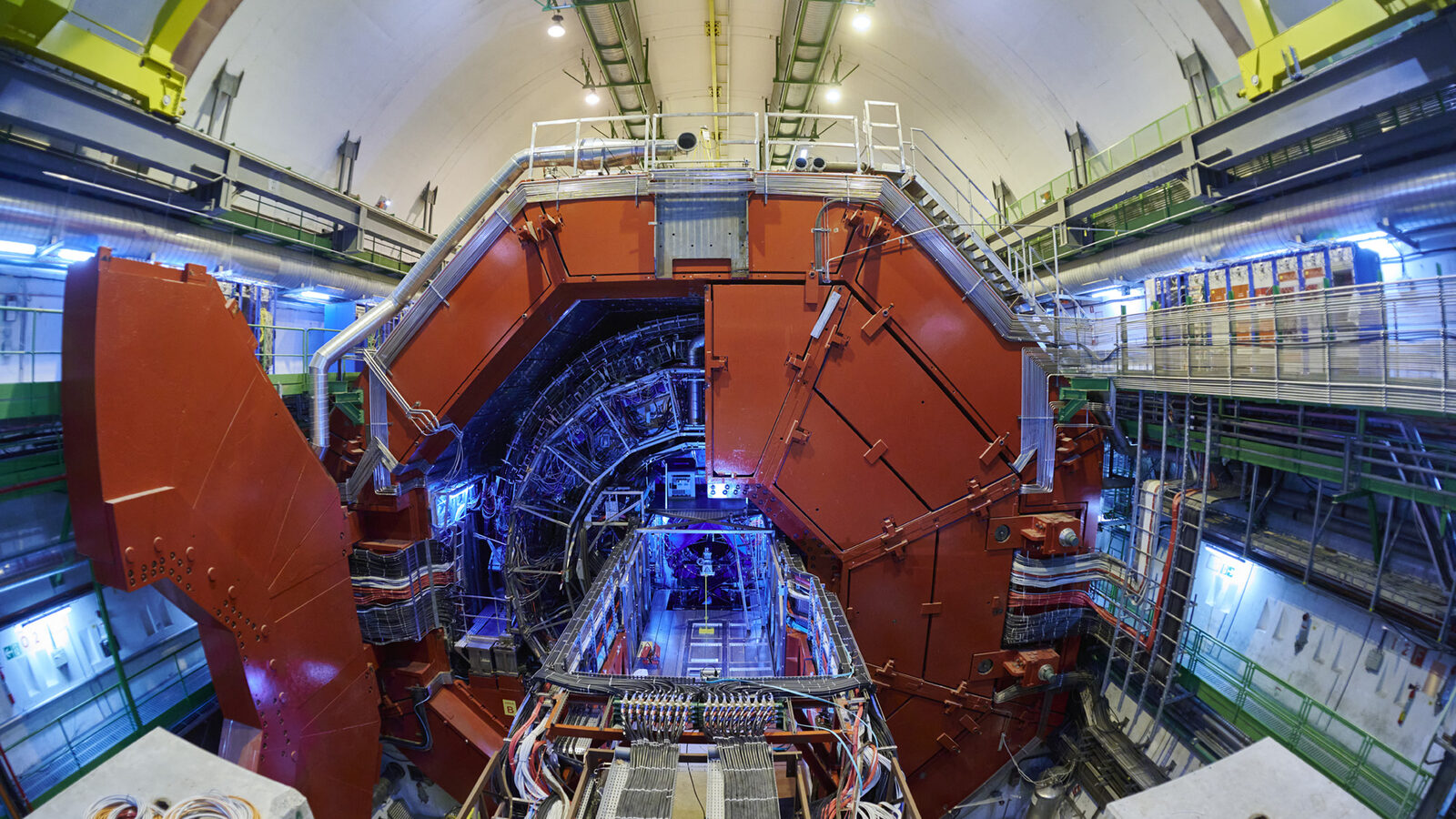
In 2023, the ALICE experiment was ready for their best year yet, until a mysterious signal threatened everything. As the LHC wraps up its 2025 lead-ion run, physicists recall how they worked together to solve the puzzle.
Jodi Cooley works half a mile underground, in a mine that stopped operating 40 years ago. A rattling elevator takes her to work, 27 floors beneath the surface. The ride down the mineshaft is five minutes of complete darkness. A colony of bats inhabits the mine.
The big-bang theory of the early universe implies that the universe is immersed in a bath of microwave light, a cooled-down remnant of early high-temperature radiation, invisible to the naked eye.
When 20-year-old Ryan Auer set out to find his very first job, he didn't expect to wind up at the Stanford Linear Accelerator Center, let alone on stage in front of over 1000 people at the lab's annual Family Day.
The instrumentation team of Fermilab's Environment, Safety & Health Section is the caretaker of a unique menagerie: albatrosses, chipmunks, hippos, pterodactyls, scarecrows, and an aardvark to name a few.
A little after midnight, foreign voices and scents of dinner drift from the kitchen and down the halls of Dorm 1. Slavic dialogue stirs me from sleep and the aroma of cooked kielbasa sausage grabs my full attention.
Buried deep in the mountains of southern China, a new neutrino experiment would rely on a series of Chinese nuclear reactors and the brains of scientists from several countries.
At a special meeting in Lisbon on July 14, the CERN Council unanimously adopted a 17-point European Strategy for Particle Physics, based on the premise that "Europe should maintain and strengthen its central position in particle physics."