class="mceTemp">
class="mceTemp">

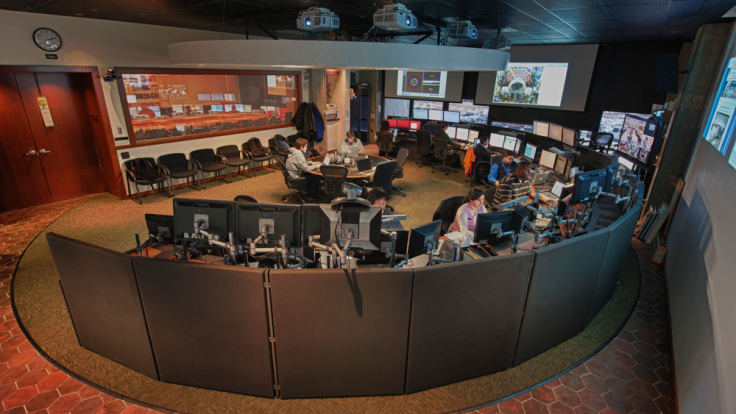
This screen image from the Tevatron main control room shows how the earthquake in Haiti affects superconducting quadrupole magnets in the accelerator tunnel during a one-hour period. The green line shows forward and backward pitch of a magnet near the CDF detector, while the blue line shows the side-to-side roll of a magnet near the DZero detector. The abort gap line shows much less than 1 percent of the beam jiggled out of alignment in one monitoring area. None of the movements would be visible with the naked eye.
Minutes after a 7.0-magnitude earthquake in Haiti on Tuesday started shaking whole blocks of Port-au-Prince into dust, physicists hundreds of miles away in Illinois knew something terrible had occurred.
The crew operating the particle beam for the Fermilab Tevatron, the world's highest-energy proton-antiproton collider, hadn't yet seen images of the toppled buildings; that would come later on the television news. But the squiggles on their computer screens spoke of devastation.
They had seen squiggles like these before--during a 2007 quake in Mexico, a 2006 quake in New Zealand, and earthquakes that triggered deadly tsunamis in Sumatra in 2005 and Indonesia in 2004.
The readings came from sensors on underground magnets that steer particles around the four-mile Tevatron ring. They record vibrations too tiny for people at the laboratory to feel, including seismic waves from distant earthquakes. Big spikes usually mean big trouble somewhere in the world.
A December symmetry magazine article explains how physicists first noticed the Tevatron's super sensitivity, and how they work to make sure it doesn't interrupt the laboratory's multi-million-dollar research efforts.
... The Tevatron has recorded about 20 more earthquakes from all over the globe, including this year’s deadly shocks in Sumatra and Samoa. Only one, a moderate local quake on June 28, 2004, shut the collider down. The tiltmeter recordings look a lot like seismogram squiggles—which makes sense, says US Geological Survey seismologist William Ellsworth, because these sensors are essentially low-resolution seismometers.
The Haiti quake didn't disrupt the Tevatron beams, though it almost reached the level at which the lab's two particle detector teams would consider shutting off part of their three-story machines to avoid potential damage. Quakes can jiggle small numbers of particles--less than 1 percent of the beam--out of alignment, as shown in the "abort gap" section of the graphic.
The earthquake's human toll is estimated at 50,000 dead and three million injured or homeless. CNN.com reports on the need for money to help victims and provides information about several of the not-for-profit charities. Physics Today describes the "perfect storm" that made the quake so deadly.