signal to background
Star Wars fan film shot at Fermilab; astronomical toilet paper; Paris skyscraper puts on cosmic laser show; tunnel cart sings ice-cream tunes; Tevatron shimmies to distant earthquakes; letters
![]() |
| Photos: Reidar Hahn, Fermilab |
May the fundamental forces be with you
A long time ago in a national laboratory far, far away… some physicists looked around their workplace and thought of dark forces. Not dark matter; not dark energy; but the ultimate force from the dark side: Darth Vader.
Now, nearly five years later, they are preparing to air the first feature-length Star Wars fan movie—and most likely the first ever filmed at a national high-energy physics laboratory. Called Star Wars: Forgotten Realm, the two-hour film was shot at Fermilab under the direction of Darren Crawford, the lab’s accelerator operations crew chief.
The actors include fellow Fermilab workers and their friends and relatives. Grade-school children played diminutive Jawa creatures; they were the only ones who fit the costumes. Physicists and engineers brought science-related gadgets, such as Tesla coils and Lichtenberg figures, to add a 1970-style sci-fi feel to the cantina scene. A local artist provided an adult-sized, moving robot.
“This film is going to blow away all other fan films,” says Mark Van Slyke, a member of the Midwest Garrison of the 501st Legion: Vader’s Fist, a worldwide organization of Star Wars costuming enthusiasts. The garrison supplied several actors, as well as costumes and props.
Crawford capitalized on the laboratory’s concrete-walled, industrial-looking experimental tunnels and its natural prairies to create the stark, wild look of a futuristic world. Computer-aided special effects, generated with the help of co-workers, promise to give the film a polished, if not Hollywood, look. While Lucas Productions does not endorse the film, it does allow fans to make and show films so long as they don’t charge admission.
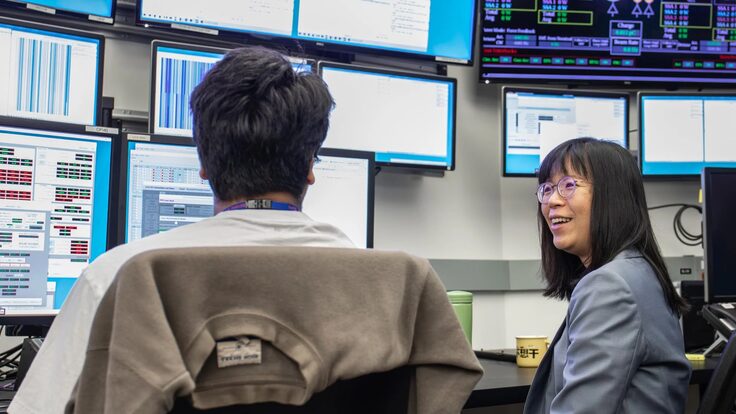
Granted, filming at Fermilab did present unusual challenges: getting security clearances, complying with safety rules, shooting on weekends and during off-hours, descending 350 feet into the NuMI experiment tunnel, and working around “Caution: Strong Magnetic Field” signs. Yet below their hard hats emblazoned with “Death Star Construction Crew,” the group was all smiles.
“Four years ago, when the word got out I wanted to make a Star Wars fan film, several people approached me and volunteered to be a part of the project,” Crawford says. “There is a great sense of camaraderie when we are all on the set.”
The film will premiere
in 2010 at Fermilab.
Tona Kunz
![]() |
Wiping with the stars
Every so often, particle physics communicators from labs around the world gather to swap strategies for getting people interested in science. At the group’s April meeting in Japan, the big hit was toilet paper.
Since 2004, more than 40,000 rolls of toilet paper with flushable facts about the life cycles of stars have found their way into Japanese society. References to Astronomical Toilet Paper litter blogs, and Web photos show the toilet paper visiting historical sites, much like the gnome in Travelocity commercials.
“People nowadays are too busy to think about the universe,” says Naohiro Takanashi, a research fellow at the National Astronomical Observatory of Japan. “We hope busy people use their time in the closed rest room to think about it.”
Tsuyuki Shikou, a company known for manufacturing toilet paper adorned with animals, flowers and vegetables, printed this version for the TENPLA Project, which is dedicated to popularizing astronomy. It follows in a whimsical Japanese tradition of inscribing toilet paper with comic strips, crossword puzzles, novels, and pop culture icons.
“We hope people learn that stars have a life. They are born from a molecular cloud, they become adult and finally they die; it’s similar to our lives,” Takanashi says. “We want people to see the similarity and feel connected to the stars and have an interest in astronomy.”
You can even do a bit of astronomy with the cardboard tube at the center of the roll: Take it outside, look at the sky through the cardboard tube, count the stars in the circle and use a formula to calculate the brightness of the night sky.
That is, if you can bring yourself to use all the paper.
Fusae Miyazoe, spokeswoman for the Institute for the Physics and Mathematics of the Universe at the University of Tokyo, says many of her colleagues tell her it’s a waste to read the roll only once, “so they just leave it on the shelf in the bathroom.”
If the idea catches on, maybe
we’ll see toilet paper showing,
step by step, how particles zip
through a detector. Hmm. What
will particle physicists do with
the cardboard tube?
Tia Jones
![]() |
| Photos courtesy of JLR/CNRS/APC |
The invisibles come to Paris
How do you make the invisible visible? Astrophysicists face this challenge daily. Unlike astronomers who view stars through telescopes, astrophysicists study cosmic particles that are too small or dark to see directly. They infer the presence of cosmic rays and neutrinos—and hunt for dark matter—by looking at how these invisible particles affect the world around them.
In October, astrophysicists used magic, public lectures, and Paris’ tallest skyscraper to teach the public how to use what you can see to peer at what you can’t. Thousands of people, many of whom had probably never heard of astrophysics before, met with scientists at 50 events in 10 countries during the first European Week of Astroparticle Physics.
In Spain, magicians made objects vanish and reappear to explain how cosmic particles can exist beyond our sight.
In France, the national center for scientific research, CNRS, transformed 210-meter-tall Montparnasse Tower into a cosmic-ray detector. When cosmic rays collided with a muon detector on the roof, a laser shot a beam 1.2 kilometers across the sky to the Paris Observatory.
Linking the tower with the ancient astronomical observatory was a tribute to the contributions astronomy has made to the modern-day field of astrophysics. The urban light show also was a nod to German physicist Theodore Wulf, who in 1910 mounted an electrometer atop the Eiffel Tower to measure how the number of cosmic-ray detections increases with altitude.
Spectators joined physicists
atop the Montparnasse Tower
to see the cosmic-ray detector
in action. Questions cascaded
down on the physicists as the
laser beam flashed above the
city’s Latin Quarter, in synchronization
with the invisible cosmic
rays coming into the detector.
Arnaud Marsollier
Tunnel tunes rouse ice cream memories
Some of Fermilab’s mechanical technicians spend a lot of time underground. In the echoing tunnels of the Tevatron collider they fix things, crawling behind equipment to replace aging nuts and bolts and repair everything from vacuum pumps to multi-ton superconducting magnets. They work six days a week at an urgent pace to get the collider back up and running as soon as possible.
“What we do is not easy,” says Derek Plant, a mechanical technician for 10 years. “It takes a very special group of people with good communication and a good demeanor.”
Many of the tasks facing the team require diagnostic testing, which can take hours or days.
“During the shutdown this past summer, we had to bring a third of the Tevatron to room temperature to leak-check and repair components,” says Scott McCormick, who supervises the Tevatron’s mechanical support group. “This meant long hours and a lot of tedious work for the team.”
In this intense, hurry-up-and-wait atmosphere, it’s important to keep a sense of humor. “We find ways to keep the mood upbeat,” Plant says. “That is why we have the happy cart.”
Plant got the idea while transporting equipment in a golf cart, one of many workers use to get around the four-mile Tevatron ring. He went home, got online, purchased the sound system from an ice cream truck and installed it on his cart.
The happy cart, as it has come to be known, still looks the same as the rest of the fleet, but now it plays sweet tunes that evoke memories of carefree childhood days spent chasing the neighborhood ice cream truck. His colleagues get a kick out of it.
“After many hours underground,’’ Plant says, “the sound of an ice cream truck coming from around the bend is enough to get a chuckle out of almost anyone.” Rhianna Wisniewski
![]() |
| Tevatron recordings of the
magnitude 9.1 quake near
Sumatra that set off tsunamis
and killed 228,000 people in
December 2004. Image courtesy of Fermilab |
Was that a quake? Ask the Tevatron
Long after the hard shaking stops, an earthquake’s seismic waves reverberate around the world, imperceptibly rocking the ground. As one seismologist puts it, a great earthquake causes every grain of sand on Earth to dance.
And big particle accelerators dance along.
Fermilab’s Duane Plant found this out one Sunday afternoon when he logged on to his home computer to check the performance of the Tevatron, an underground ring four miles in diameter where subatomic particles collide. It was November 3rd, 2002.
He noticed the particle beams had suddenly stopped circulating. Then, on a TV playing in the background, a newscaster announced that a 7.9-magnitude earthquake had just struck thousands of miles away in south-central Alaska.
“And it slowly seeps into his brain,” recalls a colleague, Todd Johnson, “and he called me up and said, ‘Is this crazy?’”
Johnson and Plant, who has since retired, checked sensors installed on a dozen of the Tevatron’s magnets to detect slow ground movements that can throw the beam off kilter. “The readings for these tiltmeters were all over the place,” Johnson says, “and just when they peaked is when the beam went away.”
The two accelerator operations specialists figured out when the first surface waves from the earthquake would have arrived at the collider in Illinois. “The timing was perfect,” Johnson says.
The quake watch was on.
Since then the Tevatron has recorded about 20 more earthquakes from all over the globe, including this year’s deadly shocks in Sumatra and Samoa. Only one, a moderate local quake on June 28, 2004, shut the collider down. The tiltmeter recordings look a lot like seismogram squiggles—which makes sense, says US Geological Survey seismologist William Ellsworth, because these sensors are essentially low-resolution seismometers.
Seismic waves are a problem for other large structures, too, including LIGO, the Laser Interferometer Gravitational-Wave Observatory, which operates enormous detectors in Louisiana and Washington. Joe Giaime, head of the Louisiana observatory, says seismic waves sometimes push finely tuned pieces of equipment out of alignment, and account for about 10 percent of downtime there.
Johnson says he doesn’t
see the Tevatron quake watch as
a way of alerting accelerator
operators to turn the beam off;
the accelerator does that automatically
when needed. “We
would just let the machine do
what it wants,” he says. But it
does give them one more way
to quickly identify the cause of
a beam loss, “rather than waste
a lot of time trying to diagnose
some phantom in the machine
that isn’t really there. Also, I find
it really interesting.”
Glennda Chui
Click here to download the pdf version of this article.
Particle collisions are ephemeral, occurring in the tiniest fractions of seconds. But they could be useful for decades if physicists learn how to store the data from them in a way that future generations of physicists can access and reuse.
Photos: Reidar Hahn, Fermilab.
LHC startup
Nov 2008
On September 10, 2008, scientists at the European laboratory CERN attempted for the first time to send...
Terascale
Dec 2007
The Terascale is an energy region named for the tera—or million million—electronvolts of energy needed to access it...