signal to background
Gob-smacked by a dinobird; National Lab Day gets an island vibe; a physicist’s winning formula for predicting baseball winners; taking greenhouse-gas trapping to a new level; a very stretchy midnight snack; letters; correction
|
| Image: K.G. Huntley from data collected at SSRL/SLAC |
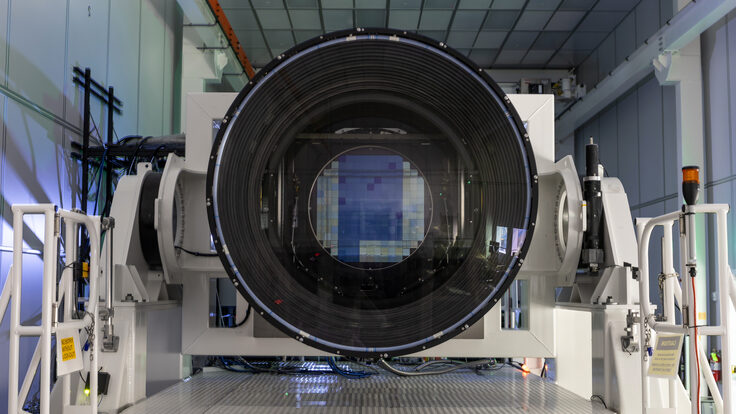
Hey, waiter! There’s a feather in my fossil!
One hundred and fifty million years ago, a creature part dinosaur and part bird sank into the murky depths of a lagoon, never to fly again. Its fossilized remains, unearthed from a German limestone quarry, are the most complete and best preserved of the 10 known fossils of Archaeopteryx, the famous evolutionary link between dinosaurs and birds.
In December 2008, this urvogel—German for “primordial bird”—traveled from its home at the Wyoming Dinosaur Center to SLAC National Accelerator Laboratory for the first-ever chemical analysis of a dinobird specimen, performed by an unlikely mix of physicists, paleontologists, and geochemists from around the world.
Their tool was a powerful X-ray beam generated by electrons racing around a particle storage ring at SLAC’s Stanford Synchrotron Radiation Lightsource. Sweeping the hair-thin beam over the 40-by-40-centimeter fossil, the team found remnants of the bird’s original chemistry, including phosphorus, sulfur, copper, and zinc.
“For 50 years, everyone has assumed that these beautiful feather impressions were nothing but impressions,” says University of Manchester geochemist Roy Wogelius. “But they’re not. The feather shafts are still there. There’s actually original chemistry left.”
What’s more, trace metals in the fossil, including copper and zinc, are “undoubtedly from the bones,” says SLAC physicist Uwe Bergmann. This suggests that Archaeopteryx, like modern birds, needed these elements in its diet to stay healthy.
“Quite simply, there’s much more inside of fossils than we ever imagined,” says University of Manchester paleontologist Phil Manning. “There’s gobsmackingly exciting stuff on the horizon; I think we have hit on some very exciting modern science. But this science can’t happen without people who work out of their box. This work is the result of completely unrelated sciences all coming together and making a perfect storm.”
It wasn’t the first time
chemical traces of the original
animal have been found in
a fossil. But until recently the
techniques were too slow and
too lacking in detail for practical
use. Now they have improved
to the point that researchers
could detect not just chemicals
from the dinobird, but also
the chemical processes involved
in its fossilization, materials
that had been used in its restoration,
and even fingerprints
on its stony surface.
Kelen Tuttle
National Lab Day puts scientists in the classroom
Pier Oddone wandered past students who were setting up electrical circuits and asked how many of them were considering careers in science. Half raised their hands. “What about a career in physics?” he asked. All but two hands dropped.
“Well, I’m here to change that,” he said.
For the next few hours, Oddone, the director of Fermi National Accelerator Laboratory in Illinois, told the students from various Hawaiian high schools about his life as a scientist and his journey from Argentina to become head of the leading high-energy physics laboratory in the United States. He told them no one can yet explain how the universe formed, and talked of the mysteries that particle physics research could unravel. He fielded questions about whether antimatter bombs like the ones in the movie Angels and Demons could exist (no) and whether the Large Hadron Collider might generate Earth-gobbling black holes (no again).
“He connected with them,” says physics teacher Hanno Adams. “They saw a scientist as human, and how science could affect their lives. The kids got a feeling that science is still in a discovery stage.”
Oddone had succeeded in doing at President Barack Obama’s alma mater, Punahou School in Honolulu, what the president had asked scientists across the nation to do in honor of National Lab Day: engage students in science, technology, engineering, and math. Hundreds of professionals fanned out to schools during the first week of May to push students to sharpen their skills in those key fields, make them aware of the careers those skills unlock, and give them a chance to learn with their hands, not just their textbooks.
Oddone and his wife, Barbara, who were on vacation in Hawaii at the time, chose to visit Punahou because it participates in the national QuarkNet program, which helps students construct cosmic-ray detectors for classroom research.
Eventually teachers had to pry the students away from the now-weary-looking Oddones.
“They were flooding around
him to get pictures and autographs,’”
Adams says. “They were
into it.”
Tona Kunz
Take me out to the calculator
Baseball fans and physicists share two key loves: numbers and acronyms. While fans pore over statistics on RBIs, OBPs, and ERAs, physicists analyze data from particle accelerators such as RHIC, LHC, and CESR.
Kerry Whisnant, a professor of physics at Iowa State University and lifelong baseball fan, studies the ghostly particles known as neutrinos. Growing up in central Illinois, he loved the St. Louis Cardinals and still catches their games when he can.
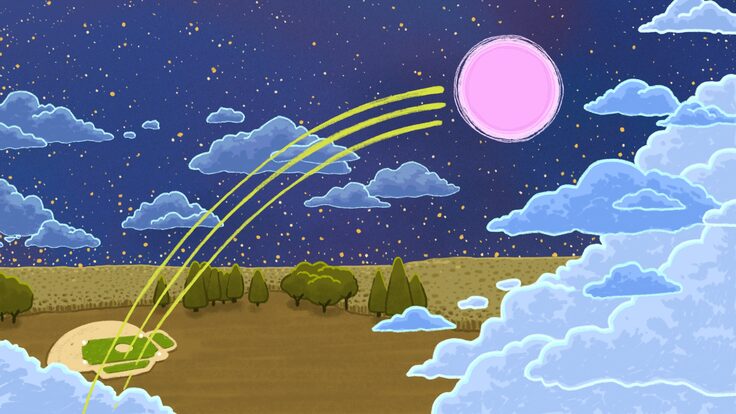
About two years ago, his love of baseball took an analytical turn. He began writing a regular column for dugoutcentral.com on the mathematics behind baseball statistics. And he started tinkering with a hallowed formula, developed three decades ago by statistician Bill James, that uses the number of runs a team scores per game to predict how it will do in a given season.
First Whisnant factored in how those runs are distributed across a season. Consistency mattered. For example, teams that consistently score about six runs per game will fare better over the course of the season than teams that fluctuate between two and 10 runs, even if the average score per game is the same.
Whisnant then accounted for the slugging percentage, which predicts the power of a hitter based on how many singles, doubles, triples, and home runs he hits per opportunity at bat.
Folding these two factors into the formula significantly improved its ability to predict how well a team would do over the course of a season, Whisnant says. It cut the already-small difference between a team’s predicted record and its actual record by half.
The impact of slugging percentage is large enough that teams might want to use it to help determine a player’s value, Whisnant says. At the same time, he acknowledges that this is just one piece of a complicated puzzle that includes such things as star power and popularity with fans.
Whisnant presented his findings
in March at the MIT Sloan
Sports Analytic Conference. His
paper won first place in the
academic division.
Julie Karceski
![]() |
| Illustration: Sandbox Studio |
Getting down with CO2
When Princeton University geoscientist Catherine Peters learned about a plan to build the world’s deepest science laboratory in an abandoned gold mine in South Dakota, she saw a chance to tackle an urgent challenge: how to store carbon dioxide deep underground so it can’t escape into the atmosphere and contribute to global warming.
Peters and colleagues from Princeton and Lawrence Berkeley National Laboratory hope to carry out their DUSEL CO2 project at the proposed Deep Underground Science and Engineering Laboratory, which will host research in physics and a wide range of other fields.
“The geology of the Homestake Mine is not what we’re interested in,” Peters says. “Instead it’s the depth.”
In the mine’s roomy interior, scientists plan to build models of the kinds of geological structures that are being considered for carbon storage, says Curtis Oldenburg, leader of the Berkeley Lab contingent. These “flow columns” aren’t miniatures. Taller than the Empire State Building, packed with layers of sand and clay and filled with brine or other fluids, they will allow researchers to see what happens to dense CO2 injected at different temperatures and pressures. They want to know if the CO2 will stay deep underground, and what happens if it leaks out.
The Houston-based company Schlumberger, a leader in deep monitoring technology in the oil and gas fields and DUSEL CO2’s industrial partner, works in far deeper wells across the world. But with a well, the only way in is from the top. The Homestake Mine’s shafts and drifts will allow access from top to bottom, revealing at what point the CO2 changes phase from a liquid to a gas, whether the paths it takes through fractured shale or cement well linings get bigger over time or seal themselves, and what role microbes play in converting CO2 to other gases or minerals.
Open to scientists from all
over the world, DUSEL CO2
will allow scientists to model
the deep Earth on a scale
a bit smaller than Earth itself.
Paul Preuss
![]() |
| Photos courtesy of Jesus Vizan |
Sharing pizza across the Pacific
Monitoring a particle detector on the midnight shift can have a limited upside: the food.
To compensate for the bad hours and limited social contact, control room supervisors on CDF, one of the Tevatron collider experiments at Fermilab, have a tradition of supplying their crews with dinner or a midnight snack. Offerings have included donuts and chips, a selection of fine cheeses and meats, and sushi brought in from two towns away.
But Japanese and Italian collaborators working remotely from control rooms at their home institutions lost out—until one night in April.
Junji Naganoma, a postdoc working at KEK in Japan, was sitting more than 6000 miles away, watching on a videoconference screen as his Illinois colleagues got ready for their midnight feast, when he heard a knock on the door.
It was a delivery man with an American-style pizza, a present from the CDF shift supervisor.
Other students gathered to gawk and hold up a Web cam so a shocked Naganoma could prove to his peers that he got their present and was eating the same thing they were. Everybody got a slice.
“They thought it was good of CDF to do,” Naganoma says.
Back at Fermilab, shift leader William Wester was relieved the delivery worked out. There had been so many things to worry about. The first pizza place he called in Tsukuba, Japan, had closed down. No one spoke English at the second, so he tried to order online, praying the buttons he clicked wouldn’t stick him with a bill for a hundred pizzas—and that his credit card company wouldn’t balk at approving a transaction involving an Illinois man ordering pizza for delivery in Japan.
Finally, Wester resorted to calling CDF collaborator Fumi Ukegawa, who was teaching in Japan, and had him place the order. As the clock ticked down to delivery time, Wester shot furtive glances at the videoconference screen, worrying Naganoma would start eating his own meal.
Laughing at the complexity
of the delivery, Naganoma said
it reminded him of times he
spent working at Fermilab and
reinforced one of the things
he loves about particle physics:
collaborating with people from
many countries and sharing
thoughts and traditions.
Tona Kunz
|
| Photos courtesy of Fumi Ukegawa |
correctionThe year Salpeter diedIn our April 2010 issue, a logbook article about a 1962 meeting of Nobel laureates misstated the year that physicist Edwin Salpeter died. It was 2008, not 2009. |
Click here to download the pdf version of this article.
In this artwork, Braniac, John Zaklikowski used every last
mother board, cell phone and floppy disk he had collected—and an array
of low-tech goods ranging from old-fashioned telephone
bells to a kitchen-sink strainer. He began with a rigid
plywood armature and used screws to attach hundreds
of components. A thick blue ring made of wax mixed
with pigment added coherence to the intricate result,
a juxtaposition of high and low tech. See more of his
work in the Gallery.
Photo: Bradley Plummer, SLAC
Shrink Wrap
Oct 2009
If you buy a Butterball turkey this Thanksgiving, you have particle accelerators to thank for its freshness. For decades now, industry has used particle accelerators to produce the sturdy, heat-shrinkable film...
Solar Neutrinos
May 2005
Ray Davis' experiments in a gold mine led him to solve the solar neutrino puzzle and win the 2002 Nobel Prize in Physics...
Positron
Apr 2007
A positron is the antimatter equivalent of an electron, with the same mass but opposite electric charge. When the two meet, they annihilate into a flash of energy...