signal to background
151-year-old recording sings for the first time; labs in Jeopardy!; fueling up on grass;
cosmic rays point to better solar panels; electronic circuits with altitude; letters
 |
| Photo-illustration: Sandbox Studio |
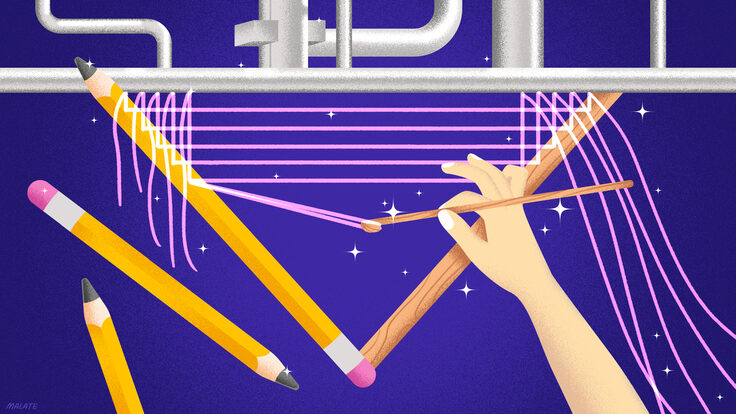
Physicist revives
oldest recording of
the human voice
In 1860, Parisian inventor
Édouard-Léon Scott de
Martinville set out to capture
the beauty of a French folk
song, "Au Clair de la Lune,"
using pig hair and soot.
He had a singer croon into
a speaking horn, sending sound
waves into a diaphragm. This
vibrated a stylus—a hair plucked
from a pig’s ear—that scratched
wavy lines into soot-covered
paper.
Scott never intended to play
back his recording. His apparatus,
called a phonoautograph,
was meant to preserve only
a paper record of sound vibrations;
Thomas Edison would not
invent the phonograph until 17
years later.
So it was all the more
remarkable when particle physicist
Carl Haber of Lawrence
Berkeley National Laboratory
pulled the sound from Scott’s
soot-covered paper and brought
the snippet of song back to life
in March 2008. It was the earliest
recording of the human voice
ever successfully played back.
"It has been a really great way
to use physics and technology
to impact other areas of society,"
Haber says of his technique,
which sprang from computer
algorithms and imaging methods
used to design particle detectors
for CERN, the European
particle physics center.
Giving voice to Scott’s
recordings is the latest of
Haber’s contributions to the
preservation of historic sound.
Currently, he’s digitizing and
recording turn-of-the-century
stories and songs in Native
American dialects, some now
extinct, that had been captured
on 3000 cylinders stored at the
University of California, Berkeley.
The challenge is to restore
those sounds without damaging
their delicate cylinders of wax,
foil, shellac, lacquer, or plastic. To
do that, Haber takes a 3-D, high-resolution
photo of the cylinder’s
grooves, which reflect various
wavelengths, or colors, of light.
Each color comes into focus at
a different depth, allowing Haber
to plot the topography of the
area inside the grooves within
a fraction of a hair’s width.
A computer translates the
images into sound pitches and
durations. It also filters out damage
to reduce static, remove
skips, and fill in portions that are
chipped, moldy, or worn, creating
the equivalent of a retouched
photograph.
Haber says that when the
US Library of Congress finishes
constructing a new center to
store the world’s sound recordings,
he will move his imaging
machine there.
You can hear Scott’s recording,
and others restored by
Huber and his colleagues, at
firstsounds.org.
Tona Kunz
I’ll take particle
accelerators for
$200, Alex
Knowing accelerator trivia may
someday earn you cash and
a shot at fame.
During the past few
months, the TV quiz show
Jeopardy! visited Brookhaven
National Laboratory in Long
Island, NY, and SLAC National
Accelerator Laboratory in
California to shoot footage
for rounds of questions
on particle accelerators.
In a twist on traditional quiz
shows, Jeopardy! host Alex
Trebek gives contestants
answers for which they must
provide the questions. For
example, under the category
"Accelerators: Science at Nearly
the Speed of Light from the
Stanford Linear Accelerator
Center," one clue stated: "In
the two-mile-long linear accelerator,
an electromagnetic wave
pushes these particles along,
kind of like surfers." The correct
question: "What are electrons?"
The show’s roving "Clue
Crew" filmed video clues eight
to 12 seconds long at various
locations in the labs.
At Brookhaven, this involved
standing in the accelerator
tunnel for the Relativistic Heavy
Ion Collider, or RHIC, to illustrate
how magnets help push
particles to nearly the speed
of light. The segment has not
been scheduled to air yet,
but a local TV news report
on the filming can be seen at
http://tinyurl.com/55zvb9.
At SLAC, the camera crew
filmed in the main control room
as staffers worked in the background,
seemingly undisturbed.
But filming in the lab’s klystron
gallery was not so easy; the buzz
from the microwave-generating
klystrons that provide power to
the accelerator’s beam line
nearly drowned out the speaker’s
voice. The episode aired
in September; you can find clips
at http://tinyurl.com/58r4q9.
What is the sound of discovery,
Alex?
Calla Cofield
 |
Photo: Fermilab
|
Fermilab grasses may
thwart damaging
greenhouse gases
Michael Miller watches grass
grow for a living—super grass,
of sorts, grass that could fuel a
car and reduce carbon dioxide
emissions at the same time.
He and other researchers
from Argonne National
Laboratory and the University of
Chicago have turned 13 acres at
Fermilab into an outdoor laboratory.
Their goal is to find the best
ways to use native prairie
grasses to attack the global
warming and fuel crises.
"I believe nature has given
us a lot of variety to work with,"
says Miller, a senior Argonne
scientist. "It is just identifying
those traits that fit best with
what man needs."
Miller and his colleagues are
studying seven combinations
of prairie grasses, including plots
of switchgrass and big bluestem
planted in June as well as native
grasses that thrive on Fermilab’s
restored prairie.
He’s trying to determine
which factors produce the most
durable, bountiful grasses for
use as fuel. He’ll also determine
their carbon footprints, balancing
the amount of carbon needed to
grow the plants and turn them
into fuel against the amount of
carbon they sequester, or store,
in the soil as their roots die and
decompose.
By the end of 2009, Miller
and his team hope to have a
clearer picture of which combinations
of grasses would create
the most efficient, environmentally
friendly feedstock for fuels.
Switchgrass already has
known advantages over corn
as a feedstock for biofuels.
It grows four to eight feet tall
in dense patches across the
Midwest, flourishing in areas
not normally tilled for crops.
The grass needs replanting
only once every decade, can
grow with little or no fertilizer,
tolerates drought, and sequesters
the same amount of CO2
that would be released by
burning it for fuel. That makes
the production of fuel from
switchgrass carbon neutral or
even carbon negative.
Even if native grasses are
not harvested for fuel, they still
provide a benefit by trapping
greenhouse gases. Miller says
900 acres of Fermilab prairie
store as much carbon dioxide
in soil as 250 compact cars
emit in a year.
"What we are trying to do
is take advantage of our prairie
system," Miller adds. "Fermilab’s
long history of maintaining and
restoring the prairie gives us
a lot of knowledge about the
grasses."
Tona Kunz
Pierre Auger tests
solar technology
As the Pierre Auger Observatory
in Argentina collects cosmic
rays for science, its thousands
of solar panels are collecting
data that could make solar
power cheaper, more efficient,
and more reliable.
 |
| Photo courtesy of Acciona Energia |
Pierre Auger is "a fantastic
experimental test," which is the
best in the world right now for
solar panels and their batteries,
says Angeles Lopez Aguera,
dean of physics faculty at
Santiago de Compostela
University in Spain. "Industry
never, never will be able to
have this large an amount of
experimental data."
Spain is a global leader in
the production and design of
solar panels and home to the
11 biggest photovoltaic power
plants in the world (see image above). Much bigger plants are
on the drawing board worldwide,
including a 550 MW installation
proposed in California that would
generate enough electricity for
roughly 550,000 homes.
Battery outages in these
large solar parks can take two
weeks to reach and repair.
Reliability is also an issue for
solar panels in remote areas,
from isolated villages in developing
countries to the Colorado
site where a second Pierre
Auger Observatory is planned.
So Santiago University is
working with two Spanish corporations—
including ISOFOTON,
the second-largest producer
of solar panels in Europe—to
monitor the performance of the
3320 solar panels that power
Pierre Auger’s detectors, which
are scattered across 1200
square miles of semi-arid pampas.
Spain provided most of
the solar panels and Brazil
most of the batteries as their
contributions to the international
observatory.
The companies hope the 70
million bits of data the panels
provide each year will help them
produce solar panels and batteries
that last longer, withstand
long periods of extreme temperatures,
better respond to
peak power needs, and optimize
the amount of sunlight
converted to electricity.
Researchers recently created
a prototype "intelligent" regulator
for the solar panels that will be
tested in Spain and at the
Colorado observatory. The regulator
will sound an alarm when
a battery is about to go out so it
can be replaced, avoiding power
outages and optimizing the life
spans of batteries.
"This is important for Pierre
Auger, that is clear," Aguera
says, "but it is also important
for the big solar parks."
Tona Kunz
 |
Photo courtesy of IBM
|
Labs and industry
perfect 3-D chip
High-tech businesses must
constantly innovate or become
obsolete. But when it comes
to investing in new machinery
and adopting new techniques,
industry can be timid, says
Bob Patti, chief technical officer
of Tezzaron Semiconductor.
That’s where research laboratories
come in. Freed from
market constraints, they can
afford to break new ground
and demonstrate that an innovative
technology works.
Companies can then adapt the
technology, with minimal risk,
for products with mass appeal.
In this case, Fermilab has
recruited more than a dozen
other research labs to work
with Tezzaron to develop three-dimensional
computer chips.
Fermilab has been working
on 3-D chips since 2006 as
a way to make detectors that
track particles coming out of
high-energy collisions more
precise and compact. Now it
hopes to use industry’s economy
of scale to accelerate the
production of the new chips.
Tezzaron benefits by sharing
the cost of developing new prototypes
and by demonstrating
to potential customers that the
3-D chip is cost-effective.
Once companies see others
out there using a new technology,
"they feel more comfortable
placing bets on it," Patti says.
For almost a decade,
Tezzaron has been developing
3-D chip technology to give
devices such as cameras and
cell phones more memory and
to improve the speed and
energy efficiency of information
processors.
Traditional integrated circuits
are flat and connect at the
edges like tiles. "They were like
one-story buildings built on
different lots," Patti says.
In the late 90s, companies
began stacking the flat chips
and connecting them at the
edges like buildings with multiple
stories—but with no way
for electrical currents to
move up and down, aside
from outdoor fire escapes.
In today’s 3-D circuits, wires
run directly from one layer
to the next, a shorter distance
that uses 40 percent less energy.
"We’re installing elevators,"
says Gretchen Patti, a member
of Tezzaron’s technical staff.
Working with research laboratories
pushes the company to
improve its product, she says.
"If you’re working with a client
who is not afraid to push
the envelope," she says, "you’re
more likely to come up with
something better than expected."
Kathryn Grim
Letters
Unfair dice
I enjoy the magazine very much, but must register my complaint about the illegal dice depicted on
the rear cover of the March/April 2008 issue. The opposite faces on each legal die must add
up to seven, obviously not possible with those on the cover unless they have really been "doctored."
Anyway, don’t shoot craps with this guy!
Nils I. Larson
After sifting through the 14 dice on the back cover of the March/April 2008 issue, I discovered and
confirmed that ten of them are very rare indeed. Or at least they are rare in any legitimate gaming
house. As shown, these ten dice could dramatically change the outcome of the game, but would
definitely affect the user’s ability to roll again, if caught using them.
Guy R. Martino
Antimatter novels
I’m surprised that William Higgins’ brief article about antimatter in science fiction (September 2008)
ended so abruptly, especially without any reference to Jack Williamson’s Seetee Ship and Seetee
Shock. I’ve enjoyed those two so often that the pages are falling out, needing glue for rebinding.
What’s great about your article is it reminded me about my favorite sci-fi topic, which I’ve overlooked
for some time. I’ve been busy re-reading my A.E. van Vogt collection.
Now I need to check eBay for other antimatter novels, as well as the missing van Vogt books I’d
planned to repurchase!
Walter P. Kraslawsky
|
Click here to download the pdf version of this article.
Send a letter to the editor
Share this page with others! Submit to:
|
|
|
|
|