Secrets of the Pyramids
In a boon for archaeology, particle physicists
plan to probe ancient structures for tombs and
other hidden chambers. The key to the technology
is the muon, a cousin of the electron that
rains harmlessly from the sky.
By Haley Bridger
 |
| Illustrations: Sandbox Studio |
In the dense jungles of northwestern Belize, the sound of metal
hitting rock startles flocks of tropical birds and troops of black
howler monkeys. Archaeologist Norman Hammond and his team stop digging.
They have hit a stone wall 10 feet below ground; inside is a royal
tomb. After almost one hundred test excavations at La Milpa, an ancient
Mayan city of 50,000 people, Hammond has unearthed something big.
Within the tomb lie the remains of a man wearing a jade pendant in
the form of a vulture's head. He is thought to be either Bird Jaguar, the
fifth-century ruler of La Milpa, or one of Bird Jaguar’s successors.
And finding him was an incredible stroke of luck.
Hammond made his famous discovery more than 10 years ago, but
repeated efforts to find other tombs at the site have come up empty-handed.
Lacking an ancient map of La Milpa or blueprints for its five pyramid
mounds and buried plaza, archaeologists rely mostly on instinct. They run
the risk of piercing priceless relics with their shovels or digging fruitlessly
for years.
The ground beneath the site “could be Swiss cheese, for all we know,”
riddled with burial chambers, tunnels, and hidden entrances, says Hammond,
who is based at Boston University.
Now researchers hope to find those hidden spaces with the help of
particle physics.
A cosmic X-ray machine
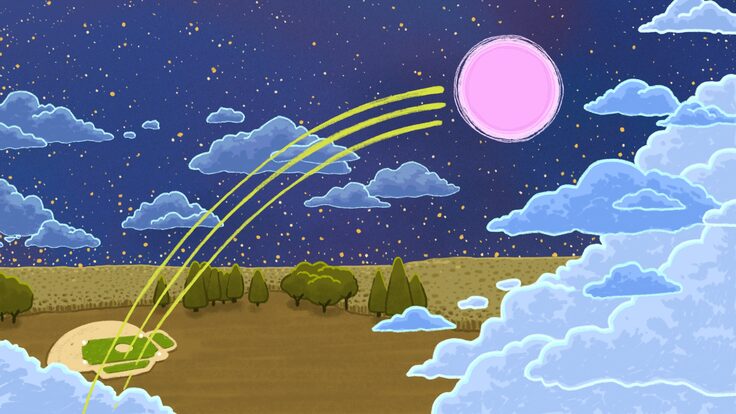
The key to the new approach is the muon, a heavy cousin of the electron
that’s created when cosmic rays hit the atmosphere. Muons pass harmlessly
through people and buildings; in fact, nearly 600 of them fly through your
body each minute. They fascinate scientists because they’re one of the
few high-energy particles raining down from the sky that can be examined
for clues to the nature of the cosmos. Particle physicists started building
muon detectors in the 1940s and they’re still at it today; the most advanced
particle detectors in the world, at the Large Hadron Collider in Geneva,
Switzerland, have components that record muons created in particle collisions.
But it’s the ability of the muon to penetrate deep into rock and
water that has archaeologists excited.
Muons traveling through rock or other dense material will slow and
eventually stop, while those flying through empty spaces keep going fullspeed.
The idea is to catch the muons after they’ve passed through an
archaeological site and measure their energies and trajectories. With this
information, researchers can reconstruct their paths and compile a 3D
image that reveals hidden chambers or other voids.
 |
La Milpa
Scientists at the University
of Texas at Austin plan to
place two muon detectors
on either side of a pyramid
at La Milpa in Belize. This
arrangement gives them a
stereo view of the site,
making it easier to compile
a 3D image.
Photo: Norman Hammond,
La Milpa Archaeological
Project
Schematic: Sandbox Studio |
If archaeologists are like surgeons probing a patient, physicists are the
radiologists whose X-rays show where to cut and how to do it safely. Just
as X-rays leave patients unscarred, muons offer a way to explore ancient
ruins without disturbing them.
This fall, a team led by Arturo Menchaca-Rocha of the National
Autonomous University of Mexico, or UNAM, plans to place a muon detector
beneath the Pyramid of the Sun in Teotihuacán, northwest of Mexico
City. Meanwhile, Roy Schwitters of the University of Texas at Austin is making
plans to install muon detectors in wells dug on opposite sides of a
mound at La Milpa.
The detectors will gather muons for about a year, slowly building a picture
of the interior of each pyramid.
First stop: Egypt
Muon detectors have a rich history of revealing the unusual and the unseen.
Sixty years ago, scientists in Australia used them to measure layers of
mountain snow. Today, Japanese scientists are testing the technology as a
way to track magma rising within volcanoes, a possible sign of impending
eruption. Border patrol agencies in the United States see muon detectors
as a potential way to uncover radioactive materials shielded and hidden
inside cargo containers and trucks.
It was about 40 years ago that archaeologists tapped muons for the
first time. Luis Alvarez, a Nobel Prize-winning physicist at the University
of California, Berkeley, wondered if muons might reveal chambers in the
Second Pyramid of Chephren, one of the three great pyramids of Egypt,
that had somehow escaped the notice of archaeologists and looters for
4500 years.
Alvarez and his team put a detector in the Belzoni Chamber, near the
center of the pyramid’s base, and left it to collect muons for two years.
They concluded that no additional chambers were hidden in the limestone
above, although the scan was able to distinguish the four edges of the
pyramid and what little remained of its smooth limestone facing. While it
would have been more exciting to discover a new chamber, this information
was nonetheless valuable for Egyptologists and archaeologists studying the
pyramid—and it showed that the technique worked.
There are other high-tech ways to explore a ruin. Ground-penetrating
radar reflects off buried features, while electrical-resistivity probes measure
the increased resistance to electrical flow due to the presence of stone and
brick. Though useful, neither of them probes as deeply or takes as wide
a view as the muon detector does.
 |
Egypt
In the first experiment of its
kind, a team led by Luis
Alvarez placed a muon detector
in a chamber of
Egypt’s Second Pyramid of
Chephren. Although the
muons revealed no hidden
chambers, the experiment
showed that the method
had value for archaeology.
Schematic: Sandbox Studio |
The Pyramid of the Sun
In the early 1970s, a pair of archaeologists cleared stone and gravel out of
a well at the base of the world’s third-largest pyramid, the Pyramid of the
Sun at Teotihuacán. Beneath the rocks they found a stairway leading to
a tunnel 100 meters long and eight meters below ground. It opened an
extraordinary opportunity for the physics community, Menchaca-Rocha
says: “It is the key that will allow us to carry out an experiment similar
to that of Alvarez” by placing a muon detector directly below the pyramid.
Menchaca-Rocha hopes to put the detector in place this fall and begin
collecting data by the end of the year.
The detector contains six gas-filled chambers. When a muon travels
through one of them, it collides with particles in the gas and gives off
light. By recording those light flashes and noting exactly where the muon
entered and left the chamber, researchers can calculate its energy and
trajectory. Menchaca-Rocha thinks the detector will reveal any cavity more
than 75 centimeters—30 inches—tall.
The results could help to answer a question that has stumped archaeologists
for decades: What was the purpose of the pyramid?
Linda Manzanilla, an archaeologist with UNAM, studies Teotihuacán, once
a bustling center full of pyramids and temples. “It was a city that attracted
many people,” she says, “and it flourished for five centuries.” She believes
a volcanic eruption drove people from the north towards the valley where
the metropolis rose; “There they built a temple to appease the fire gods.”
Originally devoted to agriculture, the temple became a symbol of the
state and its rulers. Could one of those rulers lie in a tomb within the
Pyramid of the Sun? “I don’t think so. I don’t believe we will find anything
inside,” Manzanilla says. No tombs have been found there yet, and she
doesn’t think that will change.
But without a muon detector, Manzanilla can’t test her predictions. “The
Pyramid of the Sun is so wide and so high,” she says. “Ground-penetrating
radar can see only a small depth and width. We can expand that view using
the muon detector.”
And, she hopes, put to rest speculation about what is inside.
 |
Teotihuacán
At the Pyramid of the Sun
in Teotihuacán, scientists
from UNAM will take advantage
of an existing tunnel
to place their muon detector.
Muons traveling through
its six gas-filled chambers
will give off flashes of light.
Schematic: Sandbox Studio |
Mayan mysteries
Schwitters is eager to answer similar questions at La Milpa in Belize.
The design of his detector is slightly different. It’s a gas-filled cylinder
wrapped with strips of material that detect muons as they enter and leave.
Another detector, at the bottom of the cylinder, picks up flashes of light from
muons zipping through the gas.
Rather than putting his detector directly below the pyramid, which
would require digging a tunnel, Schwitters plans to place two detectors in
shallow shafts on either side of the structure and 50 to 60 meters apart.
This will give them a stereo view of the site, eliminate blind spots and make
it easier to construct a 3D image. Only the most energetic muons will
be used for the reconstruction; since they are not as easily deflected, their
paths through the site are truer and more direct. Schwitters says it should
take about 10 days to record and trace 1000 muon arrivals.
While waiting for the funding they need to set up a laboratory in Belize,
Schwitters and his team have been testing the 16-foot-long prototype
detector they built at the University of Texas at Austin. Big stacks of bricks
stand in for the stony bulk of the pyramid; the team moves the bricks up
onto the roof and into other difficult positions to see how the detector
handles the challenge. From the data, Schwitters and his group can see
not only the piles of bricks, but also the shadows of the nearby engineering
and physics buildings, massive structures that impede the flow of muons.
If the detector can distinguish these dense objects, Schwitters says, it
can find cavities as well.
“The technology has really improved since the time of Alvarez,” Schwitters
says. “The detectors are simpler and more robust. We are looking to make
the detector more portable and improve our software, and then we can
get serious.”
Designing the detector is the first of many challenges for the Schwitters
team. Once they get funding and permission, they will have to transport
the detectors to Belize and dig holes in which to put them. They’ll also need
to find a way to power the lab at the remote site. “It’s a slow process and
we’ve got a lot to do here,” Schwitters says, adding that he hopes to move
to Belize by the spring of 2009.
La Milpa remains shrouded in mystery. Hammond says, “Some questions
we cannot yet answer are: Why was the city founded? What was its
strategic or economic importance? Why did it collapse? And why was it
abandoned in a time of great construction?” Muon detection may answer
at least some of these questions and give archaeologists enough of an
edge to unearth the next exciting discovery.
 |
|
At left: This detector, developed for
use at La Milpa in Belize,
snags incoming muons in
two ways. First, a muon’s
trajectory is recorded by
three layers of material
wrapped around a cylindrical
chamber. Meanwhile, photodetectors
pick up flashes
of light generated as
muons strike molecules of
gas inside the chamber. |
At right:The detector developed by
UNAM for the Pyramid of
the Sun contains layers of
scintillating material; they
collect light produced when
muons interact with gas in
the detector’s six chambers.
Diagrams: Sandbox Studio |
Click here to download the pdf version of this article.
Send a letter to the editor
Share this page with others! Submit to:
|
|
|
|
|