|
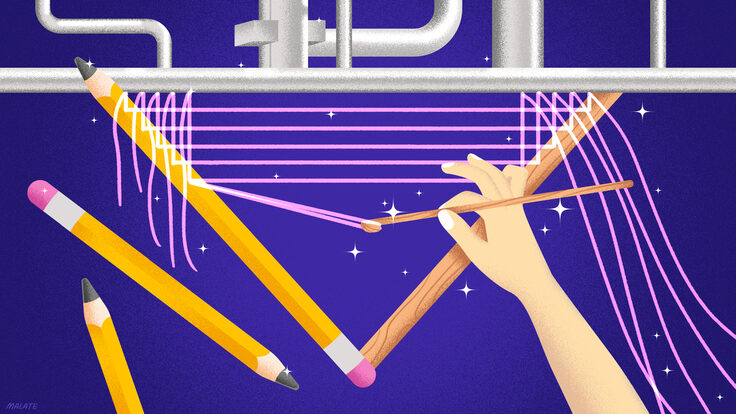
Sending high-density packets of positrons through a beam pipe produces electron clouds that diffuse the positron beam.
|
| Illustration: Sandbox Studio |
Clouds of electrons could block the view of new discoveries at the proposed ILC, a multi-billion-dollar particle collider. Eliminating those clouds is critical to the prspects for the machine's success.
by Erik Vance
Creating and then annihilating the tiniest and most powerful beams of
electrons and positrons ever produced, the proposed International
Linear Collider could open pathways to new particles, new dimensions,
and new discoveries beyond our current imagination.
But clouds could block the view. Like clouds of ice crystals or condensed
water droplets floating in the sky and blocking the sunshine, these
clouds of electrons could dim the accelerator's brightness and block the
view of new discoveries.
Within the global effort to make the ILC shine brightly, Mauro Pivi of
Stanford Linear Accelerator Center wants to channel these electron clouds
into a gutter inside the machine. Lanfa Wang, also of SLAC, wants to
attract and dissipate them with an electrical charge. Each is clear about the
stakes: prospects for building the multinational, multi-billion-dollar ILC
depend significantly on its cost, and its cost depends in part on removing
the clouds.
"If we manage to cure the electron cloud problem," Pivi says, "we could
save one damping ring and hundreds of millions of dollars."
Physicists have built particle colliders for more than half a century, but
designing a collider as complex as the up-to-40-kilometer-long ILC brings
up lots of new questions along the way. To catch a glimpse of the universe's fabric at the smallest possible scale, the ILC uses beams of
tightly-packed electrons, smashing them head-on into beams of tightlypacked
positrons, the antimatter counterparts of electrons.
To maximize experimenters' chances of making discoveries, the machine
must produce as many collisions as possible. Accelerator physicists achieve
this maximum by squeezing the largest number of particles into the smallest
possible space, hurling these tiny, high-density packages of particles
toward each other at close to the speed of light. When an electron in one
bunch hits a positron from another, the resulting annihilation provides
the energy that creates new particles and exposes new forces.
Making these high-intensity bunches, then shrinking them to a size one
ten-thousandth of the thickness of a human hair, is a science of its own.
Starting at opposite ends of the ILC collider, the initial bunches of electrons
and positrons are far too diffuse to be of experimental value. Separate
machines called damping rings, which are several kilometers long, transform
loose streams of particles into tight, disciplined beams before their final
acceleration toward the collision point at the center of the ILC.
The design of the damping rings is determined by three factors: accommodating
the desired number of electron and positron bunches, meeting
the stringent requirements for the size of the beam, and finding the least
expensive solution.
But before the final design can be approved, someone has to find out
how to handle the electron clouds.
The electrons and positrons of the ILC travel along the center of vacuum
beam pipes. Whenever they change direction, they emit light that hits
the metal wall of the beam pipe and kicks out electrons from the atoms in
the wall. The positron beam attracts these negative electrons, providing
them with additional energy: the electrons bounce around inside the beam
pipe, repeatedly hit the surrounding wall, and cause an avalanche of additional
electrons.
"These electrons hit the wall and they multiply," says Pivi. "From one
electron they become two. Then four, eight, sixteen, thirty-two–after a
little while you have a cloud of electrons and you cannot get rid of them."
Pivi is part of the international team designing the ILC damping rings.
Together with his colleagues, he is working on a solution to the "electron
cloud effect," which diffuses the positron beam. The positrons are
attracted to the surrounding negatively-charged electron cloud, causing the positron beam to grow in size and sometimes even to wobble out
of control. Such a beam would be too large and too diffuse for the main
accelerator of the ILC, and would produce too few collisions.
In existing electron and positron accelerators with low beam intensity, the
clouds have been relatively easy to control. Wherever possible, electrically
charged coils are wound around the beam pipe to trap the troublesome
particles near the wall, leaving a clear path for the beam. For the ILC
with its high-intensity beams, damping rings do not offer enough room for
the same kind of coils. Scientists need to find a new technique to brush
the particles aside or they will have to eliminate the clouds a altogether.
To combat the electron clouds, ILC designers looked at the optimal size
and shape of the damping rings. Electron clouds only grow thick if positron
bunches follow each other machine-gun-style right one after another. If
designers increase the distance between the bunches by using a longer
damping ring, the clouds are thinned.
To give the bunches the preferred extra space, one initial design suggested
a massive damping ring for the positrons shaped like a telephone receiver, about 17 kilometer in circumference. The sheer size of this ring,
nicknamed the "dog bone" by physicists, would spread the bunches enough
to eliminate any opportunity for the clouds to form.
However, the dog-bone configuration is expensive, and Yunhai Cai,
a SLAC physicist overseeing part of the design, says it doesn't push scientists toward an innovative solution. Instead, ILC scientists are favoring
two six-kilometer-circumference damping rings for the positrons. Each ring
would handle one half of the total number of positron bunches, and the
two rings could sit on top of each other in one tunnel, reducing the cost of
construction.
"The reason we want two rings is because we want the bunches separate
enough so the electron cloud is not a problem," Cai says. "If you only have
space for damping two bunches, then you can only provide two collisions. If
you have space for 3000, you are much better. It's like bullets. The faster
you can get them out, the better. But those bullets have to be really good
bullets. You want them really sharp."
"If we manage to cure the electron cloud problem, we could save one damping ring and hundreds of millions of dollars."
|
| Mauro Pivi |
| SLAC physicist Mauro Pivi and his colleagues are testing new technologies that may reduce the electron clouds in beam pipes. This prototype beam pipe is outfitted with grooves that trap electrons before clouds can form. |
 |
Photo: Diana Rogers, SLAC |
Cai also points out that a double-circle shape is an efficient, symmetrical
design. However, while building two large rings will solve the electron
cloud problem, in some ways it's an expensive quick fix. Cai says more
creative and permanent solutions are needed.
What if scientists could get rid of the clouds altogether? Without the
clouds, researchers could envision an ILC damping ring as small as
three kilometers around to bring the electron and positron bunches into
shape. The design would require loose electrons to be absorbed before
they recruit more.
Inspired by his colleagues Alexander Krasnov and Gennady Stupakov,
Pivi has devised a solution featuring rectangular grooves cut into the
chamber walls to trap the errant electrons. As the electrons bounce off the
walls, Pivi's grooves capture them: like golf balls being tossed into a rain gutter, the electrons bounce around inside a groove, lose energy, and are
absorbed by the surface of the grooves.
Pivi has designed and tested several models, one for the straight sections of the damping ring and others for those that curve. Grooves in
the straight sections would be about one millimeter deep, while those on
the corners would be a tenth that size–roughly the size of a strand of
spaghetti versus a strand of human hair.
Pivi is testing his larger grooves in the lab. By aiming a beam at several one-square-inch plates with grooves, he can see how well the grooves
trap electrons. So far, results have been good. Without grooves, the secondary
yield of the walls is about two: for every electron that hits the
wall, two bounce back. With grooves, yields are down to 0.6, meaning fewer
electrons escape than go in.
The next step will come this summer when Pivi begins experiments
using the larger grooves at SLAC's PEP-II accelerator facility.
"The latest lab measurements were great," Pivi says. "We got what we
expected. When we install chambers with these grooves in PEP-II we will
see if there is an electron cloud or not. This will be the test."
The spaghetti-sized grooves are inexpensive and can be machined relatively
easily. However, the tiny hair-sized grooves might present a challenge.
Each panel of hair-sized grooves must be precisely cut, and the
higher cost of the panels might make them prohibitively expensive.
Across the hall from Pivi, Lanfa Wang proposes a different solution to
get rid of electrons. Rather than trapping the electrons, he plans to bribe
them into leaving.
"If we want to kill the electrons in the central region of the chamber, we
should put in a strong electrode," Wang says.
Electrodes are electrical conductors through which a voltage can be
applied to the surrounding area. In the case of Wang's solution, a clearing
electrode creates a positive charge along the interior of the beam pipe
that is strong enough to pull electrons away from the center, creating
a clear path for the positron beam. Out of reach of the beam, the particles
slow down and dissipate.
Scientists at the European laboratory CERN will test a similar promising
technique using proton beams, but the method has never been used with
the much lighter electrons and positrons so far. Wang and Pivi hope to test
an optimized electrode design in SLAC's PEP-II as early as this summer.
At present, it remains to be seen how successful the various damping
ring designs will be. Wang says if the electrodes meet his expectations,
it might be possible to eliminate one of the two positron damping rings currently
envisioned for the ILC, reducing the cost of the machine. The most
likely solution may be a combination of the two technologies.
"There are many solutions," Pivi says. "We have good artillery against
the electron clouds. We will test all possibilities."
The best solution, of course, will be the one that provides the most unclouded view for the machine, and thereby for the science ahead.
Click here to download the pdf version of this article.
Send a letter to the editor
|