|
The power of pi at Fermilab; DESY turns
on its new free-electron laser; selling old equipment
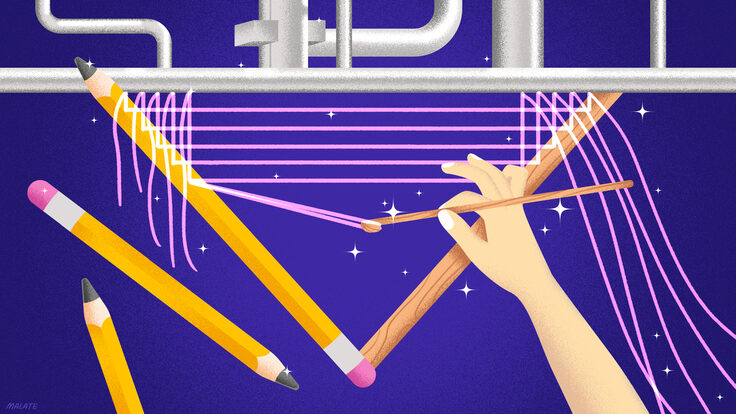
on eBay; studying the properties of spiders' webs with synchrotrons;
review of Deep Down Things; letters.

Photo: Deborah Guzman Meyer, Fermilab |
Believe it or not, most of Fermilab's power comes from pi. Electrical power,
that is, as the shape of the lab's power poles is modeled after π, the
symbol for the famous number. The π-poles were designed by founding director
Robert Wilson during the construction of the lab. Amazingly, the original wooden
poles are still standing, over 30 years later—but not without encountering
some obstacles along the way.
Because the π-poles are wooden, they are subject to infestation from insects
and woodpeckers. That's why engineer Joe Pathiyil is not only in charge of power
distribution for the site, but he is also on continual woodpecker duty. In order
to minimize the damage to any poles from woodpecker holes, "we fill the woodpecker
holes with epoxy and put steel mesh around the area," explains Pathiyil.
While reliability and safety are important reasons to maintain these unique
structures, they are not the only ones. "A lot of who we are at Fermilab is
captured in our unique art and architecture," says Randy Ortgiesen, deputy head
of Fermilab's Facilities Engineering Services Section. Engineering Group manager
Ed Crumpley agrees, adding, "Wilson thought as a sculptor, not as an architect,"
when he designed Fermilab structures such as the Feynman Computing Center, the
high rise that now bears his name, and, of course, the π-poles.
The π-poles are a symbol of the intellectual endeavors that take place
at Fermilab, and—with protection, care, maintenance, and replacement
as needed—they will continue to supply Fermilab with power for years to
come.
Elizabeth Wade

Photo: DESY |
He boldly pressed the red button and said, "They promised to explain to me afterwards
what I am doing here exactly."
And the director kept that promise: "With this push of a button you have opened, like in a camera, the shutter to take pictures with this pioneering facility for free-electron lasers. Flashes of laser-like X-ray light are now available for science," he said.
The scene of the action: an experimental hall at DESY in Hamburg, Germany, on August 3, 2005. The actors: German Chancellor Gerhard Schröder and DESY's director-general Albrecht Wagner, facing some 50 representatives from the media. The occasion: the dedication of the world's first vacuum ultraviolet free-electron laser (VUV-FEL), a machine that sets new standards: ten million times the peak brilliance of the best synchrotron radiation sources today; coherent radiation; light pulses of only 10 to 50 femtoseconds duration; tiny wavelength, tunable from 6 to 30 nanometers.
At the dedication, Wagner, Schröder and DESY's Jochen Schneider (photo, left to right) took a walk through the VUV-FEL tunnel. During its first phase of operations, a total of 29 VUV-FEL research projects will be carried out by 200 scientists from 60 institutes in 11 countries. The experiments focus on fields such as cluster physics, solid state physics, surface physics, plasma research, and molecular biology. Demand for beam time is high, and researchers interested in many more projects are already knocking at the door.
The startup of the VUV-FEL is of great interest to the accelerator community. A main component of the 260-meter-long facility is a linear accelerator that uses superconducting radio-frequency technology, developed at DESY by the TESLA Collaboration from 1992 to 2004. The same technology is also at the heart of two even larger projects. By 2012, DESY and its international partners will build a 3.4-kilometer "FEL big brother," the European X-ray laser (XFEL). And the design of the approximately 40-kilometer-long International Linear Collider, a global project, features superconducting technology, too.
Petra Folkerts, DESY

Photo: Elizabeth Clements, Fermilab |
In need of a computer monitor? How about a forklift? Or maybe a sousaphone?
If you are working for the US federal government or an approved agency, all
this and more is available to your organization—for merely the cost of shipping
a few boxes or a crate. The Web site GSAXcess.gov
provides extensive listings of surplus items from various government facilities
around the country, including Fermilab and other Department of Energy laboratories.
"The program is like a flea market for the federal government," says Eric Mieland,
of Fermilab's Environment, Safety & Health Section.
But if you need that sousaphone for your home, there is still hope. If there is no interest in the items at GSAXcess.gov, they become available for the general public to bid on, for example at gsaauctions.gov or at commercial Web sites. "If no one picks up items when they are listed on federal sites, we sell them on Bid4Assets (www.bid4assets.com) or eBay (www.ebay.com)," explains Jack Kelly, the manager of Fermilab's Property and Inventory Control Department. "We try to sell equipment before we recycle it, because it generates revenue for the lab."
Fermilab not only sells items on the Web, it also goes bargain hunting, sometimes procuring top-of-the-line equipment for little cost. Greg Sellberg of the Silicon Detector Facility's (SiDet) Micro Detector Assembly group is especially skilled at taking advantage of government surplus programs, acquiring about 90% of his equipment from them—and saving Fermilab countless dollars in the process. For example, Sellberg routinely pieces together test stations worth $100,000 with equipment he acquired for $35 in shipping costs. "I try to use government resources, especially taxpayer money, in the best possible way," Sellberg says, "and government surplus is a phenomenally good system for doing that."
Elizabeth Wade

Photo: Hwo-Shuenn Sheu, NSRRC |
The amazing properties of spider webs have fascinated scientists for years.
Some of the mysteries of the spider's thread (such as the radii and spirals
of threads produced by the Nephila pilips spider shown above) are unraveling
through the use of synchrotron light sources. We now know that the remarkable
thermal stability and the equatorial reflections of the spider's weavings are
due to the crystals in the orb-web. These properties remain undiminished even
over 100 degrees Celsius.
Perhaps an old Buddhist story from hundreds of years ago complements and enhances the scientific papers on
this topic.
A long long time ago, a somewhat cruel thief called Gadado went straight
to the place of eternal punishment after he died. The torment was unbearable
and remorse arose in Gadado. One day, Buddha passed by and heard a weary sigh.
Deciding to give Gadado a second chance, Buddha said, "If you manage to recall
even a small favor you have done for someone, forgiveness will be granted to
you." Pitifully, Gadado could recall none. As Buddha was about to leave, a tiny
spider wandered toward Gadado, speaking of his kindness for once not stepping
on the spider while on his way to rob some travelers. "Let your savior be saved
by you." Buddha smiled at the heroic little creature. The spider climbed up
the cliff and sent a very thin spider thread down. The grateful and almost jubilant
Gadado held on to the thread and started moving up. Halfway up, he looked down
and realized that a handful of people had clung to the fine thread below him.
Worrying the thin filament might break, Gadado, who had so soon forgotten the
reason for his forgiveness, kicked them down hard. "Go to hell," he said. And,
to hell he also went again.
Had Gadado been a synchrotron user he might have known that a bunch of spider
threads can easily pull an 11-passenger Learjet.
Diana Lin, National Synchrotron Radiation Research Center, Taiwan
|
Reviewed by Mike Perricone
Bruce A. Schumm
Johns Hopkins University Press, Baltimore, 2004
How deep down does Bruce Schumm want to take us? "Deep down within the atomic
nucleus," he writes, "deeply within the paradoxical richness of empty space,
deep inside the synapses of the great scientific thinkers of the twentieth century."
An experimental particle physicist from the University of California, Santa
Cruz, Schumm is a collaborator on the BaBar experiment, and previously the SLD
experiment, both at Stanford Linear Accelerator Center, and is also working
on International Linear Collider detector studies. Schumm writes: "Einstein
held that any physical theory worthy of respect must be explicable to any clear-thinking
person."
Schumm states that he intends the book for the "deeply interested public."
Is his approach on target? Moving from particles to waves, on to the importance
of phase, then to the irrelevance of phase in quantum mechanics, he writes,
"It's not that the phase of quantum mechanical systems becomes irrelevant, but
that the irrelevance of phase is understood to be, in and of itself, tremendously
relevant. The rigorous formulation of this notion, known as gauge theory, is
a theory of the relevance of irrelevance; within this oxymoronic inspiration
lies one of the most profound intellectual leaps in the storied history of particle
physics." Perhaps the best matches are well-read physics amateurs, or readers
with a scientific background, not necessarily in physics.
Still, after following
the complex trail of the mass-giving Higgs boson—from the concept of screening
in solid state physics, through the noted 1964 paper by Peter Higgs linking
screening to relativistic quantum field theory, and on to what he terms "the
developing notion" of hidden gauge symmetry—Schumm knows how to get himself
back in phase: crack a cold one ("Not a ‘Lite' one, mind you, but a robust draft
fit for the occasion") and raise a toast to Peter Higgs.
|
Careers in particle physics
I am a high school student in Illinois, close to Fermilab. I am very interested
in a career in particle physics. I admire the efforts of the many laboratories
to introduce topics of particle physics to various age groups, including mine.
One problem I find myself having lately, however, is figuring out how to turn
my particle physics dream into reality. With a myriad of universities, majors,
and positions in laboratories, it is almost impossible to figure out where to
go, what to major in, and what job to look for that pertains to my specific
responsibility desires. I am sure that there are many others, like myself, who
experience this problem. So, I would like to suggest an article or issue topic
that is focused on teens like me, looking to enter the industry but not sure
what to do. It could outline which universities to attend or majors to study
in order to enter specific fields in physics. It could also describe the responsibilities
of various positions in a laboratory environment. From the articles in your
magazine, I can see that the particle physics field is very focused on the future.
I think it would be very beneficial to give guidance now to the people who are
the future of particle physics.
Tomo Lazovich, Lyons, Illinois
Editor's note: symmetry plans to cover this topic in the future
but, for now, check out the archive of the first Quantum Diaries Career
Week at http://blogs.quantumdiaries.org/37/
for a list of questions and answers. A second career week will be held
in October.
Letters can be submitted via letters@symmetrymagazine.org
Correction: The article
"Super-fast Super-sensitive Detectors" in the September issue of symmetry should
have read "Particle detectors have evolved from simple foil-covered plates,
used by Ernest Rutherford to discover the atomic nucleus in 1911,…" rather than
the mention of the discovery of the electron.
Click
here to download the pdf version of this article.
|