HomeAbout symmetryContact UsPast IssuesSubscribe
symmetry - dimensions of particle physics


signal to background
Seismic metal shoes  |  Cigarette lighter  |  Typing rain  |  The universe (in fireworks)  |  Secret city  |  Author Growth
Review - Understanding the Universe: from Quarks to the Cosmos
Review - Angels and Demons
Review - Blank
Sculpture
Photo: Diana Rogers/SLAC

Seismic metal shoes
After waiting more than a year for safety and maintenance arrangements, sculptor Douglas Abdell's Kryeti-Aekyad set foot outside the Stanford Linear Accelerator Center's main auditorium on August 6. The welded bronze sculpture's lightning-bolt legs stand seven feet high and ten feet heel-to-toe, poised mid-stride on earthquake-ready, steel-and-concrete platform shoes. The piece was donated to Stanford University by Gap clothing chain owners and art collectors Doris and Donald Fisher. The artist Abdell—US-born in 1947—created a "whole series of these works, these geometric, anthropomorphic sculptures that sort of look like they want to run away," says Hilarie Faberman, PhD, curator of modern and contemporary art for Stanford's Cantor museum.

Aekyad's two blocky zig-zags extend from an off-center apex downward, to balance in slots cut in specially-manufactured steel plates. The plates, in turn, are bolted into 12-inch-deep concrete soles for stability against northern Californian earthquakes. The steel is temporary. To prevent corrosion from electrolysis between the plates and Aekyad's silicon bronze feet, SLAC will replace the steel with sculpture-matched silicon bronze as soon as material becomes available.
Shawne Neeper

Understanding the Universe
Reviewed by David Harris
Understanding the Universe: from Quarks to the Cosmos
Don Lincoln
World Scientific, Singapore, 2004

The past decade has seen an explosion of books about physics for the non-specialist. However, few of their authors ever get their hands really dirty in among the actual experiments that drive progress in physics. There also seems to be room for a slightly more advanced level of popular science book for those aficionados who have graduated from introductions to relativity, quantum mechanics and cosmology.

Don Lincoln, an experimentalist on DZero at Fermilab, motivates his tale of the development of particle physics, from its origins to its current state, almost entirely by experiments, a refreshing alternative to the usual theoretical treatments. Rather than posing thought experiments, Lincoln describes real experiments that have led to deeper questions and the con-sequent progress of particle physics. Particularly useful is his discussion of the modern accelerators and detectors that are the workhorses of the field. This is information that would normally be revealed to those embarking on an experimental particle physics program, and almost never to the casual observer or the science-interested general public.

With his light and easy-to-read style, Lincoln's humor and personal tales do much to convey the flavor of modern particle physics research—a picture that is not often painted so realistically in other popular physics books. The content is more complicated than in most similar books, but this is a virtue for its intended audience, as it allows for greater depth.

The book is as current as publication timetables allow, but even since it went to press, the observation of direct CP-violation, higher precision measurements of the top quark mass and other results are missing. But this reflects only the rapid progress of the field, not any weakness of the book. And as Lincoln indicates in his concluding words, there is much research still to be done, and he is keen to get back into it.

Cigarette Lighter
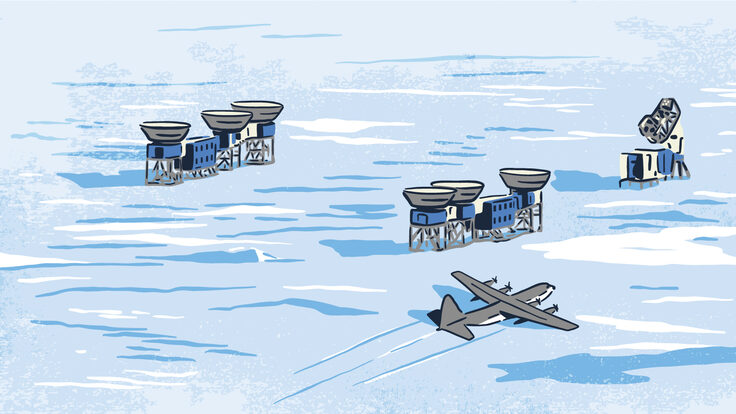
Some might think it strange that data taken from the Radio Ice Cerenkov Experiment, a kilometer-wide neutrino detection system buried in South Pole ice sheets, is analyzed with the help of a cigarette lighter. Others might find it downright bizarre that, after a multi-million dollar renovation of the Fermilab facility where the detectors are being developed, the 65-cent lighter proved the best calibrating device available.

But not RICE experimenters Alice Bean, James Snow, and John Ralston. To these rugged physicists, who conduct experiments, rain or wind, in a leaky test facility on the Illinois prairie, scientific success isn't a matter of expense, but of basic efficacy.

"The lighter's electric ignition generated precisely the EM impulse we needed—just what a particle does at 50 gazillion times the cost," Bean said. "We were going to construct this complicated electric generator system to create the signal, but then John thought of the lighter, and it worked perfectly." Bean and her colleagues are doing research and development on radio frequency detectors at Fermilab to better understand data taken from the RICE experiment. "We've got all this info, but in order to read it properly we have to discern between hadronic and electron reactions. Flicking the lighter next to the detector simulates a passing electron, and so helps us to know what we should be looking for. The lighter is vital to our studies of ultra-high-energy neutrinos."
Jeb Burt

Typing rain
The assembled group of SLAC users hushed as Gabriella Sciolla rose to open the SLAC Users Organization annual meeting. And with that quiet came the rain. Not falling-from-the-sky precipitation but the randomly dispersed patter of laptop keyboards, which had started ten minutes
earlier but had gone unnoticed in the din of conversation.

Nobody seemed much troubled by the noise as it rose and fell in waves, sheets of noise traveling through the auditorium; Jonathan Dorfan's "State of the Lab" presenta- tion enlivened the drizzle like crackles of thunder.

A quick count revealed about three people for each laptop. Although only one of the former was tapping at each of the latter, others cast surreptitious glances over the flickering screens. Watching the watchers showed what caught the most attention. Least interesting, but most common in the room, seemed to be one or other email client relaying empty banter around the world, or perhaps to the other side of the room. More inviting of glances were the rough drafts of presentations to appear later in the meeting. Figures being shifted, enlarged; captions being adjusted; PowerPoint bullets being filled.

Angels & Demons 1
Angels & Demons 2
Reviewed by Mike Perricone
Angels and Demons
Dan Brown
Atria Books, New York, 2004

A religious cult has stolen 250 milligrams of antimatter from a secret laboratory at CERN, intending to use it as a "devastating new weapon of destruction" to demolish the Vatican, in Dan Brown's fictional thriller, Angels and Demons. But the real demons are in the details of antimatter production in Brown's precursor to his mega-best-seller, The Da Vinci Code.

The magnetic "trap" canister used to store the antimatter in Brown's novel is based on the very real Penning traps, which are widely used to store ions, and which have been successfully adapted to antimatter storage at CERN. And annihilating 250 milligrams of antimatter would pack quite a punch. According to David McGinnis, of the Accelerator Division at Fermilab, the explosive power would be the equivalent of about 10 kilotonnes of TNT, or about half that of the atomic bomb dropped on Hiroshima, Japan, in 1945.

Now we encounter some problems—or "reality," as McGinnis, formerly head of Fermilab's Antiproton Source, terms it. (Brown, of course, happily, knowingly and unequivocally describes the story as complete fiction; see the accompanying autograph page.)

Based on the experience at Fermilab, the largest known producer of human-made antiprotons anywhere, McGinnis estimates the power bill alone for producing one-fourth of a gram of antimatter would be on the order of one thousand trillion US dollars. As McGinnis says, "Somebody, somewhere would notice that kind of expense. It's not something that could be kept hidden by one scientist working alone in a secret basement laboratory. Also, it takes an army of people to produce the antimatter for our experiments."

At 0.6 trillion-trillion antiprotons per gram, producing 250 milligrams of antimatter would mean producing about 0.15 trillion-trillion antiprotons or antimatter particles.

"Fermilab can make antiprotons at a rate of 120 billion antiprotons per hour," McGinnis says. "At the end of Collider Run II of the Tevatron, we hope to make antiprotons at a rate of 400 billion antiprotons per hour. Even at this rate, it would take us about 40 million years to make 250 milligrams of antimatter."

Say all these hurdles are overcome; McGinnis spots yet another "fact" that defies credibility.

"The book has a beautiful young Italian woman scientist running around with a middle-aged male professor," he says. "I do not think this is possible."

And yet, as one speaker after another talked of the things most critical to the daily working lives of SLAC users, the screens of most interest to the inquisitive revealed news about the world outside this indoor rainstorm.
David Harris

Fireworks
Photo: CERN

The universe (in fireworks)
In its 50th anniversary year, CERN had the honor of opening the 2004 Geneva Festival (Fêtes de Genève).

The Festival traditionally opens with a bang, but this year's was the biggest yet. On July 30, on a warm summer's evening by Lake Geneva, several tonnes of fireworks replayed the early history of the universe.

Starting with the big bang, the display had acts representing inflation, the breaking of symmetries, the clash of antimatter and matter, hadrons and nucleosynthesis, the first atoms and the universe becoming transparent, and the formation of stars and planets.

It was a challenge to translate these very abstract ideas into more than a thousand kilograms of TNT of different color. But, set to the music of The Matrix, Alan Parsons, and Jurassic Park, one of the most spectacular physics presentations ever staged dazzled the audience of two hundred thousand spectators.

CERN physicist Rolf Landua, who scripted the narrative and worked with the pyrotechnicians on the realization, said: "From the many enthusiastic and emotional comments that I received from spectators, both from CERN and from outside, I got the impression that we have really touched on an important means of communicating science—by creating emotions."
Gary Haslam, CERN

Secret city
Snezhinsk, Russia, kept a secret for 35 years—its own existence. The city, revealed only in 1992, is one of several developed in the 1950s for weapons development and manufacturing in the former Soviet Union. But in recent years, Snezhinsk's Scientific Research Institute for Technical Physics fabricated parts for the CMS detector being built for the Large Hadron Collider at CERN.

"It's hard to get to, but a very beautiful place with great people," says Nural Akchurin, a CMS collaborator from Texas Tech University, who has visited the city several times. "To get there you fly to Ekaterinburg in the Urals and drive for two hours on country roads, and all of a sudden guards and barbed wire appear. Once you're there, you have a minder, a guy who follows you everywhere. You feel like you have gone back 50 years."

Snezhinsk is home to almost 50,000 people, 80 percent of whom work for the Institute or the Russian Federal Nuclear Center. Although only half of the research performed now is weapons-related, Snezhinsk is still a closed city.

"You can't leave and your mother can't visit without permission from Moscow," says Akchurin. "Wives work there, husbands work there, their kids go to school there. They grow up not knowing much of anything outside the city. A few of the young guys came to CERN, and it was a huge culture shock for them."

Katie Yurkewicz

Author growth
The SPIRES databases, run by a collaboration of SLAC, Fermilab and DESY libraries, have a wealth of information about the field of particle physics. Every issue we hope to provide an interesting tidbit of statistical data culled from the databases. Feel free to suggest your own idea for a quick study.

Over the last 40 years, the number of authors on experimental collaboration papers has increased by a factor of 10. In 2004, papers from BaBar and CDF led the way with over 600 authors each. As the LHC comes online at CERN and begins producing papers, we can expect these numbers to increase yet again.
Travis Brooks, SLAC

Blank Game Reviewed by Davide Castelvecchi
Blank
www.blankgame.co.uk
Some scientists like to come up with new brainy games in their spare time, but Angela Ramsey and Andy Briggs have made their passion for games into a business.

The former health physicists (both worked in the British nuclear power industry) have invented a stimulating word game called Blank, and made it commercially available in the United Kingdom and the United States.

Blank can be played by any number of players, including solo. Winners must know plenty of unusual words—and be able to retrieve them from the recesses of their memory with the lightning speed of a Google search.

The idea of Blank is simple: Given three random letters with two blanks in between, find words that fill in both blanks while using at least two of the given letters, in the given order. For instance, with the letters C-R-T one can make the words CaRd, aCcReTion or triCeRaTops, but RoTation is not acceptable.

Allowed words are those in any standard English dictionary, though words that start with a capital letter are out.

Longer words earn more points, especially if they extend to the left of the random letters.

Speed is key: the game comes with a sand timer, and the more words you can think of in the minutes you have, the more points you earn.

Blank comes with an ingenious random generator for assigning letters: A figure-eight rail in which letters printed on plastic chips cycle around like cars on a never-ending highway junction.

Click here to download the pdf version of this article.


© 2005 symmetry  A joint Fermilab/SLAC publication.  PO Box 500 MS206  Batavia, IL 60510  USA