symmetry - Dimensions of Particle Physics
June 2010   View full table of contents

June 2010 Issue
  • The Muon Guys: On the Hunt for New Physics
    Scientists are resurrecting an experiment that died two deaths on two continents over the course of two decades. Called Mu2e, it will look for an event so rare that, according to the Standard Model, people should never be able to build a machine sensitive enough to see it.
  • The LHC Decoded
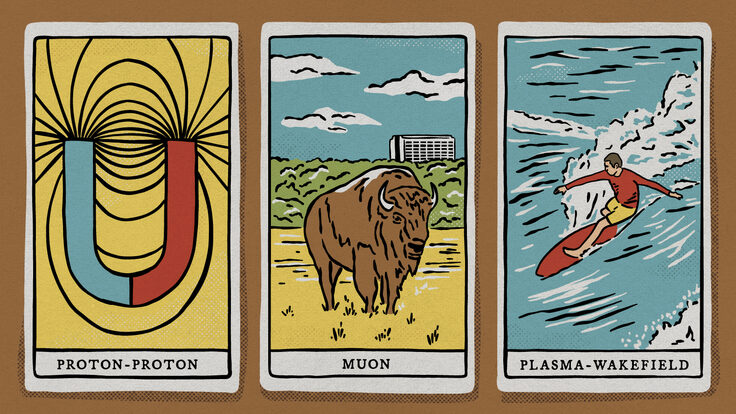
    Walk like a physicist, point by point, through three displays that highlight scientific and technical milestones from the Large Hadron Collider’s first months of operation.
  • Science Road Trip
    In the summer of 1928, the young Ernest O. Lawrence set out across America in a Flying Cloud coupe to begin his new life at the University of California, Berkeley. Eighty-one years later, a writer and a photographer took a road trip to visit the legacy of this accelerator-physics pioneer: American Big Science.

April 2010   View full table of contents

April 2010 Issue
  • Are We There Yet?
    With the Large Hadron Collider up and running, expectations are high: Shouldn’t discoveries start pouring in? These things don’t happen overnight. We trace the long, careful path from intriguing data to official discovery.
  • A Field Where Jobs Go Begging
    With a growing demand for particle accelerators in science, medicine, and industry, accelerator science is in desperate need of skilled specialists.
  • Catalyst
    An original science-fiction story by John Gilbey, inspired by a visit to SLAC National Accelerator Laboratory.

February 2010   View full table of contents

February 2010 Issue
  • DUSEL: Big Plans for Deep Science
    Plans are under way to turn the former Homestake mine in South Dakota into the first US national laboratory for underground science and engineering &nash; the largest and deepest facility of its kind in the world.
  • EXO Takes Clean to an Extreme
    Some particle physics experiments require an extraordinary degree of cleanliness and quiet. How far will they go to achieve this? Try etching tools with acid, setting up shop in a deep salt bed, putting equipment on stilts, and choreographing a 2100-kilometer truck ride so not a moment would be lost.
  • Gran Sasso: A Tale of Physics in the Mountains
    In an epic story of fairy-tale beauty and world-leading science, human courage and determination confront adversity and Gran Sasso laboratory comes forth to see the stars once more.

December 2009   View full table of contents

December 2009 Issue
  • Fermi’s Excellent Adventure
    Since its launch in June 2008, the Fermi Gamma-ray Space Telescope has shed light on some of the brightest, most explosive events in the universe and opened tantalizing windows into dark matter and the nature of space-time.
  • Preserving the Data Harvest
    Canning, pickling, drying, freezing— physicists wish there were an easy way to preserve their hard-won data so future generations of scientists, armed with more powerful tools, can put it to good use. They’ve launched an international search for solutions.
  • Recycle, Reuse, Re-accelerate
    Chugging along in the background, old physics machines are the workhorses behind many cutting-edge projects, from the world’s most powerful X-ray laser to the Large Hadron Collider and a lab that tests microchips bound for Mars.

October 2009   View full table of contents

October 2009 Issue
  • Grad Students Follow the Data
    Worried about getting the experimental data they need to finish their PhDs, about two dozen graduate students have left the long-delayed Large Hadron Collider for experiments at the Fermilab Tevatron. Most say they won’t be gone for long.
  • Cleaner Living Through Electrons
    Studies show that blasts of electrons from a particle accelerator are an effective way to clean up dirty water, nasty sewage sludge, and polluted gases from smokestacks. Now researchers need to make the technology more compact and reliable.
  • Crashing the Size Barrier
    Like surfers on a monster wave, electrons can ride waves of plasma to very high energies in a very short distance. Scientists have proven that plasma acceleration works. Now they’re developing it as a way to dramatically shrink the size and cost of particle accelerators for science, medicine, industry, and myriad other uses.

August 2009   View full table of contents

August 2009 Issue
  • Superconducting Technology, Chicago Style
    Fermilab is cooking up a hot technology—and the serving is ultracold. The laboratory is stepping up efforts to develop and test superconducting radio-frequency cavities, a key technology for the next generation of particle accelerators and the future of particle physics.
  • Not a Moment to Lose at the LHC
    Physicists from the Large Hadron Collider’s experiments turn an unexpected shutdown to their advantage.
  • Dancing With Physicists
    For her latest work, choreographer Liz Lerman took members of her dance troupe to CERN, where they reveled in the fog, danced in the aisles and found inspiration in wide-ranging conversations with scientists.

July 2009   View full table of contents

July 2009 Issue
  • Growing a Diverse Workforce
    When it comes to training, hiring, and retaining women and members of ethnic minorities, particle physics lags far behind other fields of science. Staffers at three national labs—Fermilab, SLAC, and Brookhaven—are tackling the problem at every level.
  • Dark Energy Camera Scans Ancient Skies
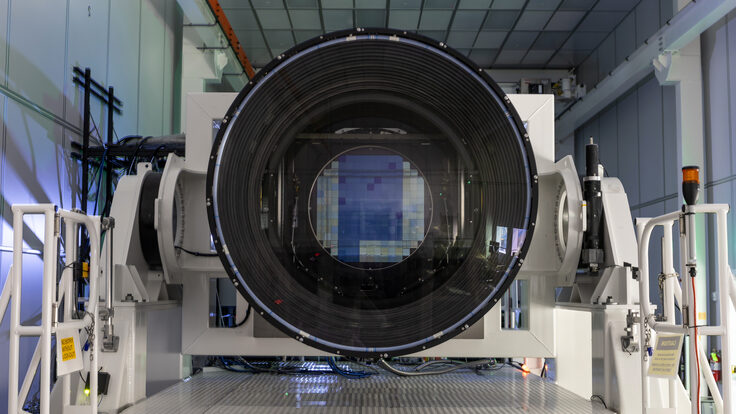
    Gazing into space, scientists wonder why the universe is expanding ever faster. What mysterious force is at work? By recording the light from hundreds of millions of galaxies from a mountaintop in Chile, they hope to find out what’s going on.
  • Helium’s Shrinking Bubble
    Helium is the lifeblood of large particle accelerators. As the world’s supply dwindles, the particle physics community must take steps to preserve this precious commodity or learn to live without it.

May 2009   View full table of contents

May 2009 Issue
  • A New Leader for CERN
    In his first few months on the job, CERN Director-General Rolf-Dieter Heuer opens new lines of communication, oversees repairs to the Large Hadron Collider, and promotes a worldwide strategy for particle physics based on a strong mix of global, regional, and national projects.
  • Chasing Charm in China
    American scientists are flocking to the Beijing Electron Positron Collider, whose recent upgrades make it the premier place to study charm quarks and their kin.
  • Credit Where Credit is Due
    In the swirling sea of thousands of people who contribute to a major particle physics experiment, how can a young physicist pop to the surface and get noticed? An international committee offers ideas.

March 2009   View full table of contents

March 2009 Issue
  • Result of the Week
    Behind every big breakthrough is a series of small steps that build on each other to enhance our understanding of the universe. At Fermilab’s Tevatron collider, physicists have been telling the unfolding story of their experiments in weekly installments for more than five years.
  • Probing the Heart of the Atom
    The familiar elements of the Periodic Table come in a number of forms, or isotopes, some found only fleetingly in the most violent events, such as exploding stars. By creating those rare isotopes in the lab, physicists are learning how the atomic nucleus works and deciphering the natural history of the elements.
  • Cosmic Weather Gauges
    Particle physics joins forces with other fields to look at two important factors shaping weather: temperatures high in the atmosphere and the dampness of the dirt beneath our feet.

December 2008   View full table of contents

December 2008 Issue
  • symmetrybreaking
    A summary of recent stories, published weekdays, in symmetrybreaking, www.symmetrymagazine.org/breaking/
  • Particle physics benefits: Adding it Up
    Stories abound about how particle physics benefits education, the economy, and society as a whole. Quantifying those benefits would help particle physics better demonstrate its value to the country.
  • A Fearlessly Creative Workforce
    Many of the people trained in particle physics move on to industry, where their skills are in high demand. There you can find a theorist exploring for oil or an accelerator scientist working on cancer treatments.
  • The Power of Proton Therapy
    When it comes to getting rid of cancer, the sharpest scalpel may be a proton beam. Technology conceived and hatched in high-energy physics is now treating thousands of patients per year, with fewer side effects.

November 2008   View full table of contents

November 2008 Issue
  • BaBar and the Very Tiny Particle
    In which the 500 members of the BaBar experiment buy enough time for one last adventure: capturing the bottom-most bottomonium.
  • The Dark Universe Debate
    Who will be the first to prove the existence of dark matter and dark energy? A particle physicist and an astrophysicist go head to head.
  • Where Old Physics Stuff Goes to Live
    The Fermilab boneyard is no burial ground; it’s a place where unwanted parts find new homes and lives. They’re matched with scientists who can put them to good use, donated to local schools and parks, or sold for recycling.

September 2008   View full table of contents

September 2008 Issue
  • Life at the LHC Reaches Fever Pitch
    As the big collider ramps up, four physicists talk about working late, finding time to play, and staying connected to family and friends.
  • Mapping the Digital Divide
    Physicist Les Cottrell is the meteorologist of Internet weather. His project tests the strength of Internet connections around the world—and finds Africa lagging farther and farther behind.
  • JLab's New Director
    For Hugh Montgomery, the leap from particle physics to nuclear physics is shorter than you might think.
  • Gallery: David Kirkby
    It’s a snail shell! It's a Koosh ball! It’s physics! A physicist-photographer finds cosmic meaning in everyday things.

August 2008   View full table of contents

August 2008 Issue
  • New Tools Forge New Frontiers
    US particle physics is pushing forward on three frontiers. Each has a unique approach to making discoveries, and only by pursuing all three can scientists address key questions about the laws of nature and the cosmos.
  • Bonnie and the ArgoNeuTs
    Inspired by heroes of Greek mythology, physicists are on a quest to find a cheaper, more efficient way to capture neutrinos—one of the strangest and most fascinating particles in the universe. Liquid-argon detectors may hold the key to discovering whether neutrinos are the reason that stars, planets, and people exist.
  • A Bumper Crop of Physics Plates
    In our October/November issue, we asked readers to share stories and photographs of physics-related license plates. Here are the responses.

March/April 2008   View full table of contents

March/April 2008 Issue
  • From Atom Smashers to X-ray Movies
    When particle accelerators gave birth to the powerful X-ray microscopes known as synchrotrons, they revolutionized the study of virtually every field of science. Now the Linac Coherent Light Source promises to make an equally big leap, making movies of atoms and molecules in action and changing the way we think about matter.
  • Secrets of the Pyramids
    In a boon for archaeology, particle physicists plan to probe ancient structures for tombs and other hidden chambers. The key to the technology is the muon, a cousin of the electron that rains harmlessly from the sky.
  • Outsider Science
    Amateur scientists make important contributions in a number of fields, from astronomy to ornithology. But very few have the background needed to succeed in high-energy physics.
  • Gallery: Miro Dance Theater
    The dancers race around the circle, faster, faster. Wham! They collide, spinning off in various directions. Far from accidental, the choreographed collisions tell the story of science at Fermilab.

January/February 2008   View full table of contents

January/February 2008 Issue
  • Short Cuts for Newcomers at the LHC
    It can take weeks to get into the groove of analyzing data from an unfamiliar detector. A new starter kit cuts that time to hours.
  • From Eye to Sight
    A particle physics technology is revolutionizing the study of how we see.
  • Physicists Rock!
    Wherever physics goes, music follows, from the lyrical strains of flute and violin to Blue Wine, Les Horribles Cernettes and Drug Sniffing Dogs.

December 2007   View full table of contents

December 2007 Issue
  • Across the Ocean, Yet Close to Home
    Among the 10,000 people working on the Large Hadron Collider, 1000 hail from universities and national labs in the United States.
  • Entering Higgs Habitat
    The LHC will allow scientists to explore the territory where the long-sought Higgs particle—or maybe even a whole family of them—resides.
  • Protecting the LHC From Itself
    While human safety is always the first concern at the Large Hadron Collider, the machine also needs shielding from its own proton beams, which pack the energy of high-speed trains.
  • Gallery: In the Labyrinth
    It’s heavy, dusty, dirty work: Deep in the bowels of the LHC detectors, workers are connecting a rat’s nest of cables.

October/November 2007   View full table of contents

October/November 2007 Issue
  • Free for All
    Forget about paying for journal subscriptions. If a new proposal takes hold, particle physics journals would get their funding from labs, libraries, and agencies that sponsor research, and readers could peruse them for free.
  • On the Trail of Cosmic Bullets
    Do the most energetic particles in the universe come from super-massive black holes? New results from the Pierre Auger Observatory make that case.
  • The Wrong Stuff
    When bad physics pops up in a movie or TV show, scientists try to set things right.

September 2007   View full table of contents

September 2007 Issue
  • Fermilab’s Path to the Future
    A new report gives top priority to developing the International Linear Collider, while laying out a plan for science that could be done along the way.
  • The End of the HERA Era
    Celebration, anticipation, and a little wistful reflection: The final shift of the HERA accelerator brought more than 1000 people to Hamburg for a last hurrah.
  • The Art of the Unseen
    As technology evolves, posters are easier to produce and pass around. But it still takes skill and imagination to illustrate the most abstract ideas of physics.
  • Gallery: Amy Lee Segami
    With an ancient art that involves floating inks on water, an engineer captures the intricate swirls of nature.

August 2007   View full table of contents

August 2007 Issue
  • The Particle Physics Life List
    symmetry presents a list of not-to-be-missed experiences for fans of particle physics—from the first cyclotron to wild turkeys, Galileo’s lens, and the world’s biggest detectors.
  • Donors Dream Big
    Drawn by the chance to help answer the most fundamental questions about the universe, philanthropists are starting to make significant investments in physics research.
  • A Lab Away From Home
    One of the most effective ways for physicists to learn new skills is to spend extended times visiting other labs. During those trips, they learn a lot more than just science.

June/July 2007   View full table of contents

June/July 2007 Issue
  • Secrets of a Heavyweight
    A dozen years after it first appeared on the world stage, the top quark is still one of the hottest topics in particle physics.
  • Talk and Chalk
    Swimming against a cultural tide, physicists–especially theorists–cling to their blackboards.
  • Industry Eyes the Next Big Collider
    Technology developed for the International Linear Collider could help make nuclear waste safer, cargo inspection easier, and drug design more effective.
  • Gallery: Roshan Houshmand
    Tracks left by particles in bubble chambers–spirals, curves, and lines–are the basis for Houshmand’s Event Paintings.

May 2007   View full table of contents

May 2007 Issue
  • The Search for Dark Energy
    What is this stuff that fills the vacuum of space, accelerates the expansion of the universe, and accounts for 70 percent of everything? More than two dozen experiments aim to find out.
  • The Great String Debate
    When Brian Greene and Lawrence Krauss tangle over string theory, wisecracks fly.
  • When the New Neighbor’s a Giant
    At one potential site for the International Linear Collider, people in the community are getting to know the project years in advance.
  • Essay: Launched into Science
    "Reading about science was not quite enough. I needed to get up close and personal with the scientists and their heroic experiments." –Pierre R. Schwob

April 2007   View full table of contents

April 2007 Issue
  • Masters of Improv
    Like the TV detective Angus MacGyver, physicists make do with materials as ordinary as Coke cans and aspirin
  • A Quest for Balance in Canada
    Canadian subatomic physics needs a shot of new money to take full advantage of new facilities and an influx of brainpower, a report says.
  • Small Cogs Drive a Big Machine
    University scientists are the backbone of particle physics. At Vanderbilt, they’re developing ways to handle massive amounts of data from the Large Hadron Collider.
  • No-show Neutrino
    The first results from the MiniBooNE neutrino experiment show no hints of a fourth neutrino, but contain a puzzling signal that could lead to new physics.

March 2007   View full table of contents

March 2007 Issue
  • Toward an International Linear Collider
    The International Committee for Future Accelerators (ICFA) announced the release of the Reference Design Report for the ILC in Beijing in February.
  • Universal Accord
    The "concordance model" is a cosmic recipe that unifies all astronomical observations to date, and though researchers do not yet understand what the ingredients are really made of, they know it tastes right.
  • Working Outside the Accelerator
    A PhD in particle physics can be a stepping stone to a career outside physics research.
  • Deconstruction: KATRIN
    Part of the KATRIN neutrino experiment made a European odyssey of 9000 km even though it started and ended its trip in Germany.

January/February 2007   View full table of contents

January/February 2007 Issue
  • BaBar’s Window on the Weak Force
    The BaBar B-factory experiment at Stanford Linear Accelerator Center looks to double its data in a mere two years as it hunts for hints of spectacular new physics that will guide future experiments.
  • Evolution of a Collider
    As physicists and engineers devise ways to make the International Linear Collider perform better at a lower cost, the design evolves, sometimes with tweaks, but other times with major reconfigurations.
  • And They Lived in Physics Bliss Forever After...
    When physicists marry physicists, the beginning may be a "big bang," but issues of life, love, and family gravitate toward the universal.
  • Day in the Life: Stanford Guest House
    Guest houses are common among particle physics labs. But in many ways, the Stanford Guest House, situated on the grounds of Stanford Linear Accelerator Center, is different.

December 2006   View full table of contents

December 2006 Issue
  • The Tevatron Brings It On
    As Fermilab's Tevatron produces more particle collisions than ever before, experimenters are making discoveries, from exotic particles to ultrafast matter-antimatter oscillations. Will they also find the Higgs particle?
  • Listening for Whispers of Dark Matter
    The Cryogenic Dark Matter Search is seeking the first definite observation of a dark matter particle. Detecting the particle involves listening for a tiny vibration among a background of noise.
  • The Many Lives of Fermi's Magnet
    The Chicago Cyclotron Magnet, known as Enrico Fermi's magnet, has just been retired from Fermilab after a rich 35-year history. Through its various reincarnations, Fermi's magnet has been a key part of many experiments.
  • Day in the Life: LCLS Ground Breaking
    SLAC's Linac Coherent Light Source will be the world's first hard-X-ray laser. On October 20, local luminaries joined the SLAC staff to celebrate the ground breaking for the landmark project.

October/November 2006   View full table of contents

October/November 2006 Issue
  • Close Quarters
    During their visits at other labs, physicists learn that it's a small world after all, especially when they stay in no-frills dorms. The lab life helps build professional networks and long-lasting friendships across the planet.
  • Catching neutrinos in China
    The first particle physics experiment with leadership almost equally split between China and the United States would be located deep beneath the mountains of Southern China, looking for neutrino interactions.
  • The European Strategy for Particle Physics
    The CERN Council Strategy Group has presented its recommendations in particle physics, focusing on a policy for Europe to "maintain and strengthen its central position" in the field.
  • Deconstruction: ILC Cryogenics
    The proposed International Linear Collider will use 16,000 superconducting cavities made of niobium, and scientists around the world are working on the cryogenic system needed to keep the cavities cool.

September 2006   View full table of contents

September 2006 Issue
  • New Life for a Linac - How the Stanford Linear Accelerator Center is transforming the world's longest linear accelerator into a novel X-ray laser.
  • The Rise and Fall of the Pentaquark - The pentaquark search serves as a model for the ways in which particle physics explores the nature of matter—even when the search is unsuccessful.
  • Packing It In - Globe-traveling physicists put some of their best thinking into strategies for their bags—all carry-ons, of course.
  • Deconstruction: Particle Pocket Card - In the early 1950s, Nobel-Laureates-to-be Norman Ramsey and Ed Purcell created cards of physical constants they found themselves using most frequently.

August 2006   View full table of contents

August 2006 Issue
  • Introducing the Large Hadron Collider - Physicists are excited by the LHC, with access to physics at an energy scale about ten times higher than has been open to exploration so far.
  • Into a New World of Physics and Symmetry - CERN theorist John Ellis charts the LHC’s voyage to a New World of discovery, exploring physics at the TeV scale with the capacity to create new forms of matter.
  • Extracting Physics from the LHC - LHC experiments will involve physicists by the thousands, working with the most complex and sophisticated particle detectors ever built.
  • The United States and the LHC - The US government has contributed more than a half billion dollars to the construction of the LHC particle collider and two related experiments in Europe.
  • The United States and the LHC - LHC Meets Industry Building the parts for the Large Hadron Collider has presented many challenges but taught many lessons for both particle physics laboratories and their industry partners.

June/July 2006   View full table of contents

June/July 2006 Issue
  • A Report Like No Other - Can the unique EPP2010 panel steer US particle physics away from a looming crisis? Physicists and policy makers are depending on it.
  • SNS: Neutrons for 'molecular movies' - A new research facility at Oak Ridge National Laboratory has produced its first neutrons, presenting new opportunities for studying materials from semiconductors to human enzymes.
  • Battling the Clouds - Electron clouds could reduce the brightness—and discovery potential—of the proposed International Linear Collider. Innovative solutions are on the way and might reduce the cost of the machine, too.
  • A (Magnus) Force on the Mound - Professional baseball player Jeff Francis of the Colorado Rockies brings a strong arm and a physics background to the playing field: "I bet Einstein couldn't throw a curveball."

May 2006   View full table of contents

May 2006 Issue
  • Asian Committee for Future Accelerators - In 2020, Asia may have the largest GDP among the three regions working on the International Linear Collider. "I believe that the time is ripe for us to realize the truly global ILC," says ACFA chair Shin-ichi Kurokawa.
  • KEK’s ambitious future - Japan’s high-energy physics laboratory KEK is undergoing a transition as it expands its science program with upgraded and new facilities.
  • India’s Drive for Science - Particle accelerator research is a key element in India’s vision of nation-building, from providing health benefits to achieving energy independence. Low labor costs help in building projects of international acclaim.
  • The Rise of HEP in Korea - In a country recognized for the production of cars and electronic goods, physicists are making plans to add their efforts in high-energy physics to the country’s future list of accomplishments.
  • Bringing Science to Vietnam - You can’t start a high-energy physics program in a remote third-world country overnight. But you might be able to do it in fifteen years.

April 2006   View full table of contents

April 2006 Issue
  • Voices: Diploma Mills - Criminals offering fake degrees from non-existing institutions are a threat at many levels. They also destroy the credibility of higher education systems.
  • 24/7: Labs That Never Sleep - When people and machines run 24 hours a day, seven days a week, a lot of the mundane is needed to produce the marvelous.
  • ILC Industrialization: Getting Down to Business - Laboratories and institutions alone cannot manufacture the many components of the ILC, requiring a major role for industry.
  • HEPAP Redux - The new members of the High Energy Physics Advisory Panel heard from leading government policy-makers, to whom they provide expert advice.
  • Hunting the Origin of Alzheimer’s - Originally a particle physicist, Christian Habeck now conducts neuroimaging and analysis research that could help change the future for Alzheimer’s victims.

March 2006   View full table of contents

March 2006 Issue

February 2006   View full table of contents

February 2006 Issue

December 2005/January 2006   View full table of contents

December 2005/January 2006 Issue
  • NOνA: A Neutrino Appearance Experiment - What happened to the universe's antimatter? The NOνA experiment hopes to find out if neutrinos played a role.
  • Eco-Science - Many of the world's leading physics labs have preserved and restored their sites' unique ecosystems.
  • The Search for Extra Dimensions - Theorists think that the fabric of space-time might consist of many more dimensions than meets the eye.
  • Graduate School Gourmet - With little money or spare time, these physicists found unique ways to make it through graduate school.

November 2005   View full table of contents

November 2005 Issue
  • Meet the Grid - Grid computing is a new way to share resources and computing power across the Internet that will be vital to future scientific collaboration.
  • Sciences on the Grid - Physicists and biologists were some of the first to use grid computing, but other scientists are kick-starting their own efforts.
  • GEANT4—The Physics Simulation Toolkit - The software package GEANT4 is an ongoing worldwide collaboration to simulate and design science instruments.
  • Computing the Quarks - To make predictions and perform calculations involving the strong force, physicists are building custom supercomputers.

October 2005   View full table of contents

October 2005 Issue
  • Snowmass 2005 - Nearly 700 physicists from around the world met in Snowmass, Colorado, to advance plans to create an International Linear Collider.
  • Asymmetric Insight - An experiment with polarized electrons probed the strength and asymmetry of the weak force over multiple energy scales.
  • More of the Universe - With a three-year extension, the Sloan Digital Sky Survey will expand its investigations to include dark matter and dark energy.
  • War & Peace - A community activist contrasts confrontational Superconducting Super Collider days with the new Fermilab public participation effort.

September 2005   View full table of contents

September 2005 Issue
  • Super-fast Super-sensitive Detectors - Experimenters around the world are studying various design options for a detector at the proposed International Linear Collider.
  • The Secret Lives of Stars - To reveal details of the births and deaths of stars, cosmologists watch their lives through computer simulations.
  • Niobium - More than 500 tons of niobium would go into building ILC acceleration structures. What's so special about this material?
  • Science: A Richer Experience of Life - Michael Salamon brings an outward vision to the White House Office of Science and Technology Policy.

August 2005   View full table of contents

August 2005 Issue
  • Global ILC Efforts - Physicists and accelerator experts from around the world are collaborating on the design of the International Linear Collider.
  • In Their Hands: The Future of Particle Physics - The members of the EPP2010 panel have realized that the field of particle physics is at an important strategic moment.
  • CLIC: The Compact Linear Collider - A small international collaboration of scientists works on the design of CLIC, a higher-energy linear collider concept.
  • Postcards from the Terascale - By discovering the laws of nature at Terascale energies, we can understand the physical laws that define our chilled-down universe.

June/July 2005   View full table of contents

June/July 2005 Issue
  • Spectrum of Discovery - The future of SLAC's research encompasses scales from the subatomic through the biological and material to the cosmological.
  • City-States of Science - The teams behind the Large Hadron Collider's experiments are of unprecented size. Life in the new collaborations will surely be different.
  • Two Tribes Become One - A physicist who has devoted his career to developing linear colliders confronts changes in the global physics community.
  • No Little Plans - Pier Oddone outlines Fermilab's future by invoking architect Daniel Burnham: "Make no little plans; they have no magic to stir men's blood."

May 2005   View full table of contents

May 2005 Issue
  • The Elusive Neutrino - Experiments are beginning to unravel the secrets behind a mind-boggling quantum effect: neutrino oscillations.
  • Searching for the Neutrino's Identity - Neutrinos are different from other matter particles. Could they even be their own antiparticles?
  • Virtual Structure - You don't have to relocate to join Barry Barish and his global team that will manage the design of the International Linear Collider.
  • Springtime at Daresbury - A laboratory in the north-west of England transformed itself into a powerhouse of accelerator physics and technology.

April 2005   View full table of contents

February 2005 Issue
  • Benvenuto - INFN Frascati offers opportunities for scientists from many disciplines, says its new director Mario Calvetti.
  • Riding the Plasma Wave of the Future - A creative group of scientists is reinventing particle acceleration as we know it.
  • The New High-Energy Frontier - US scientists have built critical components for the LHC, and they will play a key role in future discoveries.
  • Neutrons for Cancer Treatment - Physician Aidnag Diaz and his team have set out to save lives and to explore the future of neutron therapy.

March 2005   View full table of contents

March 2005 Issue
  • Science from a Hole in the Ground - US scientists from fields as diverse as microbiology and particle physics are proposing to go underground to answer new questions.
  • X-ray Blaze on an Invisible World - With laser-precise x-ray vision, the Linac Coherent Light Source will be an unprecedented tool to see how ultra-fast, ultra-small things work.
  • What's in a Name? - Names are important but physicists have done a mixed job in naming their creations and discoveries.
  • Visions of Particle Physics - Award-winning photographer Peter Ginter has developed one of the most extensive portfolios of particle physics photography in the world.

February 2005   View full table of contents

February 2005 Issue
  • Opportunities, Decisions Await Oddone - "We are living in a time of remarkable opportunity for particle physics," says incoming Fermilab director Pier Oddone.
  • Let It Rain - The most energetic particles in the universe have a message for us. The Pierre Auger Observatory is listening.
  • Einstein Iconography - Albert Einstein is a cultural icon. His image adorns coffee mugs, action figures and many other novelty items.
  • Beyond the Standard Model - What is wrong with the Standard Model of particles and interactions? Why are physicists so sure that there is something beyond it?

December 2004/January 2005   View full table of contents

December 2004/January 2005 Issue
  • Sold on Cold - Why have particle physicists lowered the temperature on a new accelerator? How cold will the International Linear Collider be?
  • The Growth of Inflation - For 25 years cosmologists have struggled to adapt one of the greatest inventions: inflation. Is a final solution near?
  • SESAME: An Oasis of Peace in the Middle East? - With help from Europe and the US, scientists in Jordan are building a lab for collaboration among neighboring countries.

October/November 2004   View full table of contents

October/November 2004 Issue
  • The Road to Beijing - How an international panel reached a technology recommendation for the proposed International Linear Collider.
  • Extreme Neutrinos - Searching for the secrets of the universe in the depths of the earth—on the sea bottom and in the Antarctic ice.
  • Families of the World - How families of scientists cope with the distinctive demands of an increasingly international field.