breaking
February 2013
-
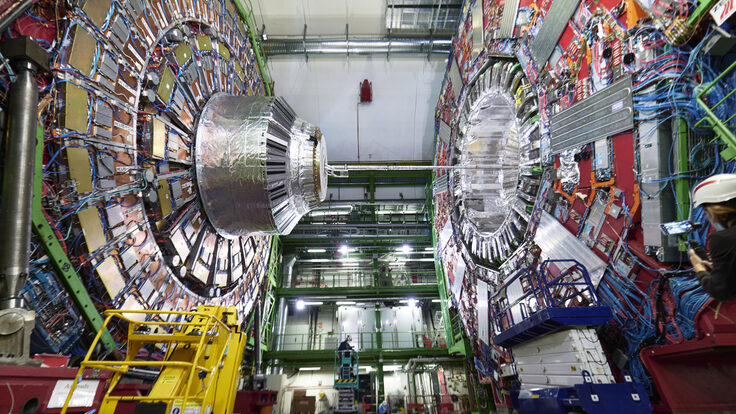
February 13, 2013breaking: Achievement unlocked: 100 petabytes of dataExperiments at the Large Hadron Collider reached a milestone in data collection just before the accelerator’s last collisions for the next two years.
-
February 11, 2013breaking: RHIC readies for run 13Cool-down begins in preparation for the Relativistic Heavy Ion Collider’s next run.
-
February 3, 2013breaking: Drell and Gates receive National MedalTwo scientists whose work has made a lasting impact on particle physics received the National Medal of Science at a White House ceremony.
-
February 1, 2013breaking: Energy Secretary Steven Chu to step downSteven Chu has announced his decision not to serve a second term as US Secretary of Energy.
-
February 1, 2013breaking: Priorities in particle physicsA first draft of the European Strategy for Particle Physics places emphasis on research at the Large Hadron Collider.
January 2013
-
January 29, 2013breaking: BaBar searches for new physics in invisible decaysOn the hunt for physics beyond the Standard Model, scientists recently searched BaBar data for evidence of invisible particles.
-
January 25, 2013breaking: We are all made of star stuff, thanks to the WPhysicists announced 30 years ago the discovery of the W boson, a particle that remains an important topic of research.
-
January 23, 2013breaking: Say hello to CERNScientists, engineers and other personalities from Europe’s largest physics lab begin a new series of “Hangout with CERN” video chats.
-
January 21, 2013breaking: A bullet through an applePhysicists have begun the first full run of proton-lead collisions in the Large Hadron Collider to learn more about the beginning of our universe.
-
January 10, 2013breaking: Midwest muon experiments carry on East Coast legacyAs researchers across the United States—and around the world—plan two new supersymmetry-hunting experiments to be located at Fermilab, symmetry writer Joseph Piergrossi sat down with collaborators from Boston University to learn more about the projects’ goals and history.
-
January 3, 2013breaking: The gift of beam: Neutron therapy restarts at FermilabWith a new power source operating at Fermilab's accelerator complex, the laboratory reopened its cancer treatment facility over the holidays.
December 2012
-
December 19, 2012breaking: US-CERN partnership to accelerate neutrino researchUS institutions are working with the SHINE experiment at CERN to better understand the particle interactions that produce neutrinos.
-
December 13, 2012breaking: Ironing out an astrophysics problemUsing an X-ray laser, scientists unravel the longstanding conundrum of why extreme plasmas in space look different than expected.
-
December 12, 2012breaking: DOE grants CD-1 approval to LBNE projectThe Long-Baseline Neutrino Experiment took another step forward, receiving approval from the US Department of Energy for the first phase of the project.
-
December 11, 2012breaking: Fundamental Physics Prize recognizes Higgs huntersThe Fundamental Physics Prize Foundation will honor leaders at the Large Hadron Collider and its CMS and ATLAS experiments with a special $3 million prize.
-
December 6, 2012breaking: Budget woes force rethink of proposed flagship physics experiment in ItalyThe Italian government has withdrawn funding for a high-profile proposed experiment. Scientists are now brainstorming other ways to advance particle physics.
-
December 5, 2012breaking: Scientists propose new projects to unravel dark energy secretsScientists have risen to the challenge to design an experiment that will make measurements of millions of galaxies to probe dark energy in new ways.
-
December 3, 2012breaking: Crystals show promise as particle pilots in LHCScientists are exploring using tiny crystals to remove rogue particles from the world's most powerful collider.
November 2012
-
November 27, 2012breaking: Stellar black widows entrap companion starsOf the hundreds of objects in the universe emitting gamma rays, two look to be "black widows," ancient stars extending their lives by sucking in material from companion stars. Stanford physicist Roger Romani is hot on the trail of these extreme stars.
-
November 19, 2012breaking: Arrow of time prefers to point forwardTo a single, isolated particle, time’s arrow could work just as well pointing forward as backward. But it doesn’t, says the BaBar collaboration.
Pages
Welcome to the new symmetry! We've recently combined the magazine with our symmetry breaking blog; now you can find all articles—including feature stories, “explain it in 60 seconds” articles and blog posts—in one location. Below you will find all symmetry breaking blog posts, past and present. Do you like what you see? Have suggestions? Please let us know.