This story first appeared in Fermilab Today on June 10, 2011.
Two months ago, CDF scientists reported an unexpected excess of proton-antiproton collisions that produce a W boson accompanied by two jets of particles. One possible explanation for the excess could be the existence of a new, unanticipated particle. Now the DZero collaboration has finished an independent analysis that tests the CDF result. Following the analysis procedure employed by CDF as closely as possible, DZero scientists did not find the same excess in the data. The collaboration will report their result and the details of their analysis at 4 p.m. today at a seminar at Fermilab.
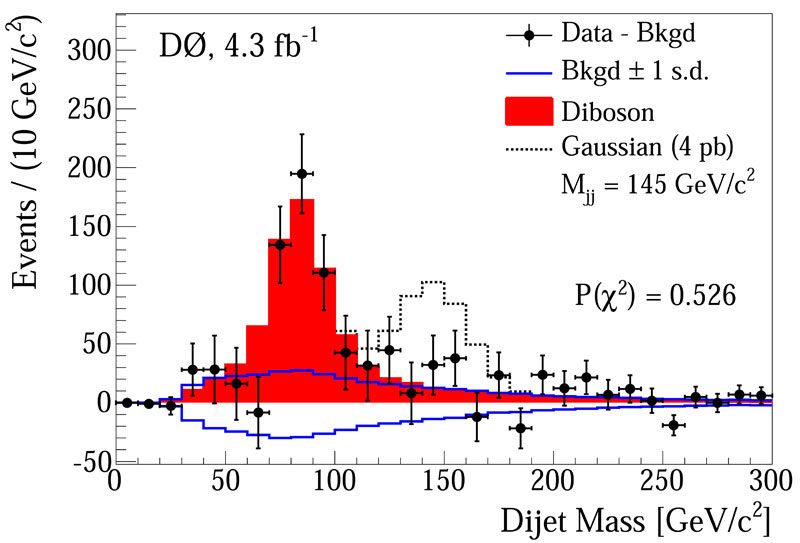
The DZero collaboration found its data for the production of a W boson and two jets to be in agreement with the predictions by the Standard Model. The red peak below 100 GeV/c2 is a well-known Standard Model feature of the decays of W and Z bosons. If the CDF excess is interpreted as a new particle, the dotted line shows what such a particle would look like in the DZero detector. The DZero data shows no excess around 145 GeV/c2.
“Our data for collisions that produce a W boson plus two jets are in agreement with the predictions from the Standard Model,” says DZero co-spokesperson Dmitri Denisov. “We have looked among two hundred trillion particle collisions, and we don’t see the excess reported by CDF.”
Over the last 10 years, CDF and DZero have published more than 500 measurements of particle physics processes using two different particle detectors and independent analysis tools. The results agree more than 99 percent of the time, but there are rare occasions that the findings differ.
“This is exactly how science works,” says DZero co-spokesperson Stefan Soldner-Rembold. “Independent verification of any new observation is the key principle of scientific research. At the Tevatron, we have two experiments that, by design, can check each other.”
Now that the independent analyses have been completed, the difference between the two experiments’ results must be understood and resolved. Fermilab Director Pier Oddone and the CDF and DZero collaborations have agreed to create a task force that will coordinate a study of the two experiments’ analyses. The task force will consist of members from both experiments and Fermilab theorists Estia Eichten and Keith Ellis.
Today’s seminar will take place at 4 p.m. in the auditorium and will also be webcast.
The DZero paper has been submitted to Physical Review Letters, and a copy is available at the collaboration’s website. The CDF paper is available at their website.
-- Kurt Riesselmann and Katie Yurkewicz