First particles collide in the Large Hadron Collider

November 23, 2009 | 2:39 pm

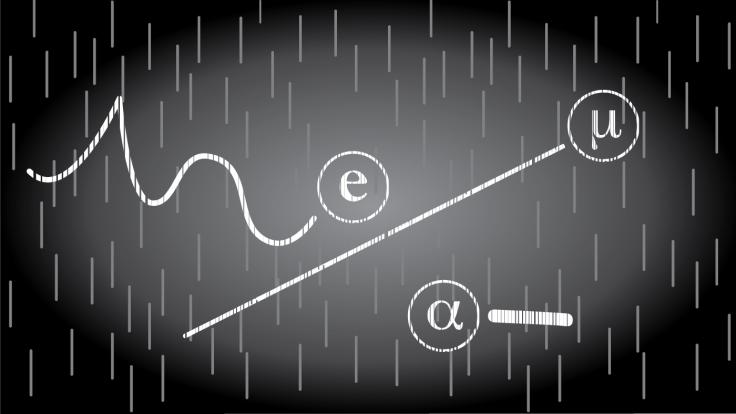
Candidate collision event in the CMS detector.

Candidate collision event in the CMS detector. Image copyright CERN.

The first protons collided in the Large Hadron Collider today at CERN outside Geneva, Switzerland. The four largest detectors at the LHC all recorded candidate collision events. Scientists at CERN, throughout the United States, and around the world celebrated the news.

“This is a very exciting moment after so many years of preparation,” said Andrew Lankford from the University of California, Irvine, deputy spokesperson for the ATLAS experiment. Beams were first tuned to produce collisions in the ATLAS detector, which recorded its first candidate for collisions at 2:22 p.m. local time. “The real accomplishment belongs to the accelerator scientists for bringing the beams into collision so quickly after they were first circulated,” he added.

These first collisions are another milestone on the way to the ultimate goal: high-energy collisions of protons in the center of the LHC experiments. They follow a weekend of rapid progress for the LHC. After more than one year of repairs, on Friday evening, November 20, beams were once again circulating in the collider. Over the weekend, the LHC team carefully studied the beams one at a time. Today at approximately 1:30 local time, two beams circulated at the same time for the first time in the LHC. As the two circulating beams passed through each other, protons from each beam hit one another, and the resulting spray of particles registered in the ALICE, ATLAS, CMS, and LHCb detectors.

Celebrations on Friday, November 20, when the first beams of 2009 successfully circulated in the LHC.

Celebrations on Friday, November 20, when the first beams of 2009 successfully circulated in the LHC. Image copyright CERN.

“It’s a great achievement to have come this far in so short a time,” said CERN Director General Rolf Heuer in a statement issued by the laboratory. “But we need to keep a sense of perspective – there’s still much to do before we can start the LHC physics programme.”

These particular collisions happened against the odds.  When the LHC is fully operational, each beam will consist of almost 3000 bunches of more than one hundred billion protons each. Despite the enormous number of protons, each bunch will still contain mostly empty space, and operators will “squeeze” them to increase the chances of two protons colliding. Today, during the testing phase of the accelerator, each beam only contained one bunch of several billion protons, and the beams were not squeezed. Thus the chance of two protons colliding as the bunches passed through each other was very small, and resulted in relatively few recorded collisions in each experiment.

“This is another great technical achievement for the LHC accelerator team and allows the collaborations on the LHC experiments to make further progress in preparing for first high-energy collision data,” said Bob Cousins from the University of California, Los  Angeles, deputy spokesperson for the CMS experiment. “We are getting a chance to test drive our detectors with real collision data.”

More than 1700 scientists, engineers, students, and technicians from 97 US universities and national laboratories have helped design and build the LHC accelerator and its four massive particle detectors, known by their acronyms: ALICE, ATLAS, CMS and LHCb. They are joined by an estimated 8500 colleagues from 59 countries around the world. US participation from institutions in 32 states and Puerto Rico is supported by the Department of Energy’s Office of Science and the National Science Foundation.

“Everyone’s very excited,” said Tom LeCompte from the Department of Energy’s Argonne National Laboratory, the physics coordinator for the ATLAS experiment. “We will use these very first collisions to determine if our detector is ‘in time,’ by which I mean that when a collision occurs, every part of the detector sees it happening at exactly the same time.”

Precise timing is critical for these huge detectors, where millions of separate detector elements, some separated from each other by tens of meters, must be synchronized to within one billionth of a second. The first collisions will also be used by scientists to calibrate and test many other parts of the complex detectors.

The first two protons collided at the relatively low energies with which they were injected into the LHC, 450 GeV each. Over the next few months, LHC scientists will raise the beam energy, aiming for collisions at the world-record energy of 3.5 TeV per beam in early 2010. With these high-energy collisions, the teams on the LHC experiments will embark on their quest to solve some of the mysteries of the universe.

American scientists have contributed critical components to the construction of the LHC accelerator and experiments, continue to play key roles in the operation of the detectors, and will be vital to the success of the experiments in their search for new phenomena such as the Higgs boson and the particles that make up dark matter.

For more images of candidate collision events, check out the CERN press release, the page of ATLAS public event displays, the ALICE Web site, and the CMS e-commentary.

Katie Yurkewicz
Posted in LHC updates |
20 Comments »

20 Responses to “First particles collide in the Large Hadron Collider”

  1. [...] LHC circulated two counter-rotating beams today, and a few hours ago the CMS experiment recorded its first collision event, shown in the [...]

  2. Alexander Nahhas Says:

    Fraud is what will come out from this experiment
    Why 4 detectors?
    In 1953 a similar method by Reines and Cowan used two detectors and measuered the same event in two different frames and we ended with the creation of the neutrino.
    No we have four detectors and registering the same evenet four times to justifiy the existence of the higgs Bosons. How much idiotic can western nations scientists get?

  3. This is great for the progress of the LHC!

    @ Alexander Nahhas:

    Why are four detectors “idiotic”? The four detectors, as I understand them, are all meant to measure different aspects of collisions, and the broader range of data should allow for better understanding of the principles at work.

  4. Simon J C Bell Says:

    Not fraud. The four experiments all ahve very different purposes, so for one accelerator, 4x the amount of good science.

    Congratulations to all the LHC team!

  5. This is not right. This isn’t even wrong.

  6. Diamond Star Says:

    What makes anyone think that past the veil of the small particle a doorway does not lie waiting to be unlocked beyond which is a talking rabbit or dancing cards?

  7. Diamond: Is mind-altering substances the answer?

    In all seriousness, this is awesome news. If you’re wondering what use it is to understand the underlying structure of the universe, you need only look around and see what understanding electricity (for example) has done for us.

  8. Peter Cuttle Says:

    “and the particles that make up dark matter”
    If dark matter actually exists, we already know that it is not like ordinary matter; why, then, the assumption that it is made of particles? Perhaps the LHC will shed no light on dark matter at all.

  9. Christopher Sahnwaldt Says:

    I’m a bit annoyed by the emphasis on America in the article. US scientists “are joined by” others? American scientists “play key roles”? Hmm…

    http://www.newsweek.com/id/157514 says:

    The U.S. contribution amounts to $500 million — barely 5 percent of the bill. The big bucks have come from the Europeans. Germany is picking up 20 percent of the tab, the British are contributing 17 percent, and the French are giving 14 percent. … Most of the brainpower is European as well. “The contribution of the non-Europeans has been essential, but limited,” says Els Koffeman, professor of particle physics at the University of Amsterdam.

  10. Fantastic good news as LHC initiates beam-beam collisions. LHC is a unique global collaboration of scientists and engineers (and budgets) in order to better understand the world in which we live. The collaboration has been wonderfully productive and should be a model for all Governments so that the many problems that burden our collective society can also be solved as well. We cannot predict what discoveries will be made at LHC in the next decade but our experience assures us that the discoveries will add to all societies to increase longevity, decrease poverty and raise the level of culture everywhere. Cheers for CERN! and all the collaborators!!

  11. Congratulations to everyone who is involved! You guys are making history!

  12. Well done to all involved with the development of the LHC. I can only imagine the wonders this machine will uncover.

    @ Alexander Nahhas:

    The 4 experiments are designed to look at different aspects of particle physics. Also, the more data they have to search for the Higgs Boson the the more conclusive the results will be. I hardly think that collecting experimental data is idiotic, especially considering the immense complexity of the LHC and what they hope to prove.

  13. I’m with you Christopher. There should NOT be such an emphasis on those in the US for any reason. It is collective, but EVERY scientist involved “play[ed] key roles.”

    What is extremely curious to me is WHY Katie Yurkewicz would write so proudly of the US in the LHC’s success.

  14. Has anybody entertained the idea that maybe in order to understand how the universe was created, we must first know how Life itself works ?

    My point is this, experiments have shown us that when Light is observed, especially when it knows it is being looked upon, will not reveal itself. No matter the reasoning for knowledge of it.

    Hence the four experiments, four different results, use eight tests get eight results and so on…
    We as a culture are not ready to advance ourselves this fast, we have already created to much without ability to WISELY use such resources.

    We will not find answers out there, not until we answer the ones in here, and in order to do that we all must ask the same question, together !
    Sincerely,
    Life

  15. The possible outcoming results will, with no doubt at all, contribute enormously to medicine and several other fields of mankind interest.

    However, as far as understanding formation of matter, as we know it, it’s an entirely different story!! First, there’s absolutely no way to recreate the very same environment like at time of Big Bang or even what we could call “present time”, for no particle collider has dark matter.

    We cannot simply ignore the absence of dark matter in such collisions if we want to understand more accurately how particle combinations take place. Dark matter is the “tissue” where all stellar objetcs are embeded in (or on). For instance, what if dark matter (proved mathematically existing) somehow drains, transfer or absorbs, entire or partially, enegry resulted from the collision?

    Second, there is no way to prove (yet) whether Earth’s gravitational field is negligible or not in regards to these particles behavior, before, during and after collision.

    Last, but not least, all spacial explosions observed so far were a core-to-out event, not opposite direction objects launched one agaisnt the other.

    I going to take a break here. Maybe I am already saying too much. But some of you, clearly laymen, make no mistake, LHC WILL bring great advances in medicine, agricluture and energy.

    Whether commom people will benefit from these advances is another 500.

    Best to all of you!

  16. To Christopher and Zach,

    You are both certainly correct that the construction and operation of the Large Hadron Collider and its experiments is a truly international effort, involving an estimated 10,000 people from 60 countries.

    That said, Symmetry Breaking is the blog of Symmetry Magazine, which is published jointly by Fermilab and SLAC, two national laboratories funded by the Office of Science of the U.S. Department of Energy. Thus I don’t believe it was inappropriate for my article to emphasize the U.S. contributions to the LHC project. Those contributions have been and continue to be substantial, especially to the two large experiments ATLAS and CMS (more detailed information and statistics are available at http://uslhc.us).

    For more on the institutions and people behind Symmetry Magazine, see its About page: http://www.symmetrymagazine.org/cms/?pid=1000001

  17. so, there, zach and cristopher, Katie Yurkewicz answered your question which, BTW, you could have figured out yourselves had you had the curiosity to google ATLAS and CMS. you can go now and bite your nails in despair that oh, my, American contribution to the hadron collider is actually acknowledged on a ummm… American blog, what a concept :-) … so, take your American bashing and your ujustified ‘annoyiance’ somewhere else, folks, this is not the right place for it…the hadron colldier is a world wide effort…

  18. I am currently observing all the discoveries going on at LHC @CERN and I am extremely excited from what I’ve seen so far. Keep up the Twitter feeds as much as possible. I appreciate getting those updates by cellphone, also could you guys possibly give us more information on the research? Or perhaps that is to the government(s) to use their discretion at publishing.

    I still want to see evidence of proper scientific research. Like a college lab report? I love reading into the wealth of data through the eyes of a rhetorician once more.

    Lets see what happens next. Also, Let us not get too excited. We haven’t developed a way to “capture” this dark matter abstract particle. We need to learn how you can hold on to this matter and utilize it as an energy source, or even possibly a “potential energy reactor” (whereby the given flux from the “anti-matter” gives enough potentiated energy to run a steam engine)

    These things are all possible through DarkMatter… Imagine the possibilities.

  19. Paul Freeman Says:

    Though completely justified, the enthusiasm for the LHC must be tempered with some perspective. This type of brute force physics will not provide a TOE (it is unlikely, in my view, that anything can do that). Neither will it tell us anything about conditions at the Big Bang; the amount of energy required to mirror that is just not possible in experimental conditions on earth (or in any other part of the universe for that matter!). Finding evidence of the Higgs field will tell us only that the experiment confirms the theory evoking the Higgs field. However, experiments which can measure the Higgs field are extremely important.
    The Higgs particle is needed to complete the Standard Model, whose description is flawed at the moment.
    Just as exciting are experiments which are trying to observe Dark Matter and Dark Energy. How these observations fit in with M-theory and more speculative ideas such as Lisi’s E8 theory, are at the cutting edge of physics along with results from the LHC.

  20. Def not fraud. The experiments are differnt. Lets be real here!

Leave a Reply