If CERN's Large Hadron Collider (LHC) can create Higgs bosons, a handful may appear in rare "exclusive" reactions that don't destroy the colliding protons--similar to a reaction now observed at Fermilab. CERN's ATLAS and CMS teams are considering adding equipment to their detectors (CMS shown here) to look for such events. Photo: CERN
Particle physicists at CERN's Large Hadron Collider (LHC) hope to discover the Higgs boson amid the froth of particles born from proton-proton collisions. Results in the 19 June Physical Review Letters show that there may be a way to cut through some of that froth. An experiment at Fermilab's proton-antiproton collider in Illinois has identified a rare process that produces matter from the intense field of the strong nuclear force but leaves the proton and antiproton intact. There's a chance the same basic interaction could give LHC physicists a cleaner look at the Higgs.
A proton is always surrounded by a swarm of ghostly virtual photons and gluons associated with the fields of the electromagnetic and strong nuclear forces. Researchers have predicted that when two protons (or a proton and an antiproton) fly past one another at close range, within about a proton's diameter, these virtual particle clouds may occasionally interact to create new, real (not virtual) particles. The original protons would merely lose some momentum and separate from the beam. Such an "exclusive" reaction--where the original particles don't break apart--gives unusually clean data because there are so few particles to detect.
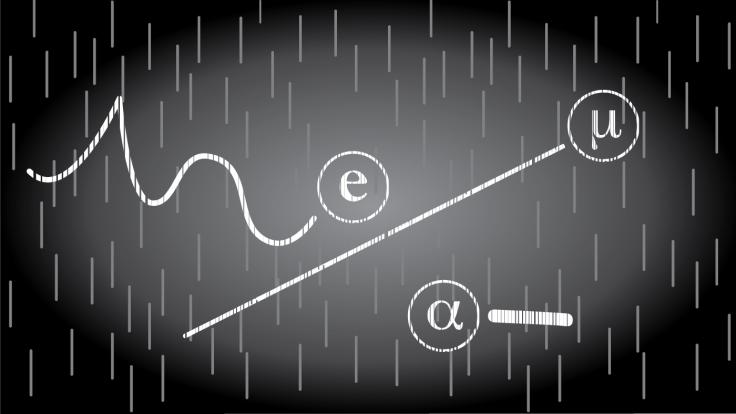
In the new experiment, researchers were looking for signs that the interaction of virtual gluons had generated short-lived particles including the Χc ("Chi-c") and J/ψ mesons, which are charm-anticharm quark pairs that decay into muons and antimuons. The Χc reaction would be especially rare because it requires protons to donate two gluons each, a requirement that also makes detailed predictions challenging, says Fermilab's Mike Albrow, a member of the Collider Detector at Fermilab (CDF) collaboration.
In 2007, CDF researchers observed hints of exclusive, virtual gluon reactions in the form of high-energy photons radiating from colliding protons and antiprotons. Now the team has sifted through nearly 500 muon-antimuon pairs, identifying 65 that must have come from the decay of the Χc--very close to the rate predicted in 2005 by a team at Durham University in England. Because the Χc has similar particle properties to the much heavier Higgs boson, the same basic reaction should produce the Higgs at the higher collision energies provided by the LHC, says Albrow. "It's the strongest evidence that the Higgs boson must be produced this way, if it does exist."
Based on the rate of Χc production, Albrow estimates LHC collisions could produce 100 to 1000 Higgs bosons per year in each of the accelerator's two largest particle detectors, ATLAS and CMS. "Even a few dozen events per year would enable you to measure the [Higgs's] mass, spin, and other properties," he says. That's why ATLAS and CMS teams are reviewing proposals to add detectors to look for exclusive Higgs events.
But not everyone is so optimistic that these events would be detectable in significant numbers. "It looks hard, but one should never say never," says Joseph Incandela of the University of California, Santa Barbara, deputy physics coordinator for CMS. Incandela points out that once the LHC is operating at full capacity, every crossing of its twin proton beams is expected to yield about 20 collisions, throwing up other particles that may obscure exclusive reactions. But he says there are scenarios such as supersymmetry, a proposed extension to the standard model (the textbook theory of particle physics) in which there could be multiple Higgs bosons. In those situations, Albrow adds, exclusive reactions might be the only ones clean enough to distinguish the different Higgs particles.
by JR Minkel
JR Minkel is a freelance science writer in Nashville, Tennessee. His first book, Instant Egghead Guide: The Universe, comes out in July.
This story was first published in Physical Review Focus and is copyright American Physical Society. Reprinted with permission.
For more information on exclusive events, see the CERN Courier.