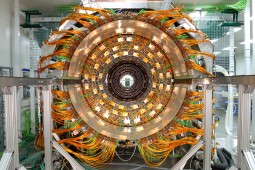
The Compact Muon Solenoid, one of the Large Hadron Collider's enormous detectors. It will be utilized in the search for new particles, including the Higgs boson. (Photo: CERN)
A great new science news site has cropped up: Northwestern University in Illinois recently posted its Science in Society articles on line.
The site has stories by students and faculty at Northwestern and Medill as well as by contributing authors. The stories cover a wide variety of scientific fields with Physics and Astronomy as one of the nine core sections.
Stories on the site aim to connect every day people with research efforts and explain how that research affects them. The introduction to the site explains, "We explore not only the science, but the legal, ethical, and even economic implications of research as well."
Two notable features on the site come from scientists working with Fermi National Accelerator Laboratory.
André de Gouvêa, Ian Low, and Tim Tait write a wonderly easy-to-understand summary of particle physics and how it is studied at the Large Hadron Collider in Switzerland titled "Big Ideas, Small Particles".
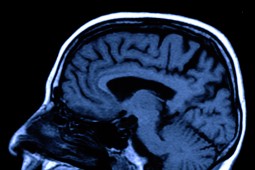
A brain MRI. MRI (Magnetic Resonance Imaging) is one of the many technologies made possible as a result of physics research.
Just for fun, the trio has thrown in a slide show demonstrating how the LHC won't create a black hole that swallows the Earth and a slide show on the history of technology in the field.
In "From a Physicist's Mind", Heidi Schellman writes an equally down-to-Earth story summarizing how the superconducting magnets work at Fermilab's Tevatron particle accelerator. She also explains how the need for cutting-edge tools for experiments has jump started technological advances leading to better products and services used in everyday life, including MRI machines, superconducting wire and the World Wide Web.