|

On the cover:
In this artwork, Braniac, John Zaklikowski used every last
mother board, cell phone and floppy disk he had collected—and an array
of low-tech goods ranging from old-fashioned telephone
bells to a kitchen-sink strainer. He began with a rigid
plywood armature and used screws to attach hundreds
of components. A thick blue ring made of wax mixed
with pigment added coherence to the intricate result,
a juxtaposition of high and low tech. See more of his
work in the Gallery.
Photo: Bradley Plummer, SLAC
June 2010:
Click here to view the pdf of this issue.
|
|
|
Editorial: The Enlightening Transition From Stuff to Stuff
Particle physics, or at least the news
reports of it, often seems concerned only
with the existence of various particles. However, physicists
are just as interested in what happens
as those particles turn into each other.
|
Commentary: Becky Parker
An electronic chip developed at CERN
inspires teenagers to design an experiment
that will fly into space—and inspires
their teacher to start a research network
for high-school students.
|
Signal to Background
Gob-smacked by a dinobird; National
Lab Day gets an island vibe; a physicist’s
winning formula for predicting baseball
winners; taking greenhouse-gas trapping
to a new level; a very stretchy midnight
snack; letters; correction.
|
symmetrybreaking
A summary of recent stories, published weekdays, in symmetrybreaking,
www.symmetrymagazine.org/breaking/
|
The Muon Guys: On the Hunt
for New Physics
Scientists are resurrecting an experiment
that died two deaths on two continents
over the course of two decades. Called
Mu2e, it will look for an event so rare that,
according to the Standard Model, people
should never be able to build a machine
sensitive enough to see it.
|
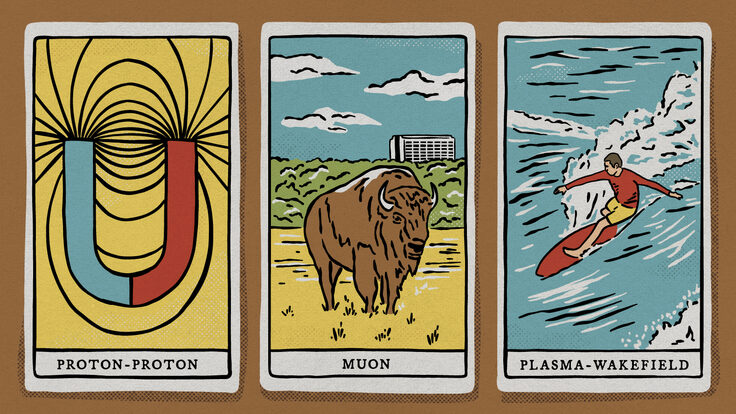
The LHC Decoded
Walk like a physicist, point by point, through
three displays that highlight scientific and
technical milestones from the Large Hadron
Collider’s first months of operation.
|
Science Road Trip
In the summer of 1928, the young Ernest
O. Lawrence set out across America in
a Flying Cloud coupe to begin his new life
at the University of California, Berkeley.
Eighty-one years later, a writer and a photographer
took a road trip to visit the
legacy of this accelerator-physics pioneer:
American Big Science.
|
Day in the Life: Joe Frisch
Running the world’s most powerful X-ray
laser requires a special intensity.
|
Gallery: John Zaklikowski
Over the past several years, John Zaklikowski
has spent nearly all of his savings on the
circuitry and electrical components he used
to create nearly a dozen works, most of
them modeled on large-scale particle physics
experiments.
|
Accelerator Apps: Sterilizing Medical Supplies
For certain products, such as prepackaged
syringes, the ideal sterilizing
agent may be a stream of electrons from
an accelerator.
|
Logbook: CERN Touch Screen
On March 11, 1972, CERN engineer Bent
Stumpe proposed a new type of interactive
computer display for controlling the lab’s
new Super Proton Synchrotron accelerator.
It was apparently the world’s first capacitive
touch screen, a technology now widely
used in ticket machines and smart phones.
|
Explain it in 60 Seconds: Charged Leptons
Charged leptons are a breed of elementary
particle that comes in three masses:
the lightweight electron, responsible for
the electricity in our homes; the middleweight
muon; and the heavy tau. The
Mu2e experiment hopes to catch muons
turning into electron, a phenomenon
known as flavor violation.
|
|