symmetry - Dimensions of Particle Physics
Table of Contents

signal to background

Learn physics from evil slugs; South Pole researchers with the right stuff; the butterfly hunter; no dirty SNO in Canada; if you can’t make it, send your avatar; letters; correction.

photo
Image courtesy of CERN

Welcome to CERNland

Alberto sits down at a computer and brings up a clickable map of CERN. But rather than dry text, he is greeted with bright, musical animation, a pinball game, a quiz show, rocket ships, evil slugs, and music videos.

Soon the 11-year-old and his classmates are glued to the monitors and navigating their way through CERNland, an interactive Web site designed to help kids learn about the European lab, its experiments, and particle physics.

The students, from the International School of Geneva, tested the Web site before its spring public debut.

CERNland is loaded with games and activities, but also requires children to learn a handful of facts about CERN and its Large Hadron Collider. They must answer questions to move forward in a Super Mario Bros.-style game or to win a game show and earn the title of "Antimatter Researcher."

"We target an age range of 7 to 13. That’s when kids discover science," says Silvano de Gennaro, project leader for CERNland. "Also, at that age their imaginations are so completely unrestrained that they can easily grasp some pretty awkward concepts, such as those you find in particle physics."

Available in English, Spanish, French, or Italian, the site was launched as part of CERN’s celebration of the 20th anniversary of the World Wide Web. Robert Cailliau, a CERN systems engineer who was involved in the development of the Web, helped launch the site, and said he’s glad to see CERN using the Web to reach out to kids.

The Web site’s initial success already has producers planning new games about the history of the universe and the links between science, technology, and everyday life.

Try the game at: https:// project-cernland.web.cern.ch/ project-cernland/.
Calla Cofield

photo
Photo courtesy of Ed Wu

South Pole physics is not for wimps

Ed Wu has never been to space, but he probably has a better idea of what it’s like than the rest of us.

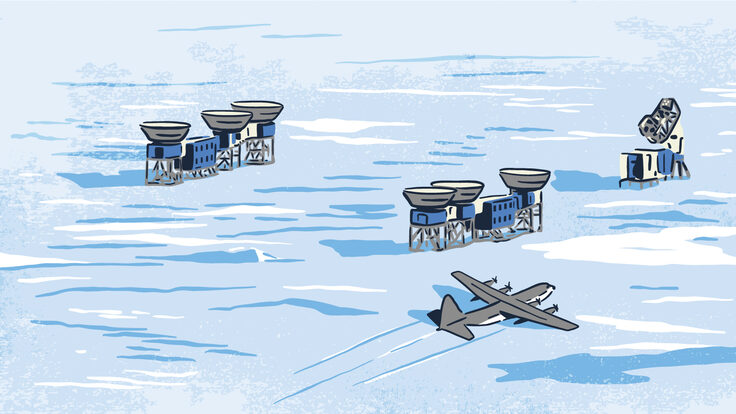
Working at the South Pole on the now-retired QUaD instrument, the experimental cosmology graduate student from Stanford University lived in close quarters with a small group of people, surrounded by extreme weather, and all but cut off from home.

The dry, rarified air suited the instruments Wu used to study high-resolution readings of the cosmic microwave background– microwaves emitted just 300,000 years after the big bang, more than 13 billion years ago.

Before he could go to "Pole," as the locals call it, he had to undergo a thorough medical and dental exam–think less a yearly physical, and more the initial screening the European Space Agency gives prospective astronauts.

Twenty-four-hour sunshine and the exhausting scarcity of oxygen at 10,000 feet make life at Pole surreal. The summer population hovers around 200, and satellites provide contact with the outside world only seven or eight hours a day. After the sun goes down in May, Pole’s 50 "winter-overs" won’t see it again until August. In the meantime, there are no visitors, cargo drop-offs, or rides home.

Psychologists have studied the experiences of winter-overs to predict the behavioral effects of long space missions. QUaD’s winter-over, a support scientist and amateur paraglider named Robert Schwartz, passed up a seventh year of Antarctic wintering in 2008 to enter the race to be an ESA astronaut. Although he wasn’t selected, he was one of only 192 out of the 10,000 candidates who passed the initial medical exam, to make it to the fourth round of physical and psychological screening.

But according to Wu, good health is not enough to keep people sane despite oxygen deprivation, cabin fever, and extreme cold.

"People skills really do matter," he says. "You have to be comfortable working with people regardless of how you feel personally, because nothing gets done at Pole without everyone. You also have to be able to derive pleasure from what you can." For Pole dwellers, that can mean anything from making a short film for the South Pole International Film Festival to taking a very hot sauna and running naked to the South Pole marker and back. "It’s as normal as you make it," Wu says.
Lauren Schenkman

photo
Photo courtesy of Tom Peterson

He stalks rare prey for its own good

Tom Peterson loves hunting season.

He spends his lunch hours scouting the best spots, and weekends lurking around the edges of Fermilab’s ponds and moving as silently as he can through old fields. He doesn’t want to scare his pregnant quarry. The season is short, the targets small and elusive.

Ask the Fermilab engineer, who specializes in cryogenics, why he endures the heat and the dirt and he’ll tell you it’s for a good cause: saving ecosystems.

When he bagged a beauty last year, he gave it to a friend at the Chicago Academy of Sciences’ Peggy Notebaert Nature Museum. After spending time in the museum’s breeding lab, that pregnant purplish copper butterfly produced hundreds of eggs, which became ammunition in the battle to repopulate the species in northern Illinois and eventually the entire state.

The purplish copper, distinguished by a purple tint on the male’s wings that fades with age, has lost habitat to farming and subdivisions in Illinois and other parts of the Midwest, as well as in the eastern United States.

"Fermilab is one of two areas that retain big populations, and all of our breeding stock comes from Fermilab," says Doug Taron, curator of biology at the museum, which is working to restore populations of butterfly species that were common at the turn of the century.

More than 50 butterfly species find a haven on the lab’s 6800-acre campus, which includes 1100 acres of restored native prairie and hundreds of acres of farm fields, woodlands, and wetlands.

It’s difficult to say, for any species, what will happen if it vanishes, Taron says: "But the less biodiversity you have, the worse it is for the ecosystem." Butterflies’ pollination of plants and critical place in the food chain make them valuable for much more than aesthetic reasons.

The females Peterson bags in this year’s hunt will be put on display in the museum’s breeding lab and their descendents moved to new homes in forest preserves, where museum staff hope they will settle in and lay their eggs.
Tona Kunz

A scrub+ for SNO+

Imagine a house-sized acrylic fishbowl inside a giant, shiny, disco-ball-like sphere, suspended in a cavern as tall as a 10-story building. Now imagine climbing around inside that pitch-dark fishbowl with a squeegee and a flashlight.

Peter Skensved does that once or twice a week.

For the past few months, the Queen’s University physicist has tackled dirt, cracks in glue joints, rips in liners, and dead photomultiplier tubes as he helps to convert the SNO particle detector in Ontario, Canada, for a new project called SNO+, pronounced "snow-plus."

photo
Photo courtesy of Peter Skensved

SNO stands for Sudbury Neutrino Observatory, an experiment in a working mine two kilometers below ground. Its transparent, spherical detector was filled with heavy water that gave off Cherenkov light when a neutrino passed through. Photomultiplier tubes picked up these light signals and passed them on to computers for analysis.

For its successor, SNO+, scientists are draining the detector. They will refill it with a scintillating liquid called LAB, or linear alkyl benzene. This will allow detection of neutrinos with much lower energies that come from the sun, exploding stars, or natural radioactive decays in the earth.

To take full advantage of this, Skensved says, the detector has to be as free of contaminants as possible. For SNO, "clean" meant keeping levels of uranium and thorium contaminants in the water a factor of a billion lower than those found in dirt and one million times lower than on the acrylic vessel’s surface. Essentially, the allowable contaminant amount could equal the size of one gram of dust embedded on the vessel.

For eight-to-10-hour stretches, he sits in a rubber boat floating in the old water and peers at, patches, and scrubs the cavity’s plastic liner and the detector’s acrylic panels. He rides the water down as it slowly drains, exposing new sections for inspection. He removes an oil film left from a water pump seal break and searches for signs of material stress, such as bubbles, hairline fractures, or holes. He’ll do the same thing for the accessible photomultiplier tubes.

When he flicks on his flashlight, reflectors in the photomultiplier tubes beam light in all directions.

"There is so much light being reflected back at you that some people get a little seasick," he says.

Scientists use high-pressure, ultra-pure-water sprayers and squeegees on really long poles to scour parts of the interior walls.

The detector must be scrubbed inside and out, but its curved, ultra-smooth walls thwart climbing. So Skensved is working out a plan to reach difficult spots: scaffolding, a seat lowered by rope, or floating docks.

When the detector is almost ready to operate, Skensved will hand-sand radon residue off the walls, likely underwater to prevent too much radon from getting in the air.

After the contaminated water drains away, the detector will be ready for the pure new liquid and physics results to come.
Tona Kunz

photo
Photo courtesy of Doug Dechow

Physics talk 2.0

From his California office, Doug Dechow stretched out on a grassy hill and listened to a particle physics lecture taking place in Chicago.

He hadn’t found an often-theorized parallel universe, but a real virtual one.

In celebration of the International Year of Astronomy, Adler Planetarium had added an extra seating option for a lecture by Fermilab physicist Herman White.

The talk was broadcast live over projection screens on Astronomy 2009 Island in Second Life, the online world that simulates buildings, places, and people interacting as they would in real life. Dechow’s virtual self, or avatar, was in the island’s virtual audience as White explained the search for the Higgs boson, the use of antimatter in medical diagnostic tools, and how particle accelerators are used to study the basic components of matter.

Avatars from across the nation e-mailed questions to White and shared instant-messaged comments as easily as if they were sitting side by side.

"Since we started using Astronomy 2009 Island, the reach of our lecture attendance has increased 25 percent," says Nancy Ross Dribin, director of interactive media at Adler.

White started giving talks to flesh-and-blood audiences nearly three decades ago. He still does that, but you can also catch his talks on YouTube, read about them in 140-word Tweets, find Facebook pages related to the scientists and experiments he talks about, and follow links to his talks from various blogs.

And now the physicist from Illinois has been instantaneously brought face to face–sort of–with Dechow, a librarian from Chapman University in California.
Tia Jones

Correction

A feature in the July 2009 issue of symmetry on the world’s dwindling helium supply did not properly introduce the physicist who manages the Cryogenic Dark Matter Search at Soudan Mine in Minnesota. He is Dan Bauer.

Letters

60 seconds of science teaching

Thanks tons for the archive of "Explain it in 60 Seconds" articles. These are great! As a high school physics teacher working here at Fermilab for the summer, I’m finding these are a great resource for me and will end up finding their way into my classroom. I immediately sent that link to the other teachers working at Fermilab that I have access to, about 10 of us in two different programs.
Terry Barchfield
Editors’ note: Past "60 seconds" articles are archived at www.symmetrymagazine.org/60seconds/

Remembering "a frog’s place"

Reading your May 2009 commentary, "Bosons and Grocery Bags," it struck me that I had to write.

We remember the Fermilab site as "A Frog’s Place," wooded with an old barn and lots of kids, where we dropped our son Ken off for a camping experience in a summer of the ’60s. It was the end of an idyll, replaced the following year with a long, unbelievably deep trench through which Fermilab’s accelerator soon would burrow. It was a dream then, one that perhaps our son could begin to imagine. He was, and still is, a sci-fi nut, now with maturing offspring of his own.

I’ll never forget that ditch (nay, more a canyon), partly because my wife and I have been drawn to Fermilab at least once a year since the ’60s. I can follow only parts of symmetry. I scan each issue, then return to a few of the articles that make the most sense. In fact, I’m postponing reading the 60-second article, "Charm Quark," on the back cover. Dessert, you know.

Miracle? I don’t know. Awe? Definitely.
Dick Jacoby, Willowbrook, Illinois


Click here to download the pdf version of this article.

Send a letter to the editor

Share this page with others! Submit to:
  |     |     |     |  

symmetry Breaking

July 28, 2010
Check out a 12-minute public television program that traces the invention of the cyclotron in Berkeley in the 1930s, the development of SLAC's two-mile-long linear accelerator in the 60s, and how they relate to what's going on at the Large Hadron Collider.
July 28, 2010
Exploring our dark universe is usually the domain of extreme physics. Clues to dark matter and energy are searched for by huge neutrino telescopes and particle detectors, deep underground, and by experiments launched into space. But an experiment doesn't have to be exotic to explore the unexplained. At the International Conference on High Energy Physics, which ends today in Paris, scientists from the GammeV-CHASE experiment unveiled the first results from their experiment, which used 30 hours' worth of data from a 10-meter-long experiment to place the world's best limits on particles of dark energy.
July 26, 2010
CERN's press release issued today states that the LHC's first measurements are allowing them to “rediscover” the Standard Model of particle physics. But the presentations at ICHEP tell a slightly different story.
Subscribe to symmetry

Email Update List

Receive email notifications of the release of future issues of symmetry:

more options
On the Cover
Issue Cover

Manga artist Takuya Uruno, whose work is featured in the gallery, designed this issue’s cover based on an edutainment Web series he created for KEK. It incorporates, from top, a superconducting radio-frequency cavity; string theory; and a Van de Graaff generator, whose static electricity fluffs up the hair of the girl in the middle.

PDF View Issue PDF

Logbook Archive
Photo - Logbook: Archive

Z Boson

Aug 2008
In May 1983, physicists working on the UA1 detector for the Super Proton Synchrotron accelerator at CERN made the first definitive observations of the Z boson...

View Logbook Archive

Explain it in 60 Seconds Archive
Photo - Explain it in 60 Seconds: Archive

Theory

Sep 2007
A theory, in everyday language, differs little from a guess or a hunch. But in science we reserve the word for a well-developed idea based on experimental evidence...

View 60 Seconds Archive