signal to background
Café swaps plastics for potatoes; cosmic lawn art; that safety sign is a joke; physicist joins canine collaboration; wiring with attitude; cosmic mud-sniffer boggles security
![]() |
| Photos: Bradley Plummer, SLAC |
Biodegradable Café
At SLAC's Linear Café, a potato doesn't just go on your fork. It is your fork.
The cafeteria began a green initiative about five months ago, abandoning traditional plastic spoons and plates in favor of biodegradable counterparts. Nearly everything used to serve food is made of paper, sugar cane fiber, or corn, including plates to soufflé cups to takeout boxes. The garbage can by the door was joined by an equally large compost receptacle. Plasticware gave way to TaterWare, a set of bendy, beige forks, spoons, and knives. (They're not edible, but they will take an imprint of your teeth if you bite them, and soften if left too long in hot soup.)
Even the garbage bags are compostable, says deputy manager Pablo Barron. Every day, piles of plates and leftover food that would normally be relegated to the trash find their way to the compost bin. "We never waste anything," Barron says.
It's not always easy being green. Customers sometimes use the garbage and compost bins interchangeably, jeopardizing the entire operation. "If we put one piece of plastic in the compost, the entire load may be rejected by the compost facility," Barron said.
Soon, this problem might be
solved by getting rid of the garbage
can altogether. Manager
Robin Martinez estimates that
75 percent of the café's products
are compostable now, but she
hopes to go entirely green in two
to three months. The only things
left that won't decompose are
straws, plastic food wrappers,
waxed red-and-white beverage
cups, plastic hexagonal salad
containers and hot-beverage
and soup cups with lids, which
are coated with a glossy lining.
Martinez said she tried to recycle
these items by giving them
to another cafeteria but "no one
would take them. They're all
going green, too."
Lisa Grossman
![]() |
| Photo courtesy of Tim Otto Roth |
Cosmic rays spray art across a lawn
Bluish lights flash on a grassy field, like giant fireflies angling for mates—sometimes a single flash, sometimes a ripple of light moving fast, as if suitors have given chase. Then all 16 lights flash at once, and the whole field glows.
The display is based not on whiffs of pheromones, but on showers of cosmic rays.
These remnants of energy from the sun and stars collide with molecules in Earth's atmosphere and break up, creating cascades of lighter particles that rain harmlessly down.
Particle physicists with the German experiment KASCADE record some of those incoming particles on 252 detectors spread over an area the size of four soccer fields. The detectors measure each particle's mass, entry angle, and energy, data that show up as blips of light on the scientists' computer screens.
For the rest of us, Tim Otto Roth translates that data into art.
![]() |
| Photo courtesy of Forschungszentrum Karlsruhe |
The result is Cosmic Revelation, a portable set of 16 sculptures that combine mirrors and strobe lights. At its November premiere at the Forum of Karlsruhe University, people strolling among the sculptures had a chance to ponder the invisible particles that continually pass through their bodies.
Each sculpture links to a portion of the KASCADE detector array, which is also on the university grounds. When a particle from a cosmic ray shower strikes the array, the corresponding sculpture flashes its strobe light. The more energetic the particle, the longer the flash. The overall pattern of flashes reflects where the particle hit and the angle it came in at. A particularly energetic shower lights up the whole field.
The display expands on Roth's work with KASCADE in 2005, in which he translated particles passing through a detector into patterns on the Internet Art Façade, a wall of 76 light panels on the side of the House of Communication in Munich.
"The point is to create a feel for cosmic ray air showers, that they exist and that they come from different directions," Roth says. "I want to give the public a feeling of the energy, and looking at pixels on a screen is a different experience from seeing these powerful flashes."
Dates and locations of future
installations are at http://tinyurl.com/d4beag
Tona Kunz
![]() |
| Photo: Reidar Hahn, Fermilab |
Chuckling their way to a safer lab
There are many ways to deliver a clever play on words: deliberately with a nudge, coyly with a wink, or tossed nonchalantly into a conversation to trigger a delayed laugh—or a groan.
Alternatively, you can print it on a sign and post it by the entrance to a national laboratory.
After a study found that most injuries at Fermilab were caused by lapses of attention, the committee in charge of safety signs put out a lab-wide call for snappy slogans. "We received hundreds in the span of two or three weeks," says committee member Tim Miller. Twenty of the slogans have been used so far, with the messages changing every week.
Some favorites:
- Many quantum worlds. Be safe in this one.
- CP violation is fine. Safety violation is not.
- Make safety the extra dimension in your work.
- Drive carefully—leave collisions to the accelerator.
- Don't be a weak force when it comes to safety.
When the signs are funny
and changed often, "everyone
looks forward to reading them,"
lab Director Pier Oddone says.
"At least I do!"
Kathryn Grim
![]() |
| Photo: Reidar Hahn, Fermilab |
A physicist's life: write a little code, mush a few Huskies
First the noses start twitching; then all five sets of ears perk up. Jen Adelman-McCarthy knows something tantalizing lies ahead.
Turning the corner, there it is: a dog struggling to break free of its owner to join her oncoming team of sled dogs. Her team leans toward the pair, eager to play. But Adelman-McCarthy barks, "On by!" Instantly, five furry necks snap forward. The dogs zoom past as if temptation had vanished.
"The complete look of shock on the person's face is a lot of fun," says Adelman-McCarthy, a particle physicist at Fermilab who relaxes—and sometimes competes—as a musher.
Dog sledding, she says, "is a collaboration like the large, international groups that work on experiments. You have dogs with strong personalities. You have to learn which dogs are capable of leading, which dogs are best to run in the middle, which are the ‘wheel dogs' that aren't always the brightest but they pull the most weight. You learn to put together a team."
Adelman-McCarthy worked for 10 years at Fermilab on the first two phases of the Sloan Digital Sky Survey, helping identify 930,000 galaxies across one-quarter of the sky. She debugged and formatted software code that flags objects of interest spotted by the survey's telescopes. Now she will do same as part of the Compact Muon Solenoid experiment at CERN's Large Hadron Collider, as well as the Dark Energy Survey using a telescope in Chile.
The physicist borrows Huskies from fellow race enthusiasts to forge a team with her own dog Behr. Rescued from an abusive past, he has worked for five years to overcome a fear of people and become a lead race dog, as well as an enthusiastic participant in events to educate the public about the sport. Dog sledding's best-known event, the Iditarod, a 1000-plus-mile race with a worldwide audience, kicked off March 7 in Alaska.
"Those racers are my heroes,"
Adelman-McCarthy says. "Behr
and I sit on the couch eating
junk food, dreaming about being
that good."
Tona Kunz
![]() |
| Photos: Reidar Hahn, Fermilab |
Electronic personalities
Some claim that handwriting can reveal personality traits. Large, free-flowing loops reflect an easy-going nature; squiggly strokes, creativity.
Some physicists think equipment offers the same insight.
"Sometimes electronics are very expressive. They can reveal a lot about their builder," says Teppei Katori, a graduate student from Indiana University. "You can tell how cautious people are, whether they have a sense of humor, or even if they require a lot of order. You just have to know where to look."
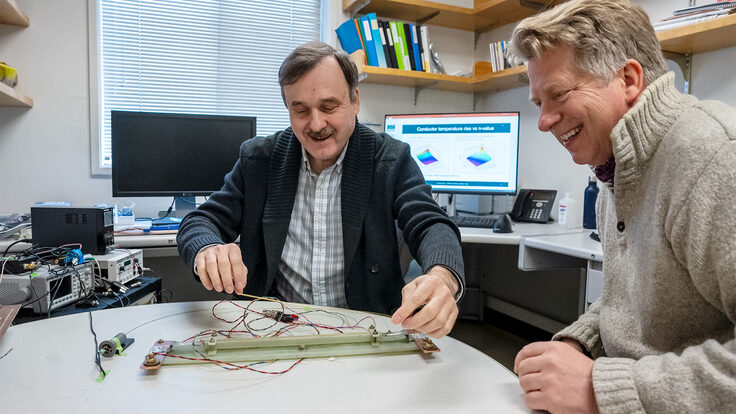
At SciBooNE, a Fermilab-based neutrino experiment, racks of electronics the size of refrigerators power the detectors and collect data. A single graduate student may build a large section of this equipment—and it takes just one glance to guess who.
On the first rack, bundles of red, green, and black cables flow smoothly, like muscle fibers in a fast, lean animal.
"You can tell this person is very organized. All of the cables flow beautifully," Katori says. It's obviously the work of Yasuhiro Nakajima, a graduate student at Kyoto University: "He's a perfectionist, and his dexterity's very good."
Across the walkway, cables of different lengths and shades of green look frazzled, as if drunk on electricity. Typed labels have given way to handwritten notes in multiple colors.
"Yoshi built this detector," Katori says. "It looks messy, just like his room."
The builder agrees.
"I'm creative," says Yoshinori Kurimoto, also a Kyoto grad student. "I think that part of my personality comes through."
The last tower of circuits and cables is surrounded by portable fans, an arrangement reflecting the cautious nature of Columbia University's Camillo Mariani.
"Why all the fans?" Katori asks. It's important to keep the electronics cool, but Mariani has twice the necessary number.
Morgan Wascko, co-spokesperson
for SciBooNE, says the
experiment encourages creativity:
"We try to give people leeway
to express themselves, to
develop their parts of the
detector in their own ways. The
bottom line is it does the job."
Jennifer Lee Johnson
The contraption is just a dirt-dampness detector. Honest.
Marek Zreda and Darin Desilets of the University of Arizona approached airport security with a suitcase full of tubing, cables, electronic devices, and wires. The guard opened it. Lights started blinking.
Zreda explained that he was a scientist who studies cosmic rays and that this was a portable neutron detector. The guard escorted Zreda and his colleague to an office.
"There were a lot of questions and some trick questions also," says Zreda, who is an associate professor of hydrology; Desilets is a doctoral student. "They asked if we knew this long-time cosmic-ray scientist, but it was a fake name."
Zreda didn't fall for it, and after about half an hour was allowed to check the $15,000 detector as luggage on a 2003 flight from Hawaii to Arizona.
While physicists aim cosmic-ray detectors at the sky to look at particles raining down from space, Zreda and Desilets aim their neutron detector at the ground to see what happens when cosmic rays penetrate the Earth. The resulting data show how moist the soil is, an important factor in forecasting weather and crop yields, modeling global warming trends, and calibrating satellites.
"I was amazed," Zreda says. "We look at something that comes from outer space—the cosmic rays that we use come from galactic sources—and they tell us about our Earth. It is a little bit twisted."
And more than a little complicated, when it comes to flying.
Many a scientist has had to explain suspicious-looking equipment to airport security. Physicists with the CMS experiment at the Large Hadron Collider, for instance, had to make multiple trips to ferry detector components from the United States to the European laboratory CERN.
But the benefits are worth the hassle, says Zreda, who doesn't fault the security people for doing their job. "The way the detector looks," he says, "they had to question us."
For more on Zreda's work,
see "Cosmic Weather Gauges"
on page 24.
Tona Kunz
Click here to download the pdf version of this article.
This issue of symmetry marks a first: two different
covers, each celebrating a team of experimenters at
Fermilab’s Tevatron collider. The CDF and DZero
collaborations alternate in writing the Result of the
Week column for Fermilab Today. Half the copies of the issue portray members of the
CDF experiment climbing Fermilab's Wilson Hall,
transformed into a giant H in honor of the Higgs
boson. The other half feature DZero collaborators
atop their detector, reaching for the Higgs.
Photo: Reidar Hahn, Fermilab
Z Boson
Aug 2008
In May 1983, physicists working on the UA1 detector for the Super Proton Synchrotron accelerator at CERN made the first definitive observations of the Z boson...
Dark Matter
Mar 2007
Dark matter is, mildly speaking, a very strange form of matter. Although it has mass, it does not interact with everyday objects and it passes straight through our bodies...