|
commentary: alan boyle
 |
| Photo courtesy of Alan Boyle |
Fear factor
Can physics rock you
in the head? Or destroy
the world?
These aren’t the
kinds of questions you
usually associate with
particle accelerators.
But over the past year,
such questions have
drawn the attention of
millions of viewers and readers to particle physics
in general, and Europe’s Large Hadron Collider
in particular.
There are several reasons behind the interest:
Physicists might point to the fact that the LHC
is the biggest, most expensive science experiment
on Earth, bringing together brainy people from
scores of countries. They might delve into a discussion
of supersymmetric particles, quark-gluon
plasma, and, of course, the elusive Higgs boson.
But I think the main factor is something less
scientific, and more psychological: It’s the sense
of wonder and fear that surrounds the unknown.
Wonder and fear may sound like polar opposites,
yet I argue that the LHC wraps them
together. Scientists are fond of saying that this
miles-wide contraption could create phenomena
never seen before on Earth, and its experiments
could produce totally unexpected results. That
acknowledgment of the limits of our understanding
opens the door to a sense of wonder about the
unknown—and fear of it.
Fear is the more powerful response—especially
when it’s been so well-visualized in the form of
a globe-gobbling black hole. For six months, I covered
every twist and turn in a lawsuit filed in the
United States that played on the fear of black
holes and other unknowns. The “doomsday lawsuit”
sought to have the LHC put on hold because scientists
couldn’t prove to the plaintiffs’ satisfaction
that there was absolutely no possibility of creating
a catastrophic black hole.
Some scientists wondered whether it did more
harm than good to write about this case. I had
to wonder myself when I heard that particle
physicists were receiving threats because of the
doomsday talk. I worried even more when I
received online comments from kids pleading with
me to stop the end of the world. “I really enjoy my
life and I don’t want it to end soon because of science,”
one wrote.
The Internet can amplify such worries through
Web sites, blogs, and forums that are sometimes
dominated by people who don’t seem to know the
difference between science and science fiction.
But that’s the best reason for addressing the fear
head-on. The best way to fill the knowledge gap
is by providing answers when you can, rather than
scoffing at the questions.
CERN, to its credit, expanded upon its previous
safety studies and explained why the LHC won’t
cause the world’s end, even under the unlikeliest
scenario. The court ultimately dismissed the
doomsday lawsuit. There’s still the possibility of an
appeal, and the fear factor may well come up
again in mid-2009 when the LHC is back on line.
But CERN’s action demonstrated that the scientific
community is willing to help ordinary folks
face and understand their fear of the unknown—
and explain the beauty of the wonders ahead.
Here are a few ideas for building on that
foundation:
-
Address the perceived risks—and revel in the
benefits: Physicists might find it worth their
while to get their message to the public via
YouTube videos, blog postings, and even
late-night call-in shows. The LHC rap video
that attracted nearly 4 million views on
YouTube is the best example. It shows that
physicists can rock your world and have fun
doing it. Next, show how advances in particle
physics can lead to new applications in medicine,
materials science, and energy.
-
Prepare teachers for tough questions from
their students: Based on the comments I
received from kids, I got the impression that
their teachers weren’t getting enough information
to address the doomsday questions
adequately. It might be worth giving a helping
hand to teachers at all school levels.
-
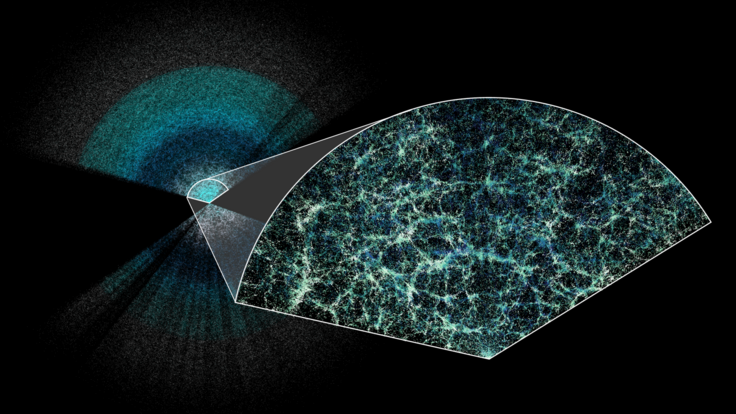
Visualize the discoveries: One reason why the
Hubble Space Telescope is such a crowdpleaser
is because its products are so visible to
the public. Hubble is essentially a machine
for manufacturing wonders. Are there ways to
show in graphic terms what the LHC will
discover? Can parts of the subatomic world
ever become as familiar as, say, the Eagle
Nebula in Hubble’s “Pillars of Creation”?
The task ahead may be trickier than finding
the Higgs boson—but anything that makes the
weird world of the microcosmos more accessible
is sure to make the unknown less fearsome in
the future.
Alan Boyle, science editor for msnbc.com, blogs about particle
physics, space exploration, and other topics at his Cosmic Log,
http://cosmiclog.msnbc.msn.com
Click here to download the pdf version of this article.
Send a letter to the editor
Share this page with others! Submit to:
|
|
|
|
|

Email Update List
Receive email notifications of the release of future issues of symmetry:
What could a radial tire possibly have
in common with particle physics?
Accelerator technology. In physics, it
boosts particles to nearly the speed
of light; in industry, it’s used in creating
the materials that go into tires. As a
bonus, this avoids the use of solvents
that can pollute the environment.
Photo: Reidar Hahn, Fermilab
View Issue PDF
Sep 2006
This year, the Particle Data Group celebrates its 50th anniversary with a release of a 1230-page edition of the Review of Particle Physics...
View Logbook Archive
Mar/Apr 2008
Rare particle decays could provide a unique glimpse of subatomic processes that elude the direct reach of even the most powerful...
View 60 Seconds Archive
|