Physicist Les Cottrell is the meteorologist of Internet weather.
His project tests the strength of Internet connections around
the world—and finds Africa lagging farther and farther behind. By Madolyn Bowman Rogers
Photo-illustration: Sandbox Studio
Sandwiched between YouTube videos of laughing
babies and exploding fountains of Mentos and
Diet Coke, you can find a 45-second animation
of Africa’s “Internet weather.” The continent is
bright yellow, and as the video runs, pale red dots
flicker across its surface. A voiceover with a
sprightly British accent informs the viewer that
the dots represent Internet connectivity measured
from April 2007 to March 2008. The paler the dot,
the slower the connection, and the more the dots
flicker, the more unstable the connection is. While
the dots flutter dimly, the voice informs us that
“Africa’s performance is the worst in the world, and
is 10 or more years behind Europe and the US.”
The Internet has ushered in an age of global
connectivity. People chat with friends across
the world and get news instantly from the other
side of the planet. Business partnerships and
trade flourish across continents. Science is
especially dependent on international participation.
In the world of high-energy physics, cutting-edge
projects like the Large Hadron Collider are possible
only because of the efforts of scientists around
the globe.
With so much depending on international
connections, it seems someone should be monitoring
just how reliable those connections are.
For the last 13-plus years, that job has fallen to
the PingER project, based at the Stanford
Linear Accelerator Center in California. PingER,
short for Ping End-to-end Reporting, measures
the speed and reliability of Internet connections
between institutions around the world. The project
began as a resource for high-energy physics,
but all the measurements are publicly available,
and in recent years numerous universities and
scientific organizations have discovered the value
of the data.
PingER data show that not everyone can
participate equally in the global culture. Many
countries are left behind, their residents isolated
behind slow and unreliable connections. The
PingER analysis has inspired the leaders of several
countries, including India, Brazil, Romania,
and Pakistan, to invest in major upgrades to
communications equipment. Other places, such
as most of Africa, have yet to catch up. Meanwhile,
demands on the global network are increasing
exponentially, and the need for someone to
monitor performance and detect problems is more
crucial than ever.
The project, however, maintains a tenuous
existence. It’s a largely unfunded program run by
a handful of computer scientists and physicists,
and it relies heavily on volunteer labor. Its existence
depends almost entirely on support from the
Pakistan National University of Sciences and
Technology and the dedication of one man,
Les Cottrell.
The Internet’s weatherman
Cottrell, who describes himself as a “renegade
physicist,” has been managing the computer
network at SLAC for roughly 40 years. He is the
narrator of the Africa video, the meteorologist
of Internet weather. He started the PingER project
in 1994 as a way to improve communication
between high-energy physics sites around the
world, which were becoming increasingly
dependent on the Internet.
“Occasionally something would fail,” Cottrell
says. “People would immediately run over to the
phone network and say ‘What’s wrong? What have
you done?’ And we didn’t have much of an idea.”
Cottrell is tall and lanky, glasses perched on
his nose beneath a mop of curly white hair, and
speaks with an elegant British accent. He is
refreshingly direct; one of his reports states that
a data packet loss of 2.5 percent “will result in
Voice Over Internet Protocols becoming slightly
annoying every 30 seconds or so.” Faced with
physicists clamoring for answers whenever
there was a failure, Cottrell decided he needed
to make measurements. “The old mantra is you
can’t manage what you can’t measure,” he says.
Cottrell made use of a common Internet data
packet, the ping, a tool that comes packaged with
every computer. It works this way: One computer,
acting as a “monitoring host,” sends a ping to
a remote computer, which then sends it back. The
round-trip time reveals the connection speed
between the computers, including the time it
takes the remote host to process the ping. The
PingER project sends 10 pings every 30 minutes
to each remote site. Long round-trip times
indicate congestion or poor routing. In very
congested traffic, packets may be lost in transit.
Remote hosts may also show variable performance,
doing well in processing some packets
and poorly with others. If no packets at all come
back, the remote host may be down.
“So just with this trivial measurement, you’ve
measured round-trip time, loss, jitter, and reachability,”
Cottrell says. The data is analyzed and
stored at SLAC and Fermilab, and the results are
made publicly available. When the project
started, a single monitoring host at SLAC was
measuring about 40 sites. The PingER project
now has 44 monitoring hosts in 22 countries that
send pings to more than 700 sites in 159 countries.
Using data to drive progress
One of the first organizations to use the data
was the International Committee on Future
Accelerators (ICFA), a group formed in 1976 to
promote worldwide cooperation in accelerator
building and research. In 1996 the group issued
a statement recognizing the importance of communications
to the field of high-energy physic and urging countries to upgrade their equipment
to ensure adequate bandwidth.
“Occasionally something would fail,” Cottrell says. “People would
immediately run over to the phone network and say ‘What’s wrong?
What have you done?’ And we didn’t have much of an idea.” Photo: Brad Plummer, SLAC
“Our whole field is based on global collaboration,”
says Harvey Newman, a physicist at the
California Institute of Technology and chair of the
group’s Standing Committee on Interregional
Connectivity. “The Large Hadron Collider in particular
has penetrated to every region of the world.
Without connectivity, you can’t really be a partner
in these experiments.”
Newman’s committee looks at PingER data
every year, as well as complementary data on
the status and growth of the Internet, to discover
countries where infrastructure isn’t keeping up
with demand. The committee then shares this data
with major research and education networks in
hopes of encouraging improvements. Where
they’ve done so, “it’s really helped to spark progress
in that country,” Newman says. A February
2004 ICFA meeting in Rio de Janeiro triggered
improvements that have taken Brazil from a relatively
primitive state of connectivity to the leading
country in Latin America in just four years.
In 1999, Newman’s committee visited the
National University of Sciences and Technology
in Pakistan and showed it the PingER data,
beginning a slow process of improvement. In
2001, Cottrell went to Pakistan to present his
data personally.
“I even met Musharraf. Mind you, I was too much
in awe to say much,” Cottrell says. “I shook his
hand and said, ‘Very nice of you to have us here.’”
Finding bottlenecks
Cottrell also met with Atta ur Rahman, the head
of higher education in Pakistan, and showed
him data that demonstrated that even though the
backbone network in Pakistan was quite good
at the time, the universities had terrible connections—only 1 megabit per second connection
speed for the entire institution, or a factor of
1000 to 10,000 times less than the connections typically available to universities in the United
States. The PingER data made it clear that the
problem lay in the last mile of connections to
the universities, which were supplied by copper
wire. Rahman jumped on this, Cottrell says, and
Pakistan has since upgraded the connections
to fiber.
Pakistan and SLAC began a fruitful collaboration,
formalized in a 2004 memorandum of
understanding that provided crucial funding for
the PingER project. Pakistani students in the
School of Electrical Engineering and Computer
Sciences help develop software for PingER.
Those who do well are invited to come to SLAC
for one year to help analyze PingER data.
“It’s a wonderful opportunity for students in
Pakistan. They’re usually not exposed to such
real-world problems,” says Umar Kalim, a computer
scientist at the School of Electrical Engineering
who came to SLAC in February 2008 to work with
Cottrell on Internet performance monitoring.
The PingER project “has created a snapshot
of how the network has evolved in Pakistan.”
Kalim says. “Compared to its neighbors, Pakistan
has made tremendous progress.”
Africa: left in the dark
The PingER project has also drawn the interest
of the Abdus Salam International Centre
for Theoretical Physics in Trieste, Italy, whose
mission is to support science in developing
countries.
“One of the main problems for scientists in
developing countries is lack of bandwidth,”
says Enrique Canessa, a physicist at the center.
“To be connected today is essential.”
The center invited Cottrell to present his data
at a 2002 roundtable with scientists, politicians,
and educators from across the globe. As a result,
numerous universities in Latin America, Asia,
and Africa agreed to participate in the PingER
project, extending its reach to much of the
developing world. ICTP began to track connectivity
between Italy and 40 countries in Africa
whose populations make up more than 80 percent
of the continent’s inhabitants.
The data revealed a continent in the dark.
Many universities in Africa have less bandwidth
than a well-connected home in Europe does.
Only 3.6% of Africa’s one billion people have
access to the Internet, and the cost of broadband
Internet service can be as high as $8000 per
month. In many parts of Africa, for example in
Uganda, all Internet connections go through satellite
links. Because the signal has to make a
48,000 mile round-trip to the satellite and back, it
takes four times as long as it would to travel
through a landline connection.
“They always talked about Africa as being the
‘Dark Continent.’ Actually it’s incredibly true,”
Cottrell says. “The really concerning thing is not
only are they a long way behind, probably
around 12-15 years behind, but they’re not catching
up. It’s getting much worse.”
If current trends continue, by 2016 connection
performance between North America and Africa
will be 1000 times worse than between North
America and Europe, according to Cottrell’s most
recent report.
Africa’s near-absence from the global Internet
community is a loss to the world, Cottrell says.
He believes it’s important “to get these excellent
minds leverage so they can do something useful.”
Scientific organizations such as the
International Heliophysical Year depend on having
good connectivity in Africa. The group studies
sunspots, which can throw off GPS tracking, and
needs to make its measurements from the equator.
Africa has the most equatorial land mass of any
continent, but without good connections, scientists
can’t upload the data they generate there.
In some parts of Africa, the connections are
better, and there is enough infrastructure to
build on. “The data tell us which countries have
a chance of moving forward,” Cottrell says.
Outlook: cloudy
The hard data provided by PingER is crucial for
convincing politicians and decision-makers to
invest money in improving connectivity, say
Canessa and co-worker Marco Zennaro from
ICTP. In April 2008, ICTP and Cottrell collaborated
on the video of Internet weather in Africa and
posted it on YouTube.
“Now there is more global awareness of the lack
of connectivity and its importance,” Canessa says.
Still, the project remains largely unfunded.
PingER is not part of Cottrell’s job description at
SLAC, and he donates much of the time he
spends on it. The funding from Pakistan pays for
software development, Cottrell says, but the
PingER project also requires a lot of day-to-day
maintenance. Remote hosts regularly go offline, for
example if they move or install a firewall, and
Cottrell or one of his helpers must contact the host
to re-establish the connection.
“The project is designed to need very barebones
effort,” Cottrell says. “We’ll try to keep it
running at a very low level.” But without more
funding, he says, he may no longer be able to
produce reports summarizing PingER findings.
And if all the funding gets cut, or when he himself
retires, “I suppose it would go away entirely.
I’d be disappointed. I think it’s very valuable, in
particular for Africa.”
So PingER’s future remains cloudy; but for
now, the Internet’s meteorologist will keep tracking
the weather.
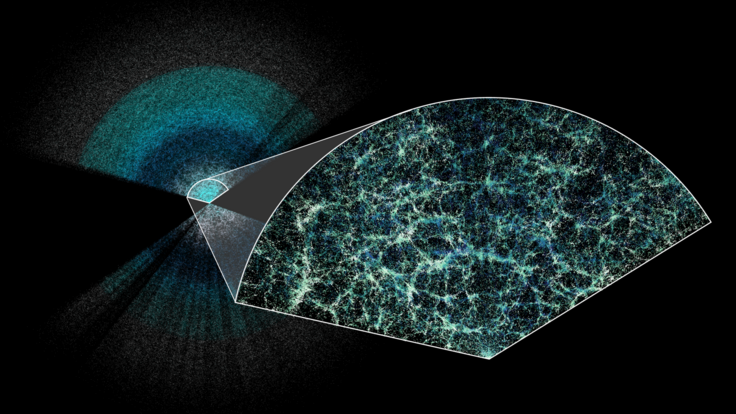
The rendering above displays the relative densities of Internet connectivity across the globe. The stronger the contrast, the more connectivity there is. It is immediately obvious that North America and Europe are considerably more connected than Africa or
South America. However, it is important to note that this map reflects only density of connections, not usage; hundreds of people
may share a single connection in an Internet cafe, often the only access people have in developing nations. Image courtesy of Chris Harrison, Carnegie Mellon University
Click here to download the pdf version of this article.
Brookhaven National Laboratory has invested in a new, private facility to treat the superconducting cavities within a few miles of the site. The new facility is top of the line, located almost next door, and shows the power of joining government and private industry.
The upcoming <i>Hubble 3D</i> IMAX movie including footage shot during a manned space mission last year is deserving of the adjective "awesome," says our <i>symmetry</i> correspondent, based on a preview screening in New York.
In the search for a better understanding of neutrinos, the Main Injector Neutrino Oscillation Search, MINOS, recently put forth results that help rule out a theorized fourth neutrino and strengthen the case against the hypothesis of neutrino decay. MINOS cospokesperson Robert Plunkett says the results “really start to close the loop” on some major theories that neutrino experiments set out to investigate.
Email Update List
Receive email notifications of the release of future issues of symmetry:
This issue features the work of
physicist and photographer David
Kirkby, whose photographs of
ordinary objects aim to give people
insights into physics. Here, a
Koosh ball—a jiggly, squishy rubber
toy—represents dark energy,
the invisible force that is accelerating
the expansion of the universe.