|
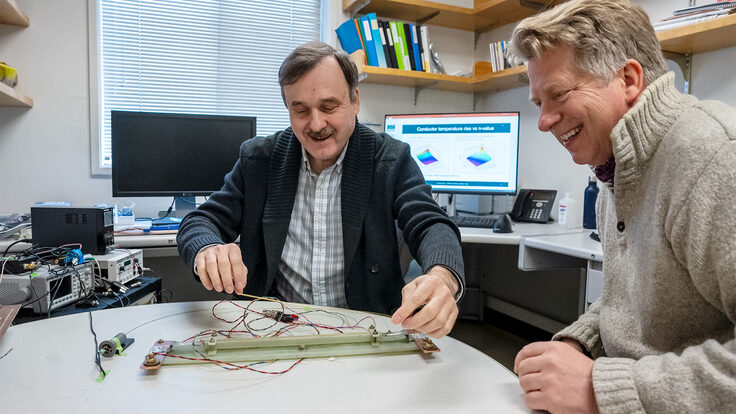
| Photo courtesy of Peter Steinberg |
With so much work
to do on so many
aspects of the Large
Hadron Collider—the
accelerator, detectors, software, physics, and
so on—it’s hard not to get a bit lost. It’s a crowded
field with thousands of scientists, all of whom
have staked the next phase of their careers on
the LHC, and all trying to finish many different
things in the little time remaining until first collisions.
Still, I’ve rarely found a productive physicist
who actually feels like a mere cog in a huge
humming machine. Maybe the fact that most of
the major discoveries in physics are ultimately
attributed to individuals—however wrongly—lets
us dream a bit. But it’s probably more that as a
practical matter, we each focus on a particular
aspect of the physics at our machines. This lets
us gain satisfaction through arriving at our own
insights, which we then share with other small
groups of colleagues and ultimately with the full
collaboration.
Of course, with the machine coming online during
the next year and no actual physics data to
focus on yet, we are all taking on a wide variety of
tasks in our working groups—two working
groups, in my case.
I spend most of my time these days helping
prepare a proposal for taking and analyzing data
from collisions of lead nuclei using the ATLAS
detector at the LHC. At the same time, I’m
involved in preparing to look at similar data from
the first proton-proton collisions at ATLAS. Even
the most prosaic events from the first LHC data—
those in which two protons shatter into hundreds
of slow particles—give insight into basic features
of the strong interaction that generates 99% of the
visible mass of the universe (an oft-forgotten
fact!). These reactions are not easily accessible
to current theoretical approaches, but they are
an essential part of the heavy ion program, which
is my main focus at Brookhaven.
As it happens, these two aspects of my work
involve entirely different groups of people at institutions
all over the world. Yet despite “running”
from meeting to meeting, I rarely leave my office
chair, even on the busiest days. Instead, most
groups interact via videoconference and teleconference.
While this sounds somehow cosmopolitan
and futuristic, it’s often quite taxing (“Can you
hear me now? Now?”). However, it has become
a standard part of life in modern mega-collaborations.
We develop longtime professional
relationships with colleagues we rarely see in
person. It’s strange at times, though perhaps
not any stranger than other modes of electronic
life we’ve accustomed ourselves to, such as
Facebook or iChat.
Despite all the meetings and communication
in our lives, we all know progress isn’t going to
happen just by talking through technical issues,
studying simulated events, or even making the
detector perform as designed. It’s also going to
be found by looking at real data, in real time, and
with hundreds of people looking over each others’
shoulders. This is where blogging the LHC experience
can play an interesting and novel role.
The earliest days of a new machine and new
detector are hard to describe as they are happening.
It is even harder to recall them in detail
after things become better understood, roles
and hierarchies become well-defined, and habits
start to form. Robert Crease, the science historian,
has suggested that “a scientific paper is more like
a trial lawyer’s concluding speech, recapitulating
the argument—not the proceedings—in summary
form and in the strongest way possible.”
Thus, the fascination with the LHC should not
just be in the results, per se, but in the false starts,
inevitable stumbles, and occasional flashes of
insight about the physics. Stay tuned to the bloggers,
both official and not, as the LHC and its
detectors rumble to life. They may well provide
some real-time glimpses into the practice of
nuclear and particle physics as it is experienced
by individuals, rather than by large groups. Of
course, some things will never make it out of the
(virtual) conference room—collaborations always
having their own secrets, and rules about revealing
them—but intriguing details are sure to emerge.
Peter Steinberg of Brookhaven National Laboratory in New
York is one of four American physicists who are blogging
about what it’s like to work at the Large Hadron Collider.
See what they have to say at www.uslhc.us
Click here to download the pdf version of this article.
Send a letter to the editor
Share this page with others! Submit to:
|
|
|
|
|