HomeAbout symmetryContact UsPast IssuesSubscribe
symmetry - dimensions of particle physics


signal to background
The prairie guy; computing potato chips; neutron array experiment; particle search on a shoestring; movies without popcorn; letters; contest: where has your symmetry been?; sudoku solution.

Photo: Fred Ullrich, Fermilab

Professor Prairie
Particles and prairie. For many people, these words are synonymous with Fermilab.

In the 1970s, when founding director Robert Wilson led the construction of the Tevatron particle accelerator, Robert Betz launched in the center of its four-mile ring one of the earliest and most ambitious prairie reconstruction projects in the state of Illinois.

Betz, who died on April 5, was a professor of biochemistry at Northeastern Illinois University. He was one of the first people to recognize the importance of saving the native prairie ecosystem. Known as "Professor Prairie," he traveled across the Midwest to identify and catalog "cemetery prairies," the last remnants of original prairie that grew on pioneer cemeteries and escaped development. At Fermilab, he used his knowledge and worked with grounds crews and volunteers to turn farmland back into the original tallgrass prairie.

"There is a chain of people who have inspired this region, for which I would list [Henry David] Thoreau, [John] Muir, Aldo Leopold, May Watts, and then Dr. Betz," said Stephen Packard, director of Audubon of the Chicago Region, speaking at the Betz memorial symposium in July. "It was visionary of Dr. Betz early in his life to look around and say, ‘There is still nature here that is important to save.'"

Early on, Betz recognized the importance of burns for the well-being of the prairie. With persistence and a big smile on his face, he set out to convince other scientists of the benefits of prairie burns. Today, burns are a standard tool to maintain prairies and to control invasive plants. While prairie plants with their long roots survive the fire, non-native plants succumb to the heat.

More than 30 years after the start of the Fermilab prairie reconstruction project, the lab is home to 1100 acres of prairie, about 270 species of birds and more than 50 species of butterflies, thanks to the vision of Professor Prairie.
Kurt Riesselmann

Number crunching, redefined
Supercomputers can play chess, map DNA, and aid in the study of dark energy. But recently they were unleashed on a bold new frontier: optimizing the production of potato chips.

Imagine a conveyor belt carrying a neat row of saddleshaped Pringles-brand potato chips. As the belt moves at high speed, the air rushing past the chips can lift them up and send them sailing off the production line.

"This is fundamentally a problem of air-flow over the potato chip," says Richard Herman, chancellor of the University of Illinois at Urbana-Champaign. "Much like air-flow over the wing of a plane, this is a problem in computational fluid dynamics." Herman, a mathematician, presented the problem in June at the 2007 National User Facility Organization meeting at Lawrence Berkeley National Laboratory as an example of public/private partnerships to improve national competitiveness.

After analyzing the problem using high-performance computers, Proctor & Gamble redesigned the chips and adjusted the speed of the production line so fewer chips go flying, Herman says.

So if you really can't eat just one, don't worry. Thanks to supercomputers, there are more chips per potato reaching chip enthusiasts worldwide.
Lauren Younis

Photo courtesy of MoNA

Raising MoNA
In the olden days, farmers would travel for miles through the American countryside to help neighbors raise a barn.

A similar bustle was under way in early July on the Michigan plains, though the focus was nuclear physics instead of farming. College students–mostly from the Midwest, but some from as far away as California—converged on the National Superconducting Cyclotron Laboratory to help the lab's graduate students and staff move the modular neutron array (MoNA).

The box-shaped array, assembled primarily by undergraduate students and used to detect neutrons, is composed of 144 plastic bars, each two meters long. It was moved to a more spacious vault as part of a major reconfiguration of the lab, which is at Michigan State University.

Each bar had to be hauled by hand, and most of the hands belonged to undergraduates.

"It was kind of like an assembly line," reflected Tova Yoast-Hull, a junior from Kenyon College in Ohio. "Except the parts don't move down the line–the people do." Pairs of students lugged each 40-pound bar down 70 meters of hallway.

Most challenging, however, were the six wires running from each bar, totaling 864 cables that had to be detached and meticulously reconnected at the proper terminals. All told, the move and reinstallation involved 27 people from 10 colleges, and took about a week.

Eddy White, a senior from the University of Notre Dame in Indiana, found the work enlightening. "Having so much hands-on experience with equipment, you really learn how it works," he said.

The lone postdoctoral researcher involved in the move, Artemis Spyrou, reminisced about the long hours she spent assembling machinery in the lab during her graduate school days in Greece, where three people managed all the equipment. "It's always fun to do teamwork," she said. In her case, there was a bonus: The only other graduate student in her group at the time, George Perdikakis, became her husband.
Annie Jia, National Superconducting Cyclotron Laboratory
A video of busy students assembling MoNA is available. Click here to see video.

Photo: Fred Ullrich, Fermilab

Particle search on a shoestring
When Aaron Chou heard about an experiment in Italy that suggested the existence of an exotic particle as a candidate for dark matter, he was intrigued enough to go looking for it.

His first stop: the Fermilab cafeteria.

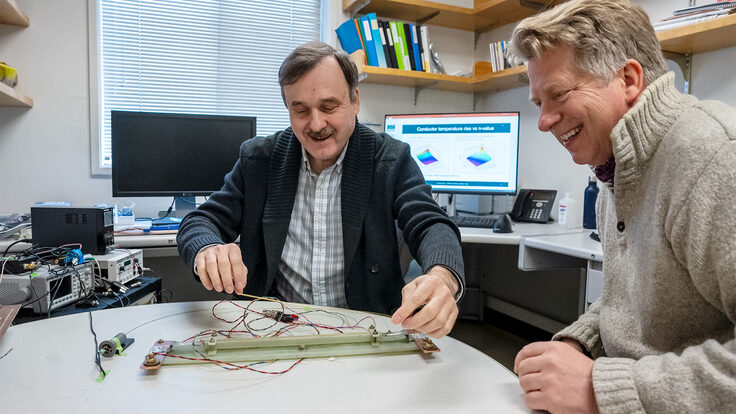
"The Fermilab cafeteria is a wonderful place to talk to people and ask around for available equipment," says Chou, a postdoctoral researcher at the lab. Working the lab grapevine, Chou (left, photo at bottom) and William Wester, a scientist in Fermilab's Particle Physics Division, scrounged enough parts to build their experiment on a shoestring budget. They borrowed a high-powered laser and scavenged a spare Tevatron magnet that could be operated at the existing Fermilab Magnet Test Facility, and kept the cost to about $30,000.

Their project, called GammeV (named for particle searches in the gamma ray to milli-electronvolt energy range), follows up on an experiment called PVLAS at Legnaro National Laboratory in Italy two years ago that suggested the existence of the ultralight particle.

The new experiment involves sending pulses of high-powered laser light through an opening in a magnet and toward a mirror. Normally, scientists would expect no photons, or light particles, to show up on the other side of the mirror. But if the new ultralight particle exists, some of the photons will convert into the proposed particle, travel through the mirror, and then convert back into photons, which scientists would detect on the other side. It would appear that light was passing straight through a wall.

Film Posters

Though scientists are skeptical of the suggested particle's existence, the results from Legnaro need to be checked, says Chou, who strayed from his usual area of research–cosmology– to help put the project together. "It's unlikely but not impossible that the result is correct. If it is, it would be one of the most astounding discoveries of this century," he says. "Such a discovery could fundamentally change the direction of future experimental research in particle physics. The potential scientific impact and the low cost of the experiment make this a no-brainer. It's the type of experiment you just have to do."
Amelia Williamson

What, no popcorn?
Most particle physicists spend at least a few hours a day looking at a computer screen. In their free time, however, many prefer the "silver screen."

At Fermilab, the International Film Society fills this need each month by presenting films from around the world. A showing of Wes Anderson's off-beat comedy The Life Aquatic with Steve Zissou kicked off the society's new season this summer.

The origins of the film society go back to 1971. The group's most important goal is "to provide a relaxed atmosphere where we can interact with our colleagues and be entertained by a good movie," says scientist Tania Moulik, who chairs the society. "Many films provide a window to different cultures, promoting understanding and providing a ground for common discussion among viewers from diverse cultures," she says– especially important in a large, international community such as Fermilab's.

The public is invited as well, and people stay to discuss a film after its showing. This season, offerings range from the Charlie Chaplin classic The Great Dictator to the contemporary Donnie Darko.

So, lean back and enjoy the show. Just don't ask for popcorn: Fermilab's Ramsey Auditorium is a food-free environment.
J. Bryan Lowder


AtenciÓn, ACHTUNG, ATTENTION
The symmetry challenge:
Where has your symmetry been?

Our readers live in all parts of the globe, from Alaska to Wyoming; from Argentina to Zimbabwe. But when a copy of symmetry lands in a mailbox, that's often not the end of its journey. We have heard stories of symmetry being read in some quite surprising places, including hiking trails and nude beaches.

What unusual places have you gone with a copy of the magazine in your suitcase or backpack? Send your story, perhaps with a photo of you and the magazine, to letters@symmetrymagazine.org with subject line "Travel," or mail it to the address on our contact page. We will publish the best stories and photos in an upcoming issue.

Where has your symmetry been?
Photo illustration by Sanbox Studio

sudoku solutionParticle sudoku
Did you find last month's sudoku tough? Word from our readers is that the puzzle in the Jun/Jul 07 issue of symmetry was much more difficult than a regular sudoku. Reader and Fermilab retiree Phil Martin, Sequim, Wash., wrote, "Awesome sudoku! Can we look forward to more in the future?"

To put those of you who are still stuck out of your misery, we provide the solution to the right. A larger-print version is online.

The solution to the puzzle is unique. Every one of the Standard Model's 16 elementary particle types appears in each row, column, and 4x4 sub-square. If you managed to complete the puzzle or found any nifty tricks to solve it, let us know at letters@symmetrymagazine.org.


Letters

Non-dark energy
With regard to your story on dark energy (May 2007): Please explain the amount of known energy there is in the universe. If there is a small percentage of known matter, what is the percentage of known energy?
Richard Blaine, Savannah River Site, Aiken, South Carolina

Michael Turner, University of Chicago, replies:
That's a wonderful question. For energy in the universe, here are the "known knowns:"

  1. Cosmic microwave background (CMB) radiation, the echo of the big bang: 0.005% of the total matter/energy density of the universe
  2. Direct light from all the stars that have ever lived (due to redshifting this peaks near the infrared): 0.0001%
  3. Re-radiated light (by dust) from all the stars that have ever lived: 0.0001%
  4. Kinetic energy of all matter: 0.00003%
  5. Cosmic rays (particles believed to be accelerated by exploding stars with energies up to at least 1020 eV): at most 0.000005%

By far, the bulk of the known energy is the CMB radiation. The biggest known unknown, of course, is the dark energy, accounting for 73% of the all the matter/energy. And at this stage, it is too early to rule out unknown unknowns that may account for up to 10% of all the matter/energy.

Within our own Milky Way galaxy, cosmic-ray particles (mostly protons) trapped by the galaxy's magnetic field have an energy density comparable to the CMB. However, outside the Milky Way the energy density contained in cosmic rays is expected to be much less.


Small world
While reading symmetry (May 2007), I came across an article about Katie and Adam Yurkewicz moving from Fermilab, Batavia, to CERN, Switzerland. I was floored when I realized that the home they were leaving (424 Blaine St) is the home I grew up in. I attended grades 1-4 in the small school building right across the street. I lived there until I got married. My father (the then-owner) lived downstairs and my wife and I and our first child lived in the upstairs apartment for a number of years after I got out of the army in 1968. My sister and her husband lived in the apartment before we did. I did a double take when I saw the picture of the moving truck parked in front of the house. We drive past the house every now and then, but I had no idea who lived there.

Small world, isn't it?
Kim Carlson, President, Savannah Community Association, Aurora, Illinois


Guru of Hatha yoga
Many readers of symmetry are undoubtedly familiar with the Dan Brown novel Angels and Demons, which is staged partially at CERN. One of the characters, physicist Vittoria Vetra, is described as "CERN's resident guru of Hatha yoga."

If any physicist may rightly aspire to having been a "resident guru of Hatha yoga," it might be me. For decades, CERN has had an active Yoga Club that provides yoga classes on site, but to my knowledge, I am the only physicist who has taught Hatha yoga regularly at CERN.

Ever since I was trained as a yoga teacher in the 1970s, wherever I find myself for an extended period of time, I arrange a free Hatha yoga class. I have offered such classes at Kent, Ohio; Anchorage, Alaska; Berlin, Germany; New York City; Tsukuba, Japan (at the KEK laboratory); and presently in Davis, California.

At CERN in the 1980s, I taught once a week for about four years on the second floor of Restaurant No. 2. My students included other physicists who were avid runners, who saw yoga as a way to increase flexibility.
Richard Breedon, University of California, Davis


Letters can be submitted via letters@symmetrymagazine.org

Click here to download the pdf version of this article.

Send a letter to the editor

Email a Friend
Share this page with others! Submit to:
  |     |     |     |