Secret of the hidden ledger; zoo events; Brookhaven celebrates diversity; making science K'nex-tions; vacuum cleaners rescue neutrino horn; Einstein still a big earner; poker-playing physicist; Antarctica in California; cartoons by design; pentaquark references; particle 'Jeopardy.'
|
Photo: Jennifer Lauren Lee, Fermilab |
When exploring the mysteries of the universe, don't neglect the floorboards. Last December at Fermilab, repairs to the ceiling over the kitchen in the Aspen East users' center, targeting a joist that had distorted the floor of the dorm room above, produced some startling debris. A small black book lay among the rubble, with the words "Aurora National Bank— ‘The Bank under the Chime Clock'" engraved in faded gold letters on the cover, and the name "A.C. Logan" peeking through a clear plastic window. Inside, brittle and mildewed pages showed handwritten deposit and credit statements spanning from January 8, 1927, to December 3, 1927. Many of the entries were for hundreds of dollars—the equivalent of thousands of dollars today, according to the Bureau of Labor Statistics.
A story in Fermilab Today prompted quick and thorough detective work. Bill Griffing, head of the lab's Environment, Health, and Safety office, came up with a match in US census records. Arthur Chester Logan was born in Illinois on January 12, 1885. Logan worked in Aurora, Illinois, as an electrical contractor, living with his wife Stella at 312 Bangs Street. The Aspen East building was originally located on Bangs Street before being moved to the Fermilab site. Logan died in 1938 at 53. Sue Populorum, of the lab's Facilities Engineering Services, found his gravestone information in a registry for Spring Lake Cemetery in Aurora.
There has been no answer to Logan's ledger entries. "I think more than anything it's kind of fun and exciting to try to figure out a little bit of a mystery—a Fermi mystery," says Linda Olson-Roach of the lab's Accommodations Office, housed in Aspen East. "We wish the person was alive to talk to so we could fill in the blanks."
Jennifer Lauren Lee
When physicists at Fermilab smash particles together, most of what comes out of the collisions is well understood. But every once in awhile strange things appear in the data— incidents popularly known as zoo events.
Dave Toback, a Texas A&M University professor who works on the CDF experiment, says zoo events are rare by definition, but occur frequently enough to catalogue—like animals in a zoo. "The idea is that you try and collect these animals so you can study them," he says. Toback uses a program called "ZooFinder" that monitors collision data and sends emails to him and other physicists when zoo events occur. "Every so often," he says, "we'll get other physicists together to try and look at the zoo."
Although the exact origin of the "zoo event" term is cloudy, Henry Frisch of the University of Chicago says the concept has evolved into a systematic strategy for finding new physics. "Keeping a sharp eye out for anomalies is a big part of trying to bust the Standard Model of physics," Frisch says, "because we really don't know what we're looking for."
Because anomalies like cosmic rays and improper detector readouts can cause zoo events, some physicists are cautious about using them as a basis for discovery. But Frisch says using the correct approach can be fruitful.
"One has to be very careful not to attribute new physics in cases where it's not, and not to ignore new physics when it is," Frisch says. Toback argues that unexplainable events are especially hard to ignore. "Many great discoveries weren't made with a ‘eureka,'" Toback says. "They were made with a ‘hmmm, that's funny.'"
Dave Mosher
 |
DOE Brookhaven Site Office personnel who helped provide or organize the international exhibits for the Second Annual Unity Day were: (from left) Patricia Quit, Emily Lalima, Mohammad Ali, Nand Narain, Judy Badal, Lou Sadler, and Jerald Bond. |
Flags, arts and crafts from different nations, and a warm welcome transformed the DOE Brookhaven Site Office's Second Annual Unity Day into a celebration of people and cultures working together. Says Site Office manager Michael Holland: "We're fortunate here at BNL. We are a little slice of the world community, all different, yet we work toward a common goal: to perform world class scientific research."
Diversity Office manager Shirley Kendall was accompanied by representatives of several Brookhaven Employee Recreation Association cultural clubs: the African American Club; the Asian Pacific American Association; the Gay, Lesbian, or Bisexual Employee Club (GLOBE); and the Hispanic Heritage Club. Deborah Bauer of GLOBE emphasized the need to treat each other with respect. "If the target of a joke or remark is offended, that's harassment," she explains. "It's how the target feels that is the deciding factor."
An international buffet and quiz games based on international cultures completed the day. Kendall concluded: "Unity Day is one tradition I hope has a long life at BNL."
Liz Seubert, Brookhaven National Laboratory
 |
Photo: Diana Rogers, SLAC |
Stanford Linear Accelerator Center librarian Lesley Wolf needed a creative idea for the next library display. Ten-year-old Connor Reed had lots of free time this summer and an extensive set of K'nex, the flexible equivalent of Lego.
The results of their collaboration are now on display in the library: a lime-green, blue, and orange model of the Linac Coherent Light Source (LCLS), complete with a rubber-band-powered injector that accelerates a smiley-faced ball dubbed "the happy electron."
A flag reading "Pief's portion" flies above the linear accelerator part of the model, "because he knows Pief built the linac," says Connor's mom, Ellie Lwin. She works for lab founder Wolfgang K. H. "Pief" Panofsky.
"This is how it shoots particles," Connor says, pulling back on the pinball-like handle and releasing it. He's used this rubber band technology before to make a pinball machine out of K'nex. The lime-green waves are the undulators, the magnets that force the electrons to make X-rays.
"I built it. I got a little help from my mom and Lesley," he says.
Lwin says her son was happy to delegate construction of the more monotonous parts while he napped.
After spending months in the hospital last school year, Connor liked learning that LCLS will look at the proteins in cell membranes to find ways to keep viruses out of our cells and let medicines in. His version has a virus getting through the cell membrane and bright green medicine perched on top, ready "to take away the virus."
Lwin said it took six or seven hours of trial and error to build the entire model and get the injector to roll the happy electron to the end of the machine. But Connor didn't get frustrated; he delved into solving the challenges, just like his mentor, Pief Panofsky.
Heather Rock Woods
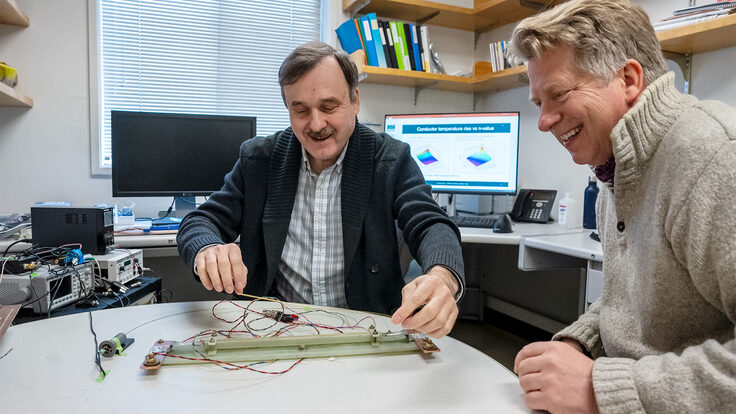
In creating neutrinos for the MINOS experiment at Fermilab, the NuMI focusing horn delivers batches of protons using intense magnetic fields generated by 200,000-ampere pulses of electric current. The pulses deliver enormous amounts of heat. Without 36 gallons per minute of low-conductivity (or de-ionized) water for cooling, the horn would burn itself up. At 4:40 p.m. on Friday, June 30, the worst happened: there was no water flowing to the horn's cooling nozzles.
About a gallon of tiny, leak-clogging resin beads, each each one fiftieth of an inch (half a millimeter) thick, had moved the wrong way through the de-ionized water system loop due to a failed check valve. They clogged the nozzles completely. Unclogging took more than three weeks of 20-hour days for the repair crews.
Sticky when wet, the beads blow away like grains of sand when completely dry. Using two vacuum cleaners on prototype components in another location, crews were able to suction out the beads. Kris Anderson, the engineer directing the cleanup, told some crew members go out and buy industrial-size vacuum cleaners. With 50 nozzles cooling the horn's inner conductor, and 19 in the outer conductor, 69 nozzles had to be cleared. The horn was finally "buttoned up" on July 26, some 27 straight days of work later including the July 4 holiday and weekends.
Anderson can't say enough about the dedication of the crews, some of whom worked near-80-hour weeks. Even the vacuum cleaners rated special mention. "They came right off the shelf, and they weren't expensive," Anderson says. "We ran those things 20 hours a day for three weeks, and none of them burned out. Whoever makes those things has a pretty good product."
Mike Perricone
 |
Parody by Sandbox Studio |
With his genius and his unmistakable appearance, Albert Einstein is an icon of both science and culture. Since his passing Einstein has inspired films, books, and even an opera, Einstein on the Beach. Not surprisingly, his popularity pays off handsomely.
In its July 3 issue, Forbes magazine ranked deceased celebrities according to their annual revenues. Einstein came in third, earning $20 million in 2005 for the Hebrew University of Jerusalem, which inherited his estate.
Approximately $5 million came from the use of his image, and more royalties came from Disney's line of educational videos and toys, "Baby Einstein," which generated $400 million in sales last year.
Einstein's earnings followed those of Elvis Presley ($53 million) and Kurt Cobain ($50 million) on the list. Rounding out the top five were Andy Warhol ($16 million) and Marilyn Monroe ($8 million).
Benjamin Berger
"Since middle school, I've always had plans to get rich," says Michael Binger, a theoretical particle physicist at Stanford Linear Accelerator Center. On August 11, 2006 his dream came true: Binger placed third at the World Series of Poker Championships in Las Vegas and walked away with $4,123,310. The no-limit Texas Hold'em tournament drew nearly 9000 entrants, with each paying a $10,000 "buy-in" to supply the $87 million later apportioned among the top 10 percent of players.
 |
Photo: Krista Zala |
"The championship included all the best players on earth, and a lot of the worst players," Binger says. "It's about knowing how to weave your way through people and survive." Stakes were raised every two hours. At the 36th level, the minimum bet was $400,000. After another player folded, leading chip holder Jamie Gold drew a straight to beat Binger's pair of tens, landing the SLAC physicist in third place.
Binger recalls a year-long surreptitious game of seven-card stud in his high school sophomore chemistry class. He moved from blackjack to poker in 2001. After winning a thousand dollars on a good day at Lucky Chances south of San Francisco, he tried a table with higher stakes. "I stepped into that and got killed," he says. "I realized there was more to the game than I'd known." Binger studied books on poker with the goal of winning back the $10,000 he had lost, and did so within months. "Blackjack is entirely solvable," he says, "but poker always involves adjusting to the precise environment. That environment includes the vagaries of opponents' psychology—as well as luck."
Over the last five years, Binger has spliced forays into poker with earning a doctorate in theoretical particle physics from Stanford. Beyond skills in probability and statistics, Binger says "there's very little direct overlap" between physics and poker. While doing research at SLAC, Binger plans to compete on the poker tournament circuit about once a month. He says he will keep financial plans modest—unless he's bluffing.
Krista Zala
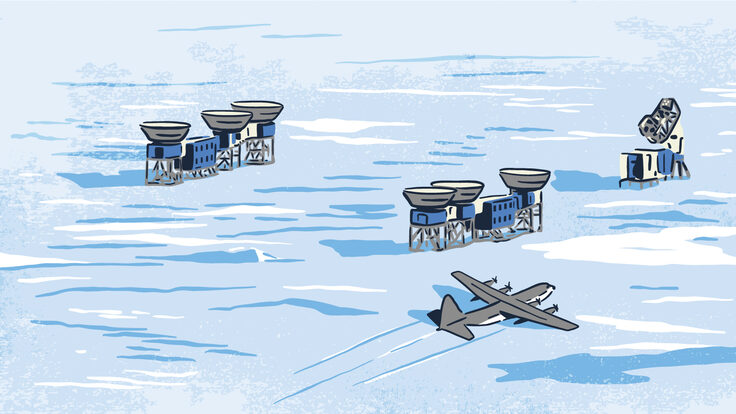
When researchers at Stanford Linear Accelerator Center realized their distance from Antarctica was a scientific inconvenience, they set about crafting an icy world of their own in Menlo Park, California.
For two months beginning December 2006, the Antarctic Impulsive Transient Antenna (ANITA) array, a new NASA probe, will circle the South Pole aboard a high-altitude balloon, seeking signs of neutrinos hitting the ice below. But for researchers to make sense of ANITA's measurements, they needed to first calibrate the 20-foot-tall detector. They brought the detector to SLAC in June where the high-energy electron beam was ready to use. All they needed was ice.
A truck rolled in through SLAC's gates, loaded with more than 10 tons of ice for a crew of workers to build a mini-Antarctica within a hangar-sized experimental hall. Overhead, the antenna array dangled from a gantry crane, ready to observe.
Collaborators then blasted the ice with a beam of electrons to create radio waves, perfectly tuned for calibrating the detector. When ultra-high-energy cosmic neutrinos strike the Antarctic ice sheet, they can also generate radio waves for ANITA to detect.
In addition to radio waves, the electron beam causes bright blue flashes of erenkov radiation, created whenever a charged particle moves faster than light through a dense medium, such as ice.
Just as those present saw the flashing blue light in a Californian ice sheet, a lucky observer on the Antarctic ice might occasionally see a similar erenkov flash, the sign of passing cosmic neutrinos.
Brad Plummer
 |
Photo: Diana Rogers, SLAC |
As a mechanical designer, Catherine Carr's first big undertaking at SLAC was a vacuum transporter system that let operators install electron cathodes, under vacuum, into the injector gun of the Stanford Linear Collider. The previous system of exposing the gun to air in order to replace the cathode required shutting down the collider for long periods. By eliminating the need to expose the cathode gun to air, the new equipment increased the uptime of the accelerator and improved its most important characteristic, high electron polarization.
Over the course of the project, Carr would frequently leave her office to visit her team members in Building 40. Each time, she spent a few minutes adding to a cartoon drawing on a chalkboard located outside Room G137.
"It was a way to channel lots of nervous energy," she says.
The chalk-and-pastel work remains today. Pictured are project supervisor Bob Kirby and machining supervisor Jerry Collet driving a caravan to the edge of contemporary knowledge, with the magician's rabbit —and SLC Injector project manager—Lowell Klaisner along for the ride. A young woman peeks out of a window below. "I'm running away with the circus, and I'm pretty happy," says Carr.
Krista Zala
 |
Source: SPIRES database |
In 2003, results published by three experimental collaborations initiated a flood of papers about a class of particles known as pentaquarks. Physicists working on the LEPS, DIANA, and CLAS experiments had observed subatomic processes that seemed to indicate the existence of composite particles consisting of five quarks. Ordinary matter particles, such as protons and neutrons, only contain three quarks. The existence of pentaquarks would provide an important test for the theory of the strong nuclear force.
Since then more than 445 papers with the word "pentaquark" in the title have been recorded in the spires database (see graphic), including over 50 papers with experimental results. The majority of the papers has come from theorists performing analyses and computations to provide further insight into the observations and to make predictions for additional five-quark signals.
Standard particle theory allows for many types of quark-composite particles, a fact that theorists have known for more than 30 years. While some quark combinations are forbidden, the quark model permits the existence of pentaquarks. Yet physicists published few papers dedicated to pentaquarks before the 2003 announcements. For the period from 1974 to 2002, the spires database contains only 32 papers that refer to "pentaquark" in their titles. The first of these papers was published in 1989, twenty years after Murray Gell-Mann received the Nobel prize for developing the quark model.
The pentaquark, however, might return to oblivion. Experimental results of the last three years have raised doubts whether the signals published in 2003 represent pentaquarks (see story). The CLAS experiment at Jefferson Laboratory as well as other experiments with large data samples that should have confirmed the initial results have found no significant signals.
Heath O'Connell
Next time you watch the Jeopardy quiz show on TV, don't be surprised if you learn about a particle physics experiment at Fermilab. Earlier this year, candidates were asked to give the question whose answer is: "This 8-letter particle, named for its lack of charge, is being studied by beaming it 450 miles in .0025 seconds." For physicist Jeff Nelson, assistant professor at the College of William & Mary, the answer was easy; unfortunately, he was watching at home, not participating on the show.
 |
Image: Sandbox Studio |
Together with about 200 colleagues, Nelson works on the MINOS experiment. The scientists examine the properties of this sought-after particle as it travels close to the speed of light from Fermilab to a particle detector located in an old iron mine in Soudan, Minnesota. "You know you've made it when you've inspired Jeopardy," Nelson says with a smile.
So how did he manage to get a photo of the Jeopardy question on TV when a rerun of "Episode 172-Tournament of Champions" aired in August? "I do tape Jeopardy every day on my digital video recorder," he says. "My wife and I have a nightly grudge match. One point for the first correct answer to each question."
On this particular night, Nelson took advantage of his MINOS research, being the first to shout the correct answer: "What is a neutrino?"
Kurt Riesselman
Click here to download the pdf version of this article.
Send a letter to the editor
|