|
by John Womersley, Fermilab
At almost any particle physics conference,
meeting, or lunch table, the phrase “physics beyond the Standard Model”
is heard over
and over again. What’s wrong with the Standard Model, anyway? Why are physicists
so sure that there is something beyond it?
And why do they think they can find it anytime soon?
Particle physics strives to identify the building blocks of matter and describe
the interactions that bind them: the set of instructions needed to create a
universe. Our most succinct and
(we believe) accurate set of instructions is encapsulated in a quantum field
theory called the Standard Model, which describes a universe made up of six
types of quarks and six types
of leptons, bound together by three fundamental forces: strong, weak, and
electromagnetic. While this model is known to be incomplete — it ignores gravity
because it is so very weak — it successfully describes almost all the
data from close to twenty years of experimentation at
particle accelerators.
Why, then, do physicists expend so much effort searching for what they call
“physics beyond the Standard Model” — by which they mean new particles and
forces outside this framework? Hasn’t the Standard Model stood the test of time
and been verified? In one sense, yes: it provides a precise framework for
calculation, and one whose results match experimental data exquisitely well.
That exquisite match occurs, however, only if we add
an additional particle to the quarks and leptons. Without it, the Standard Model
ends up predicting probabilities greater than one — more likely than a certainty,
a nonsensical result. It
is as if we were trying to calculate the angle
at which a ball will bounce off a wall and found instead that the theory
predicts an infinite number of balls bouncing back at us: it goes mathematically
crazy. This situation is similar
to the “ultraviolet catastrophe” in classical physics at the end of the 19th
century, when theory predicted infinite probabilities for
radiating high-energy light waves. Back then, the “catastrophe” pointed the way
toward
quantum mechanics. Today, the infinities in the Standard Model point toward
a missing
ingredient, a particle unlike the others and that
is named for its inventor — the Higgs boson.

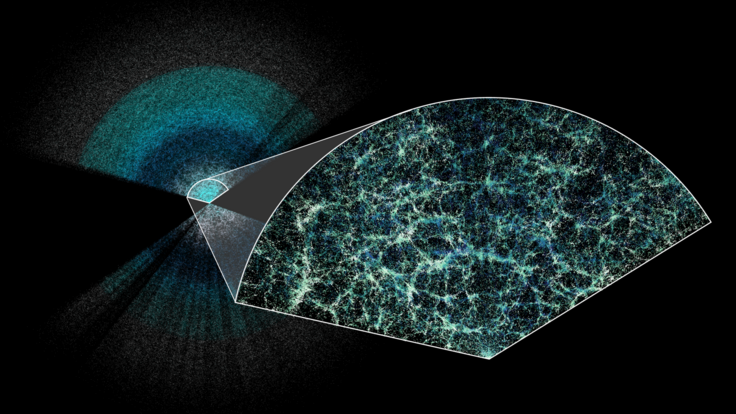
The cosmic microwave background data strongly
suggest that only about 5% of the universe is
composed of the quarks and leptons of the
Standard Model, while there is about six to
seven times more mass in the form of invisible
"dark matter." |
No one has ever seen a Higgs boson, and until we can make some of them in our
accelerators and study them, we cannot be sure that this ingredient is really
present in the universe, or at least present in the very simple form in which
it’s written in the Standard Model. We can already be sure that, Higgs or not,
there
is something out there that plays its role: its indirect effects are already
detectable. Quantum effects connect the mass of the W boson to those of the
quarks; since the top quark has
a very large mass, it has a detectable impact on the W. The magnitude of this
impact depends on the Higgs. In fact, the W mass is found to be shifted upwards
in exactly the way expected from the effects of a Higgs; if there were
no Higgs, the W’s mass should be significantly lower than what we measure.
So the Standard Model plus the Higgs
would be a complete theory, then? Yes and no. Mathematically it would be
self-consistent,
but not elegant — quantum mechanical effects would naturally tend to make
the mass of the Higgs extremely large, while our best (indirect) evidence is
that it is not; in fact, it may lie just beyond the reach of our most recent
experiments. More importantly, the Standard Model contains no particles with
the right properties to form the dark matter that seems to pervade
the cosmos. There are rather strong arguments, based on astronomical observations
and
cosmology, that this dark matter is made out
of particles—but not out of any of the Standard Model ones. The interesting
implication is
that the Standard Model is indeed a beautiful description, but a description
of just five percent of the universe (the fraction made up of quarks and leptons).
One commonly proposed idea that addresses both of these issues
is to embed the Standard Model inside a larger theory, supersymmetry.
Supersymmetry is
mathematically elegant and solves the Higgs mass issue. If supersymmetry
proves true, then for every type of familiar particle there would
be a new species of superparticle, with analogous properties but much more
mass. The lightest superparticles would be stable, and large numbers of
them would still be drifting through our universe — left over from the big
bang, when
particles and superparticles were presumably created in equal numbers.
These leftover
massive particles would then naturally form
the dark matter.

Image: DZero Collaboration
A computer reconstruction of the particles produced in a single collision in the Tevatron, recorded by the DZero detector in 2003. This is the highest energy event found in one of the supersymmetry searches. It has two energetic jets of particles (top and left) recoiling against “nothing” (the blue arrow which shows the reconstructed missing momentum). An excess of events like this would be a signal for the production of supersymmetric versions of quarks or gluons. |
The
only way to settle questions like this one is through experiment. We do
not know whether there is a simple Higgs or something much
more complicated. We cannot tell from cosmology whether the dark matter is made
out of supersymmetric particles or not. We cannot theorize or compute our way
to an answer: we must inquire directly of nature, using accelerators.
By colliding particles together at very high energies, we concentrate a great
deal of energy at
a single point in space. This allows nature to tell us what she contains.
We can bring to life all these kinds of particles and forces that are
innate in the equations describing the universe, but that we don’t see
in our everyday world.
There is a very tantalizing aspect to all this. It is not that we can be certain
of physics beyond the Standard Model: that much is already clear, since the
Standard Model doesn’t incorporate gravity or explain the masses of neutrinos.
What is tantalizing is the certainty that this physics beyond the Standard Model
is
very close — around the next bend in the road. The energies that we
can explore in accelerators allow us to create particles of just the masses
that we expect superparticles to have. Our accelerators match the energy
scale of the Higgs field, regardless of what it is made of, and they
also match the mass that we expect for the components of dark matter,
based on rather general arguments from cosmology.
This experimental program is underway, right now, at Fermilab. Run II of the
Tevatron offers
a real possibility of discovering physics beyond the Standard Model. At the
summer 2004 international conferences, we in the DZero experiment presented new,
very sensitive searches for the production of superparticles. We have searched
for both supersymmetric quarks and gluons, which would show up as events with
high energy jets; and for supersymmetric relatives
of the W and Z particles, which would show up in our detector as an unexpectedly
high rate of electron, muon and tau lepton production. In either case, we
would also expect a significant imbalance in the momentum seen in the detector,
which is shown in by the blue arrow. We would see the imbalance because the
unstable, massive superparticles would decay, and one of their decay products
would be the neutral, invisible lightest superparticle: the dark matter.
(If this is actually happening, then the Tevatron is adding a very small
amount of extra dark matter to the universe — but don’t worry, there is
so much out there already that this won’t make any difference.) Our colleagues
in the CDF experiment are carrying out a similar program of analyses. Neither
experiment has yet seen any clear indication of new particles, but the searches
are just starting to explore
the most interesting regime, and the physicists carrying out these studies
are excited: the Tevatron is performing well, and delivering lots of data.
More data means increased sensitivity and the ability to explore further.

The Standard Model includes 16 observed particles but the Higgs particle or any other particles beyond the Standard Model have yet to be discovered. (Fermilab Photo) |
The Tevatron will operate until at least 2009 and stands a very good chance of making
a discovery that would revolutionize particle physics. A very good chance represents
good odds, but it is not a guarantee: nature may have set the masses of these particles
a bit higher than seems natural to us, or may have made their effects cancel in odd ways. There’s not much we can do about that kind
of capriciousness at the Tevatron, but in the slightly longer run we can be sure that even such tricks won’t escape detection. The Large Hadron Collider (LHC), now under construction at CERN in Switzerland, will have sufficient brute force in its collision energy that it will
certainly knock down the door to this new domain of physics beyond the Standard Model.
We don’t know what we will find once we open that door. Most likely, something
strange and interesting will show up in our detectors, far different from our
simple models of a Higgs particle and supersymmetry. There are even serious
suggestions that new dimensions of space may open up. Whatever it is, a whole
world of new particles and interactions awaits exploration. The sooner we can
glimpse that world, the sooner we can start planning how to explore it
in detail, which will most likely involve constructing a new, high energy
electron-positron collider capable of precise measurements of all these
new particles and their properties.
To summarize, then, we have a very detailed knowledge of how the Standard Model
particles interact, but we know that this knowledge is incomplete: it describes
a mere five percent of the universe. We know the approximate energy scale where
new particles — including, we believe, the components of cosmic dark matter —
are to be found. The Tevatron collider has
a good chance of reaching that energy scale, which gives us great excitement
about what
we may be able to find between now and 2009. Whatever we uncover, it will pave
the way for an exciting decade, exploring this new world of new particles and
forces, both at the LHC and
at a new electron-positron International Linear Collider — and it will
start to give us an understanding of the other ninety-five percent of the universe.
John Womersley is scientific advisor to the Department of Energy’s Associate Director for High Energy Physics, based in Washington, DC. He is on a two-year leave of absence from Fermilab’s DZero experiment, to which he plans to return and continue his quest for physics beyond the Standard Model.
Click here to download the pdf version of this article.
|