breaking
April 2008
-
April 18, 2008breaking: A first encounter with the LHCKatrin Voss is Germany's new Large Hadron Collider communicator. She doesn't come from a science background so was excited to see the accelerator and detectors up close. She shared her first experience of visiting CERN with the readers of ILC NewsLine.
-
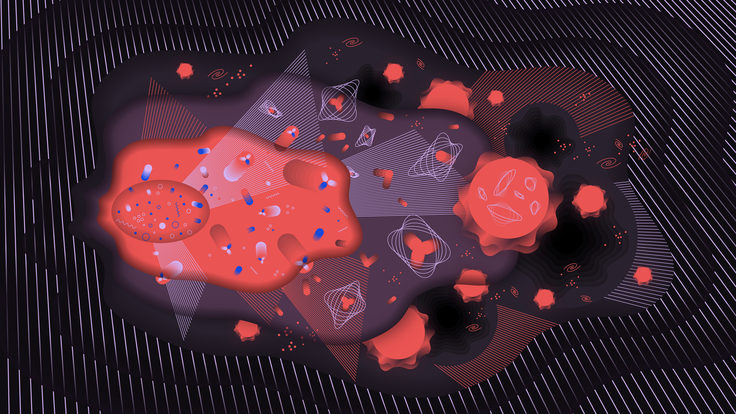
April 17, 2008breaking: Like droplets on a spiderwebTomas Saraceno is known for combining elements of physics, engineering, and architecture into his works. This particular piece, from his latest exhibition "Galaxies Forming Along Filaments, Like Droplets Along the Strands of A Spider's Web" is an interpretation of our early universe.
-
April 17, 2008breaking: Extreme particle acceleration with lasers (APS April 2008)If particle physics colliders want to reach much higher energies, they will need to use new technologies that are just being explored today.
-
April 17, 2008breaking: DAMA-LIBRA presents new dark matter claimDAMA-LIBRA again claim to see evidence of dark matter, but the result is complicated and still contentious. However, even the scientists working on the experiment aren't sure about how to best interpret their results.
-
April 16, 2008breaking: Science is cool???As I tried to explain what Fermilab does to my science-loving, 8-year-old son on the way to a Wonders of Science show there, I was hard pressed to convince him that HEP was even a little bit cool.
-
April 15, 2008breaking: The hunt for rare materials (APS April 2008)Before you build an experiment to find a rare particle, you need to find the rare material to make the detectors! The hunt for these materials is getting more challenging every year as the needs of science experiments, high-tech industries, and other disciplines turn what used to be everyday stuff into prized commodities.
-
April 15, 2008breaking: The Fermilab undergroundThe Chicago episode of "Cities of the Underworld" takes viewers into Fermilab's NuMI tunnel where the particle proton beam takes aim at a detector in the adjacent tunnel housing one of two detectors for the MINOS experiment. The second detector sits 450 miles away in a mine in Soudan, Minnesota. The show offers wonderfully vivid graphics describing how particles and neutrinos interact along the underground journey.
-
April 14, 2008breaking: What can we expect from the LHC? (APS April 2008)In a press conference this morning, Abe Seiden of the University of California, Santa Cruz, showed a great timeline that plots the amount of data collected to be collected at the Large Hadron Collider against time and then pointed out where physicists expect to make certain discoveries if nature has those discoveries waiting to be made.
-
April 14, 2008breaking: The dime of a lifetimeFermilab's Jim Schultz received a strange coin. "My initial thought was that I had gotten a Canadian coin in my change. Upon closer inspection, I recognized that the coin was a dime, and somewhat aged. But when I really looked at it, I realized that I had gotten a dime from 1892!"
-
April 13, 2008breaking: The extreme deficit of physics undergraduates (APS April 2008)An APS/AAPT statement calls for a doubling of the number of physics undergrad students. At the APS meeting, Ted Hodapp presented a long string of evidence for why the number of physics undergraduates needs to increase to satisy the United States' needs.
-
April 13, 2008breaking: The charming case of X(3872) (APS April 2008)Although most of the media attention in particle physics focuses on the high-energy frontier, lower energy work, especially that involving charm quarks, is getting very interesting.
-
April 13, 2008breaking: Pioneer spacecraft a step closer to being boring (APS April 2008)For many years, scientists have known that the Pioneer spacecraft have not been exactly where they thought they should be. Scientists have done some detailed modeling of heat flow and concluded that it could account for 28-36% of the anomalous acceleration.
-
April 12, 2008breaking: Can the Tevatron find the Higgs? (APS April 2008)In the past year, there has been a lot of discussion about whether the Tevatron collider at Fermilab can find the Higgs boson before the Large Hadron Collider can. So can the Tevatron find the Higgs? Yes, if Nature is kind.
-
April 12, 2008breaking: Dark matter discovered? (APS April 2008)Has dark matter been discovered? Rumors floating about suggest that the DAMA collaboration will announce om Wednesday that they have detected dark matter after repetition of their controversial experiment which released results in 2000.
-
April 12, 2008breaking: The cosmic quantum bounce (APS April 2008)Was the big bang the beginning? This morning I heard an interesting addition to the list of pre-big bang models that involves what the speaker Abhay Ashtekar, of Penn State University, called a "quantum bounce."
-
April 12, 2008breaking: Atoms that barely exist (APS April 2008)There are a lot of atoms out there that live on the verge of existence. These are called rare isotopes and tend to only be created in experiments designed to specifically create them. Most of them almost immediately decay back out of existence in tiny fractions of a second. But these short-lived creatures can tell us a lot about other areas of science, and also have many applications.
-
April 11, 2008breaking: But how fast can I download my rumors?Grid computing is revolutionizing the way scientists share and analyze data. But a spate of recent reports on "the Grid" being developed for the Large Hadron Collider have promised way more than the technology can now--and in some cases will ever--deliver.
-
April 11, 2008breaking: This Conference Life: APS April 2008-The arrivalI'll be reporting from the American Physical Society meeting in St. Louis, Missouri. I'll talk about the science being presented and give a flavor of what it is like to be at a large physics conference.
-
April 11, 2008breaking: Embracing the politics of scienceThe advocacy group Scientists and Engineers for America, or SEA, thinks you should have a choice of policy makers with technical and scientific backgrounds when deciding who should represent you in deciding the funding, planning, and validity of these broad-reaching debates.
-
April 10, 2008breaking: Can you explain the Higgs?Explaining the Higgs concept-how elementary particles acquire mass-and how this relates to the Higgs field and the Higgs particle is difficult. It is such a challenge that in 1993 former British science minister William Waldegrave announced a competition and offered a bottle of vintage champagne to anyone who could explain the Higgs mechanism on a single sheet of paper. This week, Time magazine rose to the challenge. Reporter Eben Harrell wrote:
Pages
Welcome to the new symmetry! We've recently combined the magazine with our symmetry breaking blog; now you can find all articles—including feature stories, “explain it in 60 seconds” articles and blog posts—in one location. Below you will find all symmetry breaking blog posts, past and present. Do you like what you see? Have suggestions? Please let us know.