Nobel Prize prediction season

October 1, 2008 | 2:57 pm

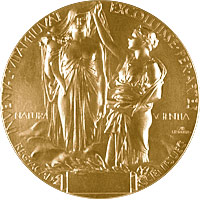
The Nobel Prize Medal for Physics and Chemistry

The Nobel Prize Medal for Physics and Chemistry

The Nobel Prizes will be announced next week and a rash of predictions are appearing around the Web. A few weeks back, Travis Brooks looked at whether you could predict Nobel Prize winners based on citation counts and concluded that you couldn’t now, although you used to be able to. However, that won’t stop people trying.

Thomson Reuters, known for its work in science citation databases, and with a strong interest in proving the usefulness of those databases, has its annual prediction of winners out now. You can decide whether choosing three different options for each prize is cheating as a prediction!

Their three possibilities for the Physics Prize are graphene, an intriguing and potentially extremely useful form of carbon; dark matter discovery, a topic of much discussion here in symmetry; and elucidation of the structures of materials that are not quite traditional crystals and which have unusual properties, specifically Penrose tilings and quasicrystals.

At symmetry, we are most interested in the Physics prize but also pay close attention to the others as the overlap between physics and the other science fields has been substantial in previous years.

So who do you think might win the 2008 Nobel Prize in Physics, or the other prizes for physics-related research? Get your predictions here in the comments fast to stake your claim for bragging rights!

David Harris
Posted in Uncategorized |
2 Comments »

2 Responses to “Nobel Prize prediction season”

  1. Dimitri Dimitroyannis Says:

    Vera Rubin for the discovery of what is known as “galactic flat rotation curves”, the most direct and robust evidence of dark matter.

  2. I’m hearing a bunch of people behind the predictions of Vera Rubin for dark matter (considered long overdue by many), but will the Nobel committee play it safe and wait until direct detection of dark matter? Or will the bullet cluster results and other evidence be considered enough to clinch it?

    Other big contenders: Alain Aspect and Anton Zeilinger. I’d say they are very likely to win one day but is this the right year? They might just have to fit in to the schedule when there isn’t a big result dying for immediate recognition. And Aspect is getting older now so the committee had better hop to it. Oh yeah, if you don’t recognize their names, Aspect did one of the foundational experiments demonstrating quantum entanglement, and Zeilinger has been at the forefront of experiments in entanglement and quantum cryptography. If only John Bell were still alive, they could have put him in as a theorist who started it all.

    As for the rumors about graphene being rewarded–I think it is likely we will need to wait for that work to be further developed and come to some killer applications before it is rewarded with a Nobel.

Leave a Reply